The study of infant consciousness investigates when subjective experience begins, how it unfolds, and how it maps onto neural and psychological development in the early years of life. In the first year, infants’ sensory, motor, cognitive, and social abilities expand as the brain matures. It is widely held that infants first have a minimal form of experience, consisting of feelings and sensory experiences. More complex forms of experience, such as self-consciousness, emerge later. A central challenge in studying infant consciousness is that infants cannot give verbal reports or follow commands and have poor motor control. In addition, many cognitive and perceptual processes can occur without consciousness. As a result, researchers must combine evidence from behavioral and neural markers with developmental milestones to infer conclusions about consciousness in infants.
History
In the 18th and 19th centuries, infants’ cognitive capacities were central to the debate over nativism and empiricism, a dispute that carried into the 20th century. Constructivist approaches argued that infants’ complex mental structures develop over time through ongoing interaction with the world, whereas nativist approaches held that infant development is guided by innate mental structures rather than built up primarily through learning and experience [see Cognitive Development]. This debate shaped discussions on consciousness, with theorists debating whether consciousness arises gradually from sensorimotor interaction or from an innate cognitive and neural architecture. Classical images of the infant mind as a “blooming, buzzing confusion” (James, 1890/1981, p. 462) gave way to empirical work suggesting structured early capacities (Gopnik, 2010; Rochat, 2001). This work has shifted the default assumption from undifferentiated sensation toward organized perception and cognition, and toward structured forms of phenomenal experience. Since then, the study of the infant mind has been increasingly guided by research on behavioral and brain development (Dehaene-Lambertz & Spelke, 2015).
In the late 20th century, a change in the clinical perspective on neonatal pain was pivotal. Until the 1980s, many clinicians believed newborns were incapable of feeling conscious pain, exhibiting only nociception (i.e., automatic spinal reflexes to noxious stimuli) (Rodkey & Riddell, 2013). Surgeries were performed without anesthesia, on the assumption that infants’ nervous systems were too immature to generate conscious pain. Since then, behavioral and neurophysiological evidence has convinced many experts that newborn infants do feel pain (Anand & Hickey, 1987; Goksan et al., 2015). Infants display behavioral, autonomic, and cortical responses suggestive of consciousness. The underlying neural mechanisms remain difficult to measure, and the developmental onset of pain capacity remains disputed. Still, this shift has contributed to broader clinical and theoretical recognition of infants as conscious, experiencing beings.
By the early 21st century, work in cognitive development and perception showed sophisticated perceptual and cognitive capacities in early infancy, including neonatal imitation, object permanence, self-awareness, goal-directed action, and social attention (Rochat, 2001, 2011; Spelke, 2022; Trevarthen & Reddy, 2007) [see Infant Perception]. In addition, philosophers distinguished phenomenal consciousness (the felt quality of experience) from access consciousness (the ability to access and report on experience) (Block, 1995), thereby redirecting attention to first-person experiential states prior to language and verbal reports [see Consciousness]. This encouraged the search for behaviors, neural signatures, and brain-level organization compatible with early forms of consciousness. Recent reviews synthesize these strands, and infant consciousness has emerged as a distinctive research focus within the science and philosophy of consciousness (e.g., Bayne et al., 2023; Dehaene-Lambertz, 2024; Passos-Ferreira, 2023).
Core concepts
Behavioral markers of consciousness
In the absence of verbal report, researchers utilize behavioral approaches in order to search for observable signs that could plausibly track conscious experience. Newborns perceive faces, voices, tastes, and bodily sensations (Rochat, 2011). They discriminate and prefer their mothers’ voices (DeCasper & Fifer, 1980). They distinguish their own crying and imitate facial gestures (Meltzoff & Moore, 1977) [see Imitation]. They discriminate some basic emotional expressions (Addabbo et al., 2018). They display preferential looking and direct attention to salient stimuli (Atkinson & Braddick, 2013). By age four months, they exhibit cross-modal integration such as the McGurk effect (Burnham & Dodd, 2004). Because perception, learning, and action can sometimes occur without awareness, none of these behaviors is decisive on its own regarding infant consciousness. Consequently, behavioral markers are best treated as indicators that gain strength when they converge with neural measures to more securely ground attributions of infant consciousness (Passos-Ferreira, 2023).
Neural markers of consciousness
Recent advances in neuroimaging have enabled the search for neural markers of consciousness in infants and even fetuses. Three lines of evidence have become especially salient (Figure 1). The local–global oddball paradigm presents infants with sequences of tones following two nested rules: a local rule within each sequence and a global rule across sequences. On rare trials, the global rule is violated while the pattern within each sequence is preserved. Newborns and three-month-old infants show P300-like brain responses to these global violations, resembling the same brain responses observed in conscious adults, suggesting early sensitivity to complex global regularities (Moser et al., 2020). Functional network studies show large-scale brain networks implicated in adult consciousness—the default mode, dorsal attention, and executive control networks—are already present, though immature, at birth and in late-term fetuses, suggesting a developing capacity for conscious processing (Hu et al., 2022). Research on the attentional blink phenomenon suggests that by age three to five months, infants show delayed but comparable neural signatures of selective conscious perception to adults, including a prolonged P300-like wave (Dopierala & Emberson, 2022; Hochmann & Kouider, 2022). The attentional blink paradigm presents infants with a rapid stream of images, with two target images (T1 and T2) hidden among distractors at varying intervals. When T2 appears too soon after T1, the brain fails to generate a conscious response to it, revealing a temporary “blind spot” in conscious perception while still processing the first target. None of these data on their own are definitive, but they strengthen the case that infants implement mechanisms relevant to conscious perception (Passos-Ferreira, 2024).
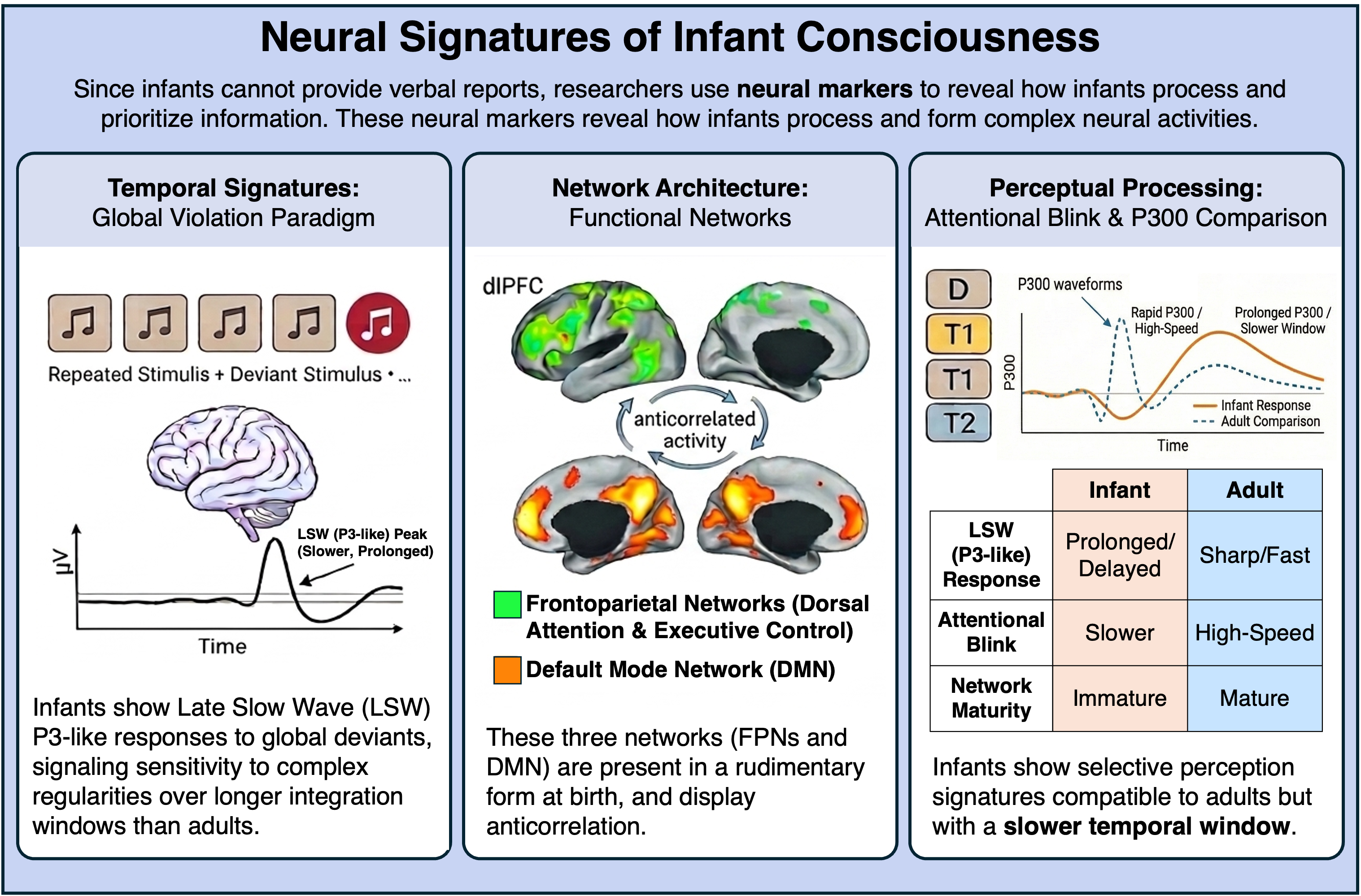
Evidence from neuroimaging regarding the neural markers of consciousness in infants. Figure generated with assistance from Gemini 3 Pro (Google. 2026).
Infant phenomenology
The nature of infant experience—its content and structure—differs from adult experience. Infants lack linguistic and reflective capacities yet may still have phenomenal consciousness; a first-order experiential state may be present prior to language and thought [see Self; Self-Consciousness]. Newborns may have sensory and affective experiences such as visual and auditory experiences, pain, pleasure, bodily sensations, and basic emotions; they may also exhibit minimal selfhood and early agentive experiences (Rochat, 2011). At the same time, their perception is coarser and slower than in adults, and they may lack cognitive aspects of experience. Compared with adults, infants integrate perceptual information over longer windows of time—illustrated by a prolonged attentional blink—and they resolve spatial detail more coarsely because of visual crowding (peripheral objects blend together). Early perceptual narrowing also means that initially broad category sensitivities become more selective over time (e.g., sensitivity to speech sounds). Taken together, these phenomena suggest that infants’ stream of experience might be less differentiated but broader in some respects than later experience (Bayne et al., 2023). Infant phenomenology is organized by sensory, affective, and agentive experiences, with cognitive forms of experience (imagination, propositional thought, planning, self-consciousness, and reflective consciousness) emerging later (Goupil & Kouider, 2019).
Questions, controversies, and new developments
Methodological challenges
The study of private subjective experiences is challenging in the absence of first-person reports. Researchers typically rely on converging behavioral and neural markers of consciousness. Two main strategies have emerged: theory-based approaches, which use theoretical models to derive predictions from a theory of consciousness, and marker-based approaches, which identify clusters of neural and behavioral indicators independent of theory (see Frohlich & Bayne, 2025; Passos-Ferreira, in press). Hybrid approaches combine these strengths, integrating behavioral, electrophysiological, and neuroimaging evidence to infer infant consciousness with greater confidence.
Onset of consciousness
If newborns are conscious, the onset must be natal or prenatal; if they are not, the onset must be postnatal. Thalamocortical development at 24 weeks is often treated as a lower bound for the possibility of fetal consciousness, but one can propose a more fine-grained developmental taxonomy (Passos-Ferreira, in press).
Late prenatal views suggest emergence at or after 24 weeks, with the onset of thalamocortical connectivity.
Natal views say that consciousness begins at birth, triggered by arousal and sensory input (Lagercrantz, 2025).
Early postnatal views posit consciousness within the first six months of life as neural markers mature (Bayne et al., 2023; Dehaene-Lambertz, 2024).
Late postnatal views suggest emergence after six months of life, linked to higher cognition (Perner & Dienes, 2003).
Theories of consciousness
Theories of consciousness can be classified by their predictions about the onset of consciousness. Early-onset theories hold that consciousness emerges at or before birth. This category includes integrated information theory, which posits that consciousness arises from integrated information within a system. This theory tends to suggest that newborn brains, which already display measurable integration, possess some degree of consciousness (Tononi & Boly, 2025). Global neuronal workspace theory links consciousness to the global broadcasting of information across distributed neural networks. Weak but detectable P300- and P400-like responses in infants suggest the early emergence of primitive workspace dynamics (Kouider et al., 2013).
By contrast, late-onset views posit that key mechanisms mature after birth. Recurrent processing theory holds that recurrent (feedback) loops within sensory areas are essential for conscious perception. These loops appear underdeveloped before age six to seven months, as shown by infants’ failure to exhibit masking effects typical of conscious vision (Nakashima et al., 2021), raising a challenge for the view that consciousness is present before this time. Higher-order theories that tie consciousness to prefrontal higher-order monitoring likewise imply that early infants, lacking mature cognitive and metarepresentational capacities, may not be conscious (Passos-Ferreira, 2023).
Broader connections
Debates about whether consciousness emerges before birth carry significant ethical, clinical, and legal implications. Many hold that the capacity for consciousness grounds moral status and clinical obligations, suggesting that when a fetus is conscious, abortion should be restricted. On prevailing accounts, a functioning thalamocortical system—typically developing around 24 weeks—sets a lower bound for possible fetal consciousness and thus for abortion limits, whereas minority early prenatal views that place consciousness earlier could motivate earlier restrictions. Some theorists reject tying abortion rights to consciousness (or to moral status), yet still acknowledge clinical obligations—for example, mitigating potential fetal pain during surgery. The claim that consciousness grounds moral status and clinical obligations makes infant consciousness a foundational issue for infant neuroethics.
Future progress depends on developing rigorously validated behavioral and neural markers for early development. This, in turn, requires advances in infant- and fetus-safe, high-resolution neuroimaging and new techniques in infant neuroscience. Research on infant consciousness also interfaces with comparative work in animals, in which reports are likewise absent, and with debates on machine consciousness, in which behavioral and neural proxies are even more indirect. As infant neuroscience matures, integrating these tools should yield a more comprehensive, empirically grounded account of how consciousness develops.
Further reading
Bayne, T., Frohlich, J., Cusack, R., Moser, J., & Naci, L. (2023). Consciousness in the cradle: On the emergence of infant experience. Trends in Cognitive Sciences, 27(12), 1135–1149. https://doi.org/10.1016/j.tics.2023.08.018
Dehaene-Lambertz, G. (2024). Perceptual awareness in human infants: What is the evidence? Journal of Cognitive Neuroscience, 36(8), 1599–1609. https://doi.org/10.1162/jocn_a_02149
Passos-Ferreira, C. (2023). Are infants conscious? Philosophical Perspectives, 37(1), 308–329. https://doi.org/10.1111/phpe.12192
Rochat, P. (2011). What is it like to be a newborn? In S. Gallagher (Ed.), The Oxford handbook of the self (pp. 57-79). Oxford University Press.
References
Addabbo, M., Longhi, E., Marchis, I. C., Tagliabue, P., & Turati, C. (2018). Dynamic facial expressions of emotions are discriminated at birth. PLoS One, 13(3), e0193868. https://doi.org/10.1371/journal.pone.0193868
↩Anand, K. J., & Hickey, P. R. (1987). Pain and its effects in the human neonate and fetus. The New England Journal of Medicine, 317(21), 1321–1329. https://doi.org/10.1056/NEJM198711193172105
↩Atkinson, J., & Braddick, O. (2013). Visual development. In P. D. Zelazo (Ed.), The Oxford handbook of developmental psychology, vol. 1: Body and mind (pp. 271-309). Oxford University Press.
↩Bayne, T., Frohlich, J., Cusack, R., Moser, J., & Naci, L. (2023). Consciousness in the cradle: On the emergence of infant experience. Trends in Cognitive Sciences, 27(12), 1135–1149. https://doi.org/10.1016/j.tics.2023.08.018
↩Birch, J. (2024). The edge of sentience: Risk and precaution in humans, other animals, and AI. Oxford University Press.
↩Block, N. (1995). On a confusion about a function of consciousness. Behavioral and Brain Sciences, 18(2), 227-247. https://doi.org/10.1017/S0140525X00038188
↩Burnham, D., & Dodd, B. (2004). Auditory–visual speech integration by prelinguistic infants: Perception of an emergent consonant in the McGurk effect. Developmental Psychobiology, 45(4), 204–220. https://doi.org/10.1002/dev.20032
↩Ciaunica, A., Safron, A., & Delafield-Butt, J. (2021). Back to square one: The bodily roots of conscious experiences in early life. Neuroscience of Consciousness, 7(2), niab037. https://doi.org/10.1093/nc/niab037
↩DeCasper, A. J., & Fifer, W. P. (1980). Of human bonding: Newborns prefer their mothers’ voices. Science, 208(4448), 1174–1176. https://doi.org/10.1126/science.7375928
↩Dehaene-Lambertz, G. (2024). Perceptual awareness in human infants: What is the evidence? Journal of Cognitive Neuroscience, 36(8), 1599–1609. https://doi.org/10.1162/jocn_a_02149
↩Dehaene-Lambertz, G., & Spelke, E. S. (2015). The infancy of the human brain. Neuron 88(1), 93–109. https://doi.org/10.1016/j.neuron.2015.09.026
↩Dopierala, A. A. W., & Emberson, L. L. (2022). Cognitive development: Looking for perceptual awareness in human infants. Current Biology, 32(7), 322–324. https://doi.org/10.1016/j.cub.2022.02.045
↩Frohlich, J., & Bayne, T. (2025). Markers of consciousness in infants: Towards a “cluster-based” approach. Acta Paediatrica, 114(2), 285–291. https://doi.org/10.1111/apa.17449
↩Goksan, S., Hartley, C., Emery, F., Cockrill, N., Poorun, R., Moultrie, F., Rogers, R., Campbell, J., Sanders, M., Adams, E., Clare, S., Jenkinson, M., Tracey, I., & Slater, R. (2015). fMRI reveals neural activity overlap between adult and infant pain. eLife, 4, e06356. https://doi.org/10.7554/eLife.06356
↩Gopnik, A. (2010). The philosophical baby: What children’s minds tell us about truth, love, and the meaning of life. Picador.
↩Goupil, L., & Kouider, S. (2019). Developing a reflective mind: From core metacognition to explicit self-reflection. Current Directions in Psychological Science, 28(4), 403-408. https://doi.org/10.1177/0963721419848672
↩Hochmann, J.-R., & Kouider, S. (2022). Acceleration of information processing en route to perceptual awareness in infancy. Current Biology, 32(5), 1206–1210.e3 https://doi.org/10.1016/j.cub.2022.01.029
↩Hu, H., Cusack, R., & Naci, L. (2022). Typical and disrupted brain circuitry for conscious awareness in full-term and preterm infants. Brain Communications, 4(2), fcac071. https://doi.org/10.1093/braincomms/fcac071
↩James, W. (1981). The principles of psychology. Harvard University Press. (Original work published 1890)
↩Kouider, S., Stahlhut, C., Gelskov, S. V., Barbosa, L. S., Dutat, M., de Gardelle, V., Christophe, A., Dehaene, S., Dehaene-Lambertz, G. (2013). A neural marker of perceptual consciousness in infants. Science, 340(6130), 376–380. https://doi.org/10.1126/science.1232509
↩Lagercrantz, H. (2025). The awakening of the newborn human infant and the emergence of consciousness. Acta Paediatrica, 114(5), 823-828. https://doi.org/10.1111/apa.70031
↩Meltzoff, A. N., & Moore, M. K. (1977). Imitation of facial and manual gestures by human neonates. Science, 198(4312), 74–78. https://doi.org/10.1126/science.897687
↩Moser, J., Schleger, F., Weiss, M., Sippel, K., Dehaene-Lambertz, G., & Preissl, H. (2020). Magnetoencephalographic signatures of hierarchical rule learning in newborns. Developmental Cognitive Neuroscience, 46, 100871. https://doi.org/10.1016/j.dcn.2020.100871
↩Nakashima, Y., Kanazawa, S., & Yamaguchi, M. K. (2021). Perception of invisible masked objects in early infancy. Proceedings of the National Academy of Sciences, 118(27), e2103040118. https://doi.org/10.1073/pnas.2103040118
↩Passos-Ferreira, C. (2023). Are infants conscious? Philosophical Perspectives, 37(1), 308–329. https://doi.org/10.1111/phpe.12192
↩Passos-Ferreira, C. (2024). Can we detect consciousness in newborn infants? Neuron, 112(10), 1520-1523. https://doi.org/10.1016/j.neuron.2024.04.024
↩Passos-Ferreira, C. (in press). Infant consciousness: How, where, whether, when, what? In L. Melloni & U. Olcese (Eds.), The scientific study of consciousness: Experimental and theoretical approaches. Springer.
↩Perner, J., & Dienes, Z. (2003). Developmental aspects of consciousness: How much theory of mind do you need to be consciously aware? Consciousness and Cognition, 12(1), 63-82. https://doi.org/10.1016/S1053-8100(02)00010-7
↩Rochat, P. (2001). The infant’s world. Harvard University Press.
↩Rochat, P. (2011). What is it like to be a newborn? In S. Gallagher (Ed.), The Oxford handbook of the self (pp. 57-79). Oxford University Press.
↩Rodkey, E. N., & Riddell, R. P. (2013). The infancy of infant pain research: The experimental origins of infant pain denial. The Journal of Pain, 14(4), 338–350. https://doi.org/10.1016/j.jpain.2012.12.017
↩Spelke, E. S. (2022). What babies know: Core knowledge and composition (Vol. 1). Oxford University Press.
↩Tononi, G. & Boly, M. (2025). Integrated information theory: A consciousness-first approach to what exists. arXiv. https://doi.org/10.48550/arXiv.2510.25998
↩Trevarthen, C., & Reddy, V. (2007). Consciousness in infants. In M. Velmans & S. Schneider (Eds.), The Blackwell companion to consciousness (pp. 43-62). Wiley-Blackwell.
↩