Self-regulation refers to the capacity to guide one’s thoughts, feelings, and actions in line with internal goals or external standards. This process becomes especially salient in moments of competing motivations such as resisting temptation or choosing between conflicting priorities. From sustaining attention and pursuing long-term goals to adapting flexibly within social and structural contexts, self-regulation lies at the heart of human agency. Self-regulation is distinguished from narrower constructs and subdomains, such as self-control (which involves resolving motivational conflicts) and cognitive control (which refers to executive processes like attention and inhibition). Contemporary models and research emphasize self-regulation processes, flexible strategy use, and metamotivation. Self-regulation plays a role in individual human happiness, although it also operates within, and is shaped by, structural contexts.
History
The roots of self-regulation can be traced back to ancient philosophical treatments of agency and goal-directed behavior. Aristotle’s teleological view of nature, in which entities are seen as striving toward their natural ends, provided an early conceptual basis for the idea that behavior unfolds relative to internally represented goal states or standards. Moreover, the Greek notion of akrasia—the phenomenon of acting against one’s better judgment—already points to the internal conflict at the center of modern theories of self-control (which is a special case of self-regulation as defined below). However, it was not until the 20th century that more systematic theories emerged, particularly because of the influence of cybernetic models of control and feedback.
Cybernetic theory, although formalized in systems science and engineering, has its roots in physiology. These foundational ideas inspired psychological models of self-regulation, most notably the control theory of behavior by Charles Carver and Michael Scheier (1998). Their model conceptualized self-regulation as a process in which individuals monitor discrepancies between actual and desired states and adjust behavior accordingly (see Figure 1).
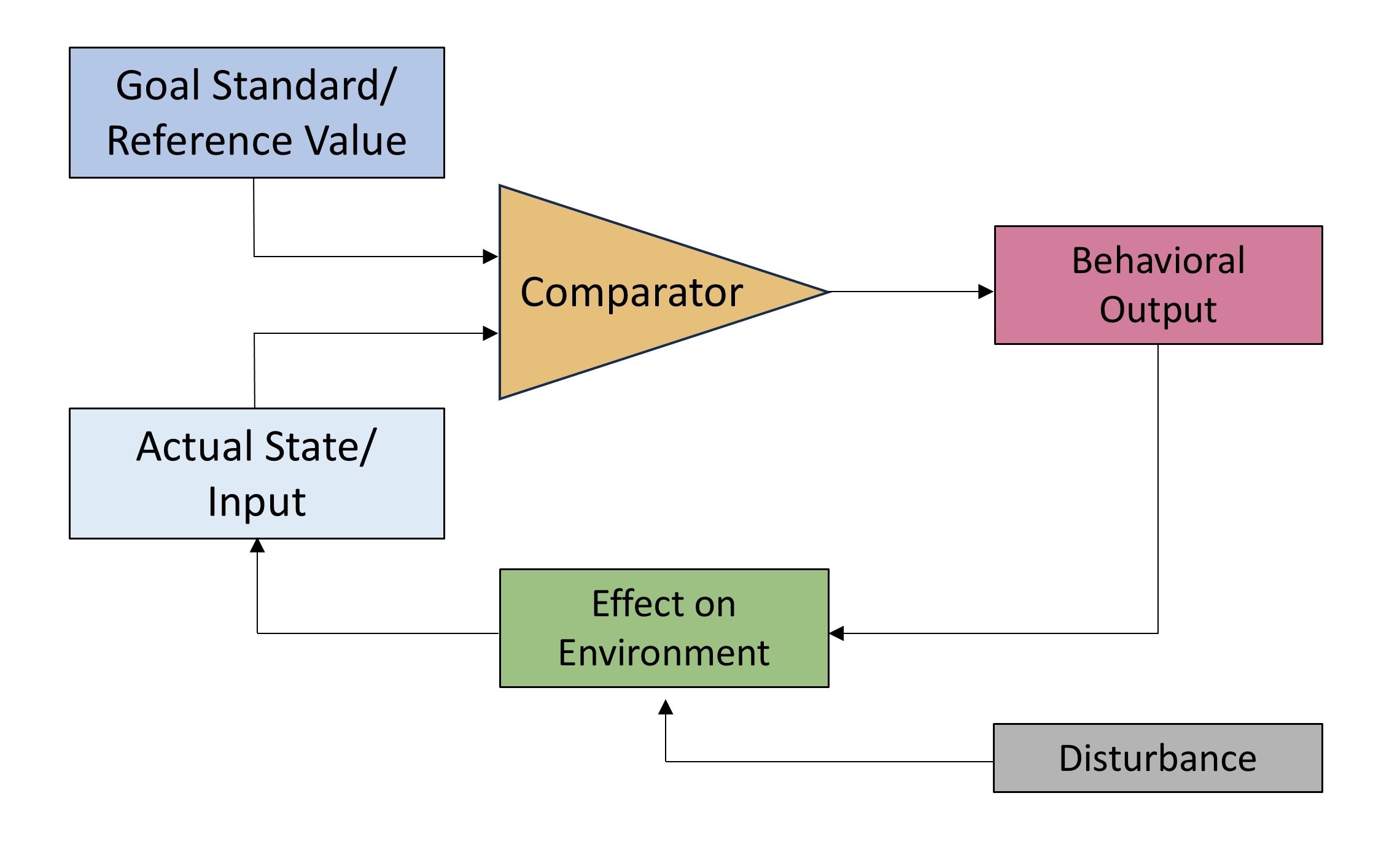
The cybernetic feedback-loop model of self-regulation as proposed by Carver and Scheier (1998).
In modern psychology, groundbreaking work has helped to establish the field of self-regulation by emphasizing its social cognitive underpinnings (Bandura, 1991) and its real-world relevance (Mischel et al., 1988) as well as the dynamics of self-regulatory failure (Baumeister et al., 1994). Complementary theories have addressed the structural and motivational architecture of goal pursuit (Kruglanski et al., 2002) and the role of motivational orientations in self-regulation (Gollwitzer, 1990).
Core concepts
Although often used interchangeably, self-regulation, self-control, and cognitive control refer to overlapping but distinct constructs that are studied across different subfields of psychology and cognitive science (Inzlicht et al., 2021).
Self-regulation is the broadest term, encompassing the processes by which people set, pursue, and revise goals over time in response to internal states and external feedback. It includes proactive and reactive strategies, is not limited to conflict situations, and spans across domains including the regulation of emotion (Gross, 1998).
Self-control refers more narrowly to the process of resolving a motivational conflict between two competing motives or goals by advancing one over the other (Hofmann & Kotabe, 2012; Inzlicht et al., 2021). Although classic models emphasize now versus later dilemmas—such as resisting dessert in favor of long-term health—contemporary conceptions recognize that conflicts may be based on other dimensions as well (Hofmann, 2025; Inzlicht et al., 2021). For example, one may choose between helping a friend move versus relaxing at home (self-serving vs. prosocial) or between studying for an exam versus attending a networking event (opportunity costs among valued goals). What unites these scenarios is the need to resolve the motivational conflict by prioritizing one goal at the expense of another.
Cognitive control is typically used in cognitive neuroscience to describe the executive processes that allow individuals to regulate attention, working memory, and action (Cohen, 2017). So-called executive functions such as attentional control, working memory, and cognitive flexibility are associated with prefrontal brain systems and are essential for implementing goal-directed behavior [see Working Memory]. Whereas cognitive control is a component of self-regulation, it does not capture the full motivational or affective complexity of self-regulatory phenomena (Inzlicht et al., 2021).
Although not used as interchangeable, the notion of cognitive effort (or just effort) is also important. Effort refers to the application of mental or physical force against resistance, which mediates between potential and actual performance in service of achieving goals (Inzlicht et al., 2025). Effort encompasses both objective exertion (e.g., measurable force) and subjective experience (e.g., the feeling of pushing oneself), with the latter often relating to behavior more directly than objective measures, especially when weighing whether a goal is worth pursuing (Shenhav et al., 2017). Self-regulation frequently, although not always, requires some effort, particularly when overcoming obstacles to goal pursuit.
Questions, controversies, and new developments
From inhibition to processes of self-regulation
Traditional accounts of self-regulation—particularly self-control—have long emphasized the effortful inhibition of dominant responses. Yet this inhibition-focused perspective has come under increasing scrutiny, both conceptually and empirically (Werner et al., 2022). For instance, a growing body of evidence has found that individuals successful at self-control rely more on preventive strategies such as situation selection and good habit building (de Ridder et al., 2012) and less on effortful inhibition than previously assumed (e.g., Hofmann et al., 2012; Milyavskaya & Inzlicht, 2017). Contemporary models now position inhibition not as the essence of self-regulation but as one possible endpoint within a broader unfolding process (e.g., Duckworth et al., 2016; Hofmann & Kotabe, 2012).
Drawing from work on emotion regulation (Gross, 1998), self-regulation is increasingly viewed as a dynamic, multistage process that unfolds over time. For instance, the process model (illustrated in Figure 2; Duckworth et al., 2016) distinguishes between situation selection, situation modification, attentional deployment, and cognitive change as stages prior to response modulation (e.g., inhibition). This shift in perspective lays the groundwork for a more comprehensive view of the various ways through which people align their behavior with goals and resolve motivational conflicts.

Redrawing of the process model of self-control by Duckworth et al. (2016).
Strategic and flexible regulation: Expanding the toolbox
This new look has also reoriented research toward the types of self-regulatory strategies people employ to advance their goals. A growing literature has identified a diverse repertoire of self-regulatory strategies that vary in effectiveness depending on timing and context (Hennecke et al., 2019; Milyavskaya et al., 2021). Current issues involve whether (a) early-stage, preventive strategies outperform later-stage strategies (Duckworth et al., 2016); (b) commanding over a larger repertoire of strategies is generally beneficial (Werner et al., 2025); (c) whether (and why) polyregulation, the use of more than one strategy per self-regulatory episode is beneficial (Milyavskaya et al., 2021); and (d) how people flexibly select, adapt, and coordinate strategies in context (Friese et al., 2024; Werner & Ford, 2023).
The role of effort in self-regulation
Humans (and other animals) generally avoid effortful activities, conducting implicit cost–benefit analyses that weigh the expected value of control against effort costs (Shenhav et al., 2013). However, effort presents a paradox; although typically experienced as costly, it can simultaneously add value to activities and outcomes (Inzlicht et al., 2018). In fact, people sometimes seek out rather than avoid effortful experiences that contribute to meaning and purpose (Campbell et al., 2025). A dual-nature perspective on effort offers a biologically grounded account of why self-regulation often feels challenging and aversive (Kurzban, 2016) and makes sustained behavior change difficult to maintain (Inzlicht & Roberts, 2024).
Broader connections
Self-regulation and the balanced life
Contrary to the view that self-regulation undermines pleasure, recent research suggests that effective self-regulation involves dynamically regulating both hedonic and long-term goals over time—more like a choreography than a tug-of-war. For instance, new studies highlight the concept of hedonic capacity, that is, the ability to enjoy pleasure without intrusions from conflicting long-term goals, as a beneficial self-regulatory competence (Bernecker & Becker, 2021). This reflects a turn away from an implicit focus on self-optimization to broader notions that emphasize goal balancing (Fishbach et al., 2009; Hofmann et al., 2014) or goal alignment (Inzlicht & Roberts, 2024) as central to our understanding of successful self-regulation.
Connecting self-regulation and public policy
Finally, there is growing recognition of the relevance of self-regulation to behavioral public policy. Rather than viewing self-regulation failures solely as individual shortcomings, recent work emphasizes how structural conditions—such as the availability of temptations or socioeconomic constraints—co-shape the success of self-regulatory efforts (Hofmann, 2024). This multilevel perspective bridges psychological models with societal outcomes from obesity and problematic media use to climate-related behaviors. It suggest that improving population-level self-regulation requires not only individual competence building but also systemic policy interventions.
Further reading
Duckworth, A. L., Gendler, T. S., & Gross, J. J. (2016). Situational strategies for self-control. Perspectives on Psychological Science, 11(1), 35–55. https://doi.org/10.1177/1745691615623247
Hofmann, W. (2025). Self-control. In D. T. Gilbert, S. T. Fiske, E. J. Finkel, & W. B. Mendes (Eds.), The handbook of social psychology (6th ed.). Situational Press. https://doi.org/10.70400/AZDY6353
Inzlicht, M., Werner, K. M., Briskin, J. L., & Roberts, B. W. (2021). Integrating models of self-regulation. Annual Review of Psychology, 72, 319–345.
https://doi.org/10.1146/annurev-psych-061020-105721
References
Bandura, A. (1991). Social cognitive theory of self-regulation. Organizational Behavior and Human Decision Processes, 50(2), 248–287. https://doi.org/10.1016/0749-5978(91)90022-L
↩Baumeister, R. F., Heatherton, T. F., & Tice, D. M. (1994). Losing control: How and why people fail at self-regulation. Academic Press.
↩Bernecker, K., & Becker, D. (2021). Beyond self-control: Mechanisms of hedonic goal pursuit and its relevance for well-being. Personality and Social Psychology Bulletin, 47(4), 627–642. https://doi.org/10.1177/0146167220941998
↩Campbell, A. V., Wang, Y., & Inzlicht, M. (2025). Experimental evidence that exerting effort increases meaning. Cognition, 257, 106065. https://doi.org/10.1016/j.cognition.2025.106065
↩Carver, C. S., & Scheier, M. F. (1998). On the self-regulation of behavior. Cambridge University Press.
↩Cohen, J. D . (2017). Cognitive control. In T. Egner (Ed.), The Wiley handbook of cognitive control (pp. 1–28). Wiley.
↩de Ridder, D. T. D., Lensvelt-Mulders, G., Finkenauer, C., Stok, F. M., & Baumeister, R. F. (2012). Taking stock of self-control: A meta-analysis of how trait self-control relates to a wide range of behaviors. Personality and Social Psychology Review, 16(1), 76–99. https://doi.org/10.1177/1088868311418749
↩Duckworth, A. L., Gendler, T. S., & Gross, J. J. (2016). Situational strategies for self-control. Perspectives on Psychological Science, 11(1), 35–55. https://doi.org/10.1177/1745691615623247
↩Duckworth, A. L., White, R. E., Matteucci, A. J., Shearer, A., & Gross, J. J. (2016). A stitch in time: Strategic self-control in high school and college students. Journal of Educational Psychology, 108(3), 329–341. https://doi.org/10.1037/edu0000062
↩Fishbach, A., Zhang, Y., & Koo, M. (2009). The dynamics of self-regulation. European Review of Social Psychology, 20(1), 315–344. https://doi.org/10.1080/10463280903275375
↩Friese, M., Bürgler, S., Hofmann, W., & Hennecke, M. (2024). Self-regulatory flexibility. Current Opinion in Psychology, 60, 101878. https://doi.org/10.1016/j.copsyc.2024.101878
↩Gollwitzer, P. M. (1990). Action phases and mind-sets. In E. T. Higgins & R. M. Sorrentino (Eds.), Handbook of motivation and cognition: Foundations of social behavior (Vol. 2, pp. 53-92). Guilford Press.
↩Gross, J. J. (1998). The emerging field of emotion regulation: An integrative review. Review of General Psychology, 2(3), 271–299. https://doi.org/10.1037/1089-2680.2.3.2
↩Hennecke, M., Czikmantori, T., & Brandstätter, V. (2019). Doing despite disliking: Self–regulatory strategies in everyday aversive activities. European Journal of Personality, 33(1), 104–128. https://doi.org/10.1002/per.2182
↩Hofmann, W. (2024). Going beyond the individual level in self-control research. Nature Reviews Psychology, 3(1), 56–66. https://doi.org/10.1038/s44159-023-00256-y
↩Hofmann, W. (2025). Self-control. In D. Gilbert, S. Fiske, E. Finkel, & W. Mendes (Eds.), Handbook of social psychology (6th ed.). Situational Press. https://doi.org/10.70400/AZDY6353
↩Hofmann, W., & Kotabe, H. (2012). A general model of preventive and interventive self-control. Social and Personality Psychology Compass, 6(10), 707–722. https://doi.org/10.1111/j.1751-9004.2012.00461.x
↩Hofmann, W., Baumeister, R. F., Forster, G., & Vohs, K. D. (2012). Everyday temptations: An experience sampling study of desire, conflict, and self-control. Journal of Personality and Social Psychology, 102(6), 1318–1335. https://doi.org/10.1037/a0026545
↩Hofmann, W., Luhmann, M., Fisher, R. R., Vohs, K. D., & Baumeister, R. F. (2014). Yes, but are they happy? Effects of trait self-control on affective well-being and life satisfaction. Journal of Personality, 82(4), 265–277. https://doi.org/10.1111/jopy.12050
↩Inzlicht, M., & Roberts, B. W. (2024). The fable of state self-control. Current Opinion in Psychology, 58, 101848. https://doi.org/10.1016/j.copsyc.2024.101848
↩Inzlicht, M., Campbell, A. V., & Saunders, B. (2025). Effort paradox redux: Rethinking how effort shapes social behavior. In B. Gawronski (Ed.), Advances in experimental social psychology (Vol. 72, pp. 1-55). Elsevier. https://doi.org/10.1016/bs.aesp.2025.04.002
↩Inzlicht, M., Shenhav, A., & Olivola, C. Y. (2018). The effort paradox: Effort is both costly and valued. Trends in Cognitive Sciences, 22(4), 337–349. https://doi.org/10.1016/j.tics.2018.01.007
↩Inzlicht, M., Werner, K. M., Briskin, J. L., & Roberts, B. W. (2021). Integrating models of self-regulation. Annual Review of Psychology, 72, 319–345. https://doi.org/10.1146/annurev-psych-061020-105721
↩Kruglanski, A. W., Shah, J. Y., Fishbach, A., Friedman, R., Chun, W. Y., & Sleeth-Keppler, D. (2002). A theory of goal systems. Advances in Experimental Social Psychology, 34, 331-378. https://doi.org/10.1016/S0065-2601(02)80008-9
↩Kurzban, R. (2016). The sense of effort. Current Opinion in Psychology, 7, 67–70. https:// https://doi.org/10.1016/j.copsyc.2015.08.003
↩Milyavskaya, M., & Inzlicht, M. (2017). What’s so great about self-control? Examining the importance of effortful self-control and temptation in predicting real-life depletion and goal attainment. Social Psychological and Personality Science, 8(6), 603–611. https://doi.org/10.1177/1948550616679237
↩Milyavskaya, M., Saunders, B., & Inzlicht, M. (2021). Self-control in daily life: Prevalence and effectiveness of diverse self-control strategies. Journal of Personality, 89(4), 634–651. https://doi.org/10.1111/jopy.12604
↩Mischel, W., Shoda, Y., & Peake, P. K. (1988). The nature of adolescent competencies predicted by preschool delay of gratification. Journal of Personality and Social Psychology, 54(4), 687–696. https://doi.org/10.1037/0022-3514.54.4.687
↩Shenhav, A., Botvinick, M. M., & Cohen, J. D. (2013). The expected value of control: an integrative theory of anterior cingulate cortex function. Neuron, 79(2), 217-240. https://doi.org/10.1016/j.neuron.2013.07.007
↩Shenhav, A., Musslick, S., Lieder, F., Kool, W., Griffiths, T. L., Cohen, J. D, & Botvinick, M. M. (2017). Toward a rational and mechanistic account of mental effort. Annual Review of Neuroscience, 40, 99–124. https://doi.org/10.1146/annurev-neuro-072116-031526
↩Werner, K. M., & Ford, B. Q. (2023). Self-control: An integrative framework. Social and Personality Psychology Compass, 17(5), e12738. https://doi.org/10.1111/spc3.12738
↩Werner, K. M., Inzlicht, M., & Ford, B. Q. (2022). Whither inhibition? Current Directions in Psychological Science, 31(4), 333–339. https://doi.org/10.1177/09637214221095848
↩Werner, K. M., Wu, R., Gross, J. J., & Friese, M. (2025). When bigger is better: Size of strategy repertoire predicts goal attainment. Motivation and Emotion, 49(1), 31–45. https://doi.org/10.1007/s11031-024-10103-z
↩