From the perspective of human cognitive neuroscience, actions are mental and neural processes involved in representing, planning, and controlling goal-directed behaviors to produce changes in the external world or in the self. Current knowledge about the brain’s action system derives from two main sources: studies of apraxia, a group of disorders in which learned, purposeful movement is disrupted despite preserved basic motor function, and the use of brain imaging methods to examine how actions are organized in the healthy brain. The action system is often conceptualized as organized in a hierarchy containing both low-level sensorimotor and higher-level cognitive representations and processes. Mental representations of action also support a range of cognitive and language functions that may not require overt movement. The high-level human action system is largely concentrated in the left hemisphere. It operates through two specialized neural networks that underlie the planning and execution of skilled behavior and mediate the participation of action representations in a range of cognitive and language processes.
History
The understanding of the neuroscience of action builds on the early 20th-century work of neurologist Hugo Liepmann, who demonstrated the pivotal role of a network of left hemisphere brain regions in both the imitation and execution of actions. Liepmann identified a posterior temporal-occipital brain region critical for action knowledge and a parietal lobe region that relays action knowledge to motor systems. When damaged, these regions are associated with disorders known as ideational apraxia and ideomotor apraxia, respectively (Liepmann, 1908; Roby-Brami et al., 2012; Figure 1). Both disorders impair the ability to imitate and perform skilled actions and are common after stroke as well as in neurodegenerative conditions such as Alzheimer’s disease.
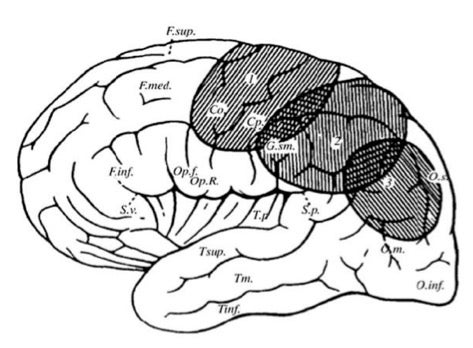
Lesion topography of three types of apraxia, according to Liepmann (1908). (1) Limb-kinetic apraxia (not discussed here), (2) ideomotor apraxia, and (3) ideational apraxia. Reproduced from Roby-Brami et al. (2012), Copyright 2011 by The Royal Society.
In the late 20th century, Rothi and colleagues (Rothi et al., 1991) refined Liepmann’s model, proposing a cognitive architecture in which sensory (e.g., visual) representations are transformed into motor commands via distinct processing routes. The indirect, or semantic, route supports the recognition and production of meaningful actions, whereas the direct route bypasses semantics to enable imitation of novel movements (Figure 2). Later theories (e.g., Binkofski & Buxbaum, 2013) expanded this two-route model, introducing mechanisms such as a gestural buffer—a temporary store that allows for selection of actions appropriate to task goals.
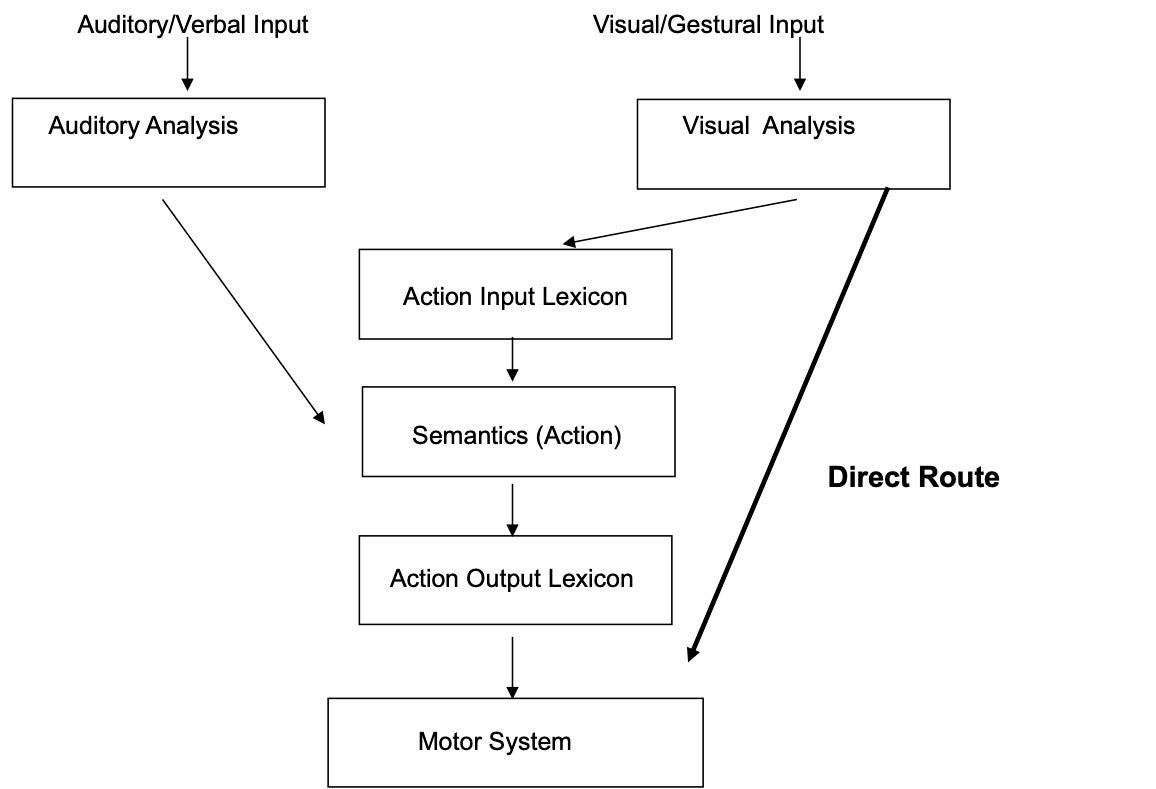
An illustration of the direct (non-semantic) and indirect (semantic) action routes in the apraxia model of Rothi and colleagues. Figure adapted from Rothi et al. (1991).
Core concepts
Frontotemporal and frontoparietal neuroanatomy of the action system
Recent advances in neuroimaging methods have enabled neural specification of an essential two-route model, revealing a bilateral dorso-dorsal pathway specialized for visuomotor control of reaching and grasping (the move system) and a left-lateralized ventro-dorsal pathway optimized for skilled actions (the use system; Figure 3) [see Action].
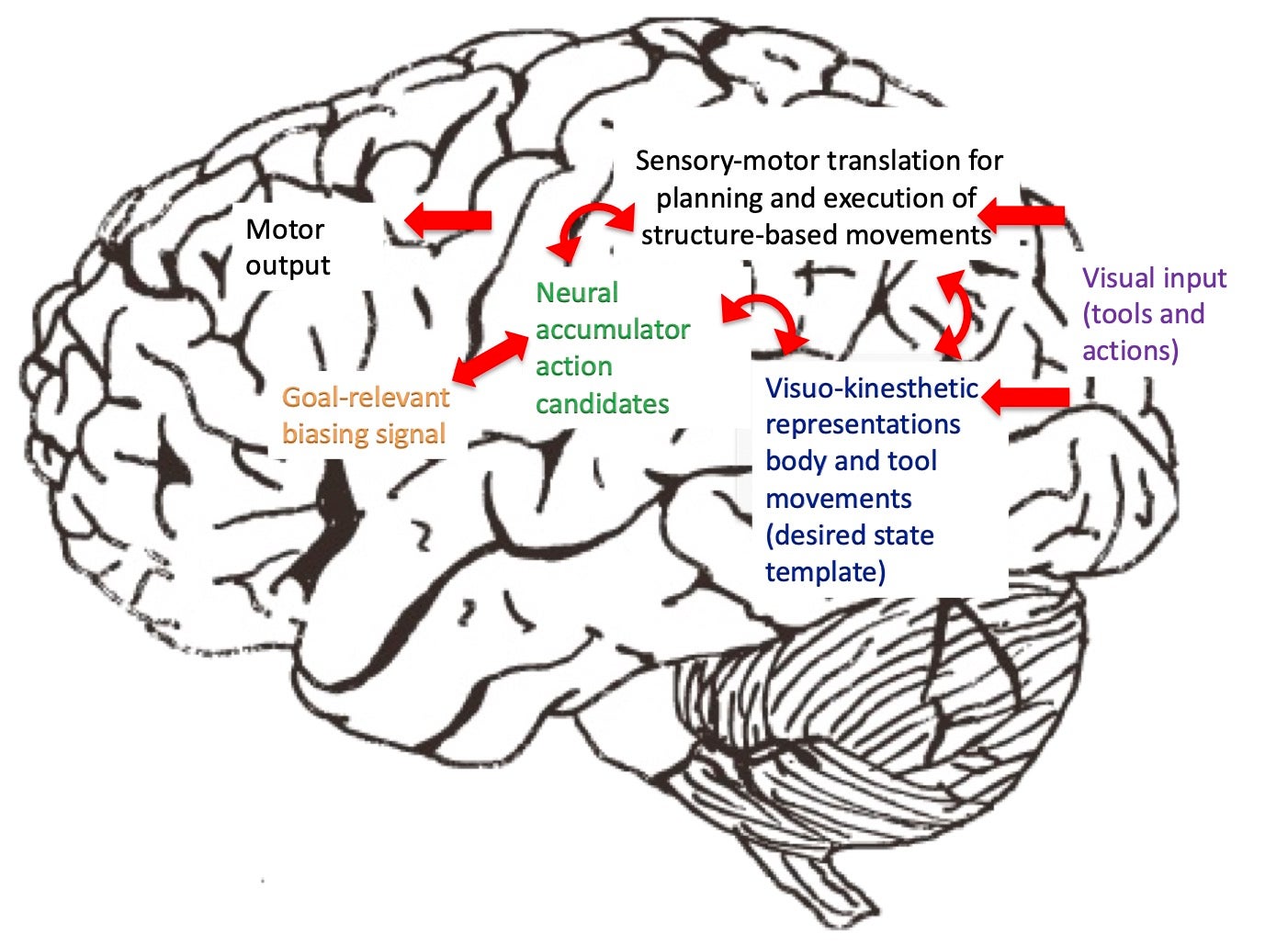
Graphic depiction of the two action systems plus model of tool use. A left lateralized posterior temporal/inferior parietal system subserves storage of multimodal manipulation knowledge (blue), which is translated into sensorimotor representations enabling tool-use production in a bilateral frontoparietal network (black), with additional “tuning” based on current visual and somatosensory input (purple). The portion of the network specialized for action selection (green) subserves a biasing signal from the inferior frontal cortex (orange) that aids in selection of potential actions from a temporary repository or “buffer” in the left supramarginal gyrus. Figure adapted from Buxbaum (2017).
Within this essential two-route network, the lateral occipital-temporal cortex (LOTC) and posterior middle temporal gyrus represent a hub for action knowledge and understanding, especially regarding the visual appearance of actions. This hub contributes both to action recognition (Martin et al., 2017) and to the activation of action-related information about objects and effectors (especially the hands) across a range of cognitive and language tasks (Lingnau & Downing, 2015; Figure 4). The inferior parietal lobe (IPL) plays a complementary role by representing somatosensory action goals that guide goal-directed movement. The IPL—and, in particular, the supramarginal gyrus (SMG)—is also critical for technical reasoning about tool use (Metaireau et al., 2024) and in temporarily buffering actions before they are selected (Randerath, 2009). The inferior frontal gyrus supports the selection of actions that best match current task goals (Rounis et al., 2021).
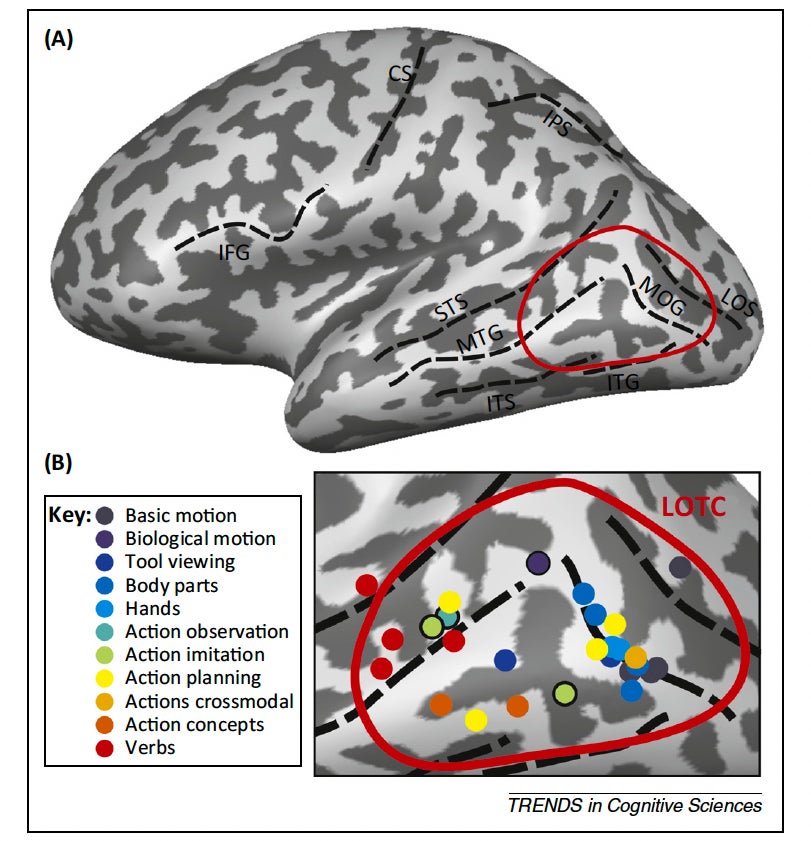
(A) Outlines of the LOTC superimposed on the segmented and inflated left hemisphere of an individual participant. Locations of key sulci and gyri are given for reference. (B) Outlines of LOTC (red line) together with activation peaks associated with different tasks reported in a variety of studies. Note that peaks do not reflect the typical spatial extent of activations nor overlap among activations. Abbreviations: CS, central sulcus; IFG, inferior frontal gyrus; IPS, intraparietal sulcus; ITG, inferior temporal gyrus; ITS, inferior temporal sulcus; LOS, lateral occipital sulcus; LOTC, lateral occipital-temporal cortex; MOG, middle occipital gyrus; MTG, middle temporal gyrus; STS, superior temporal sulcus. Reproduced from Lingnau and Downing (2015), Copyright 2015 Elsevier Ltd.
The action hierarchy
Action is often conceptualized in terms of a hierarchy (van Elk et al., 2014). At the lowest level are sensorimotor mechanisms that translate sensory input into motor commands. At higher levels are cognitive processes that store action representations, select among competing alternatives, and monitor execution. Different brain areas contribute to processing mechanisms at different levels of this hierarchy. For example, the premotor cortex supports the production of actions by specific effectors such as the hand, whereas the LOTC represents abstract actions (such as the same action performed with different body parts), and the premotor cortex is critical for the production of actions by specific body parts (Wurm & Lingnau, 2015). Similarly, the IPL represents fine-grained sensorimotor details of action, whereas the prefrontal cortex is involved in representing higher-order goals (Grafton & Hamilton, 2007).
Action competition and selection
Because multiple action possibilities are typically available, the brain must resolve competition to select actions that are most relevant to current goals. For example, experience-based tool-use knowledge is relevant when the goal is to skillfully operate a tool but not when simply moving it from one place to another. Disorders such as apraxia illustrate the consequences of disruption of this selection process. In these cases, the brain may fail to properly activate or prioritize relevant representations, leading to errors (Rounis & Humphreys, 2015) [see Action].
Questions, controversies, and new developments
The role of action in conceptual representations of objects and words
Action representations are engaged not only during overt movement but also in nonmotor tasks (Bub et al., 2008). Moreover, disruption of brain regions known to mediate action knowledge, such as the LOTC or SMG, can affect functions like manipulable object recognition and verb comprehension (Lee et al., 2014). These findings align with grounded cognition and embodied cognition views, which posit that conceptual knowledge is partly based on simulations derived from sensory and motor experiences (Barsalou, 2008) [see Grounded Cognition]. However, this perspective is challenged by those who argue that concepts are fundamentally abstract and amodal, independent of specific sensory or motor formats (e.g., Mahon, 2015). Ongoing research seeks to clarify the boundaries of grounded cognition by identifying when and how sensorimotor features are activated during conceptual processing.
Reasoning versus representation-based approaches to tool use
Countering the evidence that the skillful use of tools requires knowledge of tool manipulation gained from experience, some researchers emphasize that tool-use actions are based primarily on technical reasoning about the advantages the tool poses for solving a given physical problem (Osiurak & Badets, 2016). Recent research offers a potential rapprochement, highlighting the roles of both knowledge representations and reasoning in tool-use actions (Federico et al., 2023).
Action competition and featural overlap
Actions (and objects associated with action) compete with one another for selection as a function of overlap in their sensorimotor features (Watson & Buxbaum, 2014). Recent research indicates that these features may be represented in the SMG as kinematic synergies that are unique combinations of postures and movements (Caglar et al., 2025). Whether these patterns are specified in terms of somatosensory and proprioceptive body states or represent more abstract disembodied motion trajectories will be of interest for future research [see Bodily Sensations].
Broader connections
The action system contains monitoring mechanisms to prevent and correct errors. In parallel to a similar inquiry in the domain of language (e.g., Jefferies et al., 2020) [see Neuroscience of Language], researchers are exploring how and in which brain regions the action monitoring system operates and how monitoring may go awry in individuals with apraxia (Pyasik et al., 2022).
Further reading
Binkofski, F., & Buxbaum, L. J. (2013). Two action systems in the human brain. Brain and Language, 127(2), 222–229. https://doi.org/10.1016/j.bandl.2012.07.007
Caglar, L. R., Walbrin, J., Akwayena, E., Almeida, J., & Mahon, B. Z. (2025). Object-directed action representations are componentially built in parietal cortex. Proceedings of the National Academy of Sciences, 122(34), e2421032122. https://doi.org/10.1073/pnas.2421032122
Metaireau, M., Osiurak, F., Seye, A., & Lesourd, M. (2024). The neural correlates of limb apraxia: An anatomical likelihood estimation meta-analysis of lesion-symptom mapping studies in brain-damaged patients. Neuroscience and Biobehavioral Reviews, 162, 105720. https://doi.org/10.1016/j.neubiorev.2024.105720
References
Barsalou, L. W. (2008). Grounded cognition. Annual Review of Psychology, 59, 617-645. https://doi.org/10.1146/annurev.psych.59.103006.093639
↩Binkofski, F., & Buxbaum, L. J. (2013). Two action systems in the human brain. Brain and Language, 127(2), 222–229. https://doi.org/10.1016/j.bandl.2012.07.007
↩Bub, D. N., Masson, M. E., & Cree, G. S. (2008). Evocation of functional and volumetric gestural knowledge by objects and words. Cognition, 106(1), 27-58. https://doi.org/10.1016/j.cognition.2006.12.010
↩Caglar, L. R., Walbrin, J., Akwayena, E., Almeida, J., & Mahon, B. Z. (2025). Object-directed action representations are componentially built in parietal cortex. Proceedings of the National Academy of Sciences, 122(34), e2421032122. https://doi.org/10.1073/pnas.2421032122
↩Federico, G., Osiurak, F., Ciccarelli, G., Ilardi, C. R., Cavaliere, C., Tramontano, L., Alfano, V., Migliaccio, M., Di Cecca, A., Salvatore, M., & Brandimonte, M. A. (2023). On the functional brain networks involved in tool-related action understanding. Communications Biology, 6(1), 1163. https://doi.org/10.1038/s42003-023-05518-2
↩Grafton, S. T., & Hamilton, A. F. (2007). Evidence for a distributed hierarchy of action representation in the brain. Human Movement Science, 26(4), 590-616. https://doi.org/10.1016/j.humov.2007.05.009
↩Jefferies, E., Thompson, H., Cornelissen, P., & Smallwood, J. (2020). The neurocognitive basis of knowledge about object identity and events: Dissociations reflect opposing effects of semantic coherence and control. Philosophical Transactions of the Royal Society of London Society B: Biological Sciences, 375(1791), 20190300. https://doi.org/10.1098/rstb.2019.0300
↩Lee, C. I., Mirman, D., & Buxbaum, L. J. (2014). Abnormal dynamics of activation of object use information in apraxia: Evidence from eyetracking. Neuropsychologia, 59, 13-26. https://doi.org/10.1016/j.neuropsychologia.2014.04.004
↩Liepmann, H. (1908). Drei aufsatze aus dem apraxiegebiet. Karger.
↩Lingnau, A., & Downing, P. E. (2015). The lateral occipitotemporal cortex in action. Trends in Cognitive Sciences, 19(5), 268-277. https://doi.org/10.1016/j.tics.2015.03.006
↩Mahon, B. Z. (2015). What is embodied about cognition? Language, Cognition and Neuroscience, 30(4), 420-429. https://doi.org/10.1080/23273798.2014.987791
↩Martin, M., Dressing, A., Bormann, T., Schmidt, C. S. M., Kümmerer, D., Beume, L., Saur, D., Mader, I., Rijntjes, M., Kaller, C. P., & Weiller, C. (2017). Componential network for the recognition of tool-associated actions: Evidence from voxel-based lesion-symptom mapping in acute stroke patients. Cerebral Cortex, 27(8), 4139-4152. https://doi.org/10.1093/cercor/bhw226
↩Metaireau, M., Osiurak, F., Seye, A., & Lesourd, M. (2024). The neural correlates of limb apraxia: An anatomical likelihood estimation meta-analysis of lesion-symptom mapping studies in brain-damaged patients. Neuroscience and Biobehavioral Reviews, 162, 105720. https://doi.org/10.1016/j.neubiorev.2024.105720
↩Osiurak, F., & Badets, A. (2016). Tool use and affordance: Manipulation-based versus reasoning-based approaches. Psychological Review, 123(5), 534-568 https://doi.org/10.1037/rev0000027
↩Pyasik, M., Scandola, M., & Moro, V. (2022). Electrophysiological correlates of action monitoring in brain-damaged patients: A systematic review. Neuropsychologia, 174, 108333. https://doi.org/10.1016/j.neuropsychologia.2022.108333
↩Randerath, J. (2009). Aspekte des werkzeuggebrauchs: Vom greifen bis zur ausführung: Behaviorale und neuronale korrelate der apraxie. Der Andere Verlag.
↩Roby-Brami, A., Hermsdörfer, J., Roy, A. C., & Jacobs, S. (2012). A neuropsychological perspective on the link between language and praxis in modern humans. Philosophical Transactions of the Royal Society of London Series B: Biological Sciences, 367(1585), 144-160. https://doi.org/10.1098/rstb.2011.0122
↩Rothi, L. J. G., Ochipa, C., & Heilman, K. M. (1991). A cognitive neuropsychological model of limb praxis. Cognitive Neuropsychology, 8(9), 443-448. https://doi.org/10.1080/02643299108253382
↩Rounis, E., & Humphreys, G. (2015). Limb apraxia and the “affordance competition hypothesis.” Frontiers in Human Neuroscience, 9, 429. https://doi.org/10.3389/fnhum.2015.00429
↩Rounis, E., Halai, A., Pizzamiglio, G., & Lambon Ralph, M. A. (2021). Characterising factors underlying praxis deficits in chronic left hemisphere stroke patients. Cortex, 142, 154-168. https://doi.org/10.1016/j.cortex.2021.04.019
↩van Elk, M., van Schie, H., & Bekkering, H. (2014). Action semantics: A unifying conceptual framework for the selective use of multimodal and modality-specific object knowledge. Physics of Life Reviews, 11(2), 220-250. https://doi.org/10.1016/j.plrev.2013.11.005
↩Watson, C. E., & Buxbaum, L. J. (2014). Uncovering the architecture of action semantics. Journal of Experimental Psychology: Human Perception and Performance, 40(5), 1832-1848. https://doi.org/10.1037/a0037449
↩Wurm, M. F., & Lingnau, A. (2015). Decoding actions at different levels of abstraction. Journal of Neuroscience, 35(20), 7727-7735. https://doi.org/10.1523/jneurosci.0188-15.2015
↩