Perceptual constancy refers to the ability to perceive the same worldly property despite variation in patterns of stimulation received at the sense organs. For example, as you view a penny at various slants, it continues to appear circular despite changes in the shape of the image it projects onto the retina. Likewise, when you perceive a white wall under uneven illumination, you perceive the wall as uniformly white despite variation in the intensity of the light that different parts of the wall supply to the eyes. Perceptual constancy thus involves a type of stability in the outputs of perceptual systems (perceptual representations of objects or properties in the environment) despite variation in their inputs (patterns of proximal stimulation).
History
Although the term “perceptual constancy” first appeared during the 20th century (Boring, 1942, pp. 254–256; Koffka, 1935, p. 83), the idea that perception copes with changes in proximal stimulation to produce stable percepts of the environment is much older. The medieval polymath Ibn al-Haytham argued that objects are perceived as remaining the same size despite changes in their distance and took this to refute the view that size perception is based purely on the magnitude of the visual angle an object subtends (i.e., the angle formed by two rays emanating from the perceiver’s viewpoint and meeting the object at its extremities). Thus,
“The truth of the matter is that sight cannot perceive the magnitudes of visible objects by an estimation based only on the angles which the objects subtend at the centre of the eye. For the same object does not look different in magnitude when its distance is moderately varied. Thus when a near object, whose magnitude is perceived by sight, moves through a moderately large distance away from the eye, it does not look smaller but is rather perceived to be of the same magnitude as it looked from the first distance, provided the second distance is a moderate one” (al-Haytham, 1030/1989, book II, p. 174).
Note that beyond recognizing the importance of distance estimation in perceiving an object’s real-world size, al-Haytham also observed that size constancy can break down at extreme distances (see also Howard, 1996).
In his Dioptrics, René Descartes endorsed al-Haytham’s view that size is perceived by combining information about visual angle and distance and supplemented this claim with prescient accounts of how the mind infers distance from lens accommodation and the convergence of the eyes toward a fixated target (Descartes, 1637/2001, pp. 105–107). Both al-Haytham and Descartes explained failures of size constancy via the misestimation of distance. If the distance to a target is underestimated, then its size will be underestimated as well. Descartes’ view of distance perception was later criticized by George Berkeley, who argued that distance cannot be recovered from convergence angles because perceivers are not conscious of performing the required geometrical inferences (Berkeley, 1709/1965, section 12).
Constancy phenomena played an important illustrative role for several other early modern philosophers. David Hume called attention to failures of constancy in a well-known passage from the Enquiry: “The table, which we see, seems to diminish, as we remove farther from it: But the real table, which exists independent of us, suffers no alteration” (Hume, 1748/2000, §12.9). Hume’s idea is that the perceptual experience of the table is marked by inconstancy; the table looks smaller as one moves away from it. Likewise, John Locke seems to have adopted a purely postperceptual view of constancy, crediting observers’ awareness of an object’s intrinsic shape or color to postperceptual cognition (Locke, 1694/1975, book II, p. 8). For Locke, viewing a uniformly colored sphere under uneven lighting results in a visual idea of a variously colored circle; moving from this to an idea of a uniformly colored sphere required a cognitive act of judgment.
In his Treatise on Physiological Optics, Hermann von Helmholtz advocated for the very position that Berkeley deemed unacceptable. According to Helmholtz, perceptual representations of the environment are formed through processes that, although analogous to conscious reasoning, occur outside of awareness (von Helmholtz, 1867/1962, vol. 3, pp. 26–27). Helmholtz applied the unconscious inference account to various constancies, including size and lightness. For example, he proposed that the visual system recovers the constant lightness of a surface across changing lighting conditions by estimating the intensity of the illuminant (the incident light) and eliminating it to infer the surface’s reflectance (von Helmholtz, 1867/1962, vol. 2, p. 287). It is now a bedrock assumption within mainstream vision science that the visual system recovers properties of external objects through unconscious computation (e.g., Marr, 1982), although it is controversial whether such computations constitute inferences (Hilbert, 2012) [see Unconscious Inference].
James J. Gibson developed an influential rival to Helmholtz’s unconscious inference account. According to Gibson, the visual system picks up on or “resonates” to worldly properties without mediating computation or inference (Gibson, 1979). Central to Gibson’s account were the notions of optic array and perceptual invariants. The optic array consists of the configuration of light reaching a perceiver’s viewpoint from all directions over a period of time. Invariants, in turn, are relationships among aspects of the optic array that remain stable over that period. Gibson argued that certain invariants within the optic array covary one to one with worldly properties, and these invariants are contained within the inputs to the perceptual system. Because the sensory input, properly understood, is not impoverished with respect to the distal environment, the perceptual system allegedly need not engage in computations that elaborate on those inputs. One of Gibson’s primary examples involved the role of texture gradients, or regular changes in the density of texture patterns projected to the retina as a function of distance, in enabling veridical perception of depth and size (Gibson, 1979, pp. 160–162). Consider Figure 1. The three boxes appear roughly the same size even though their retinal images vary greatly. According to Gibson, you perceive the boxes as the same size thanks to the stable ratio between the images of the boxes and the images of their surrounding ground texture elements. Although their retinal sizes differ, all three boxes cover the same number of tile units, and this invariant relationship carries the information that they are the same physical size.
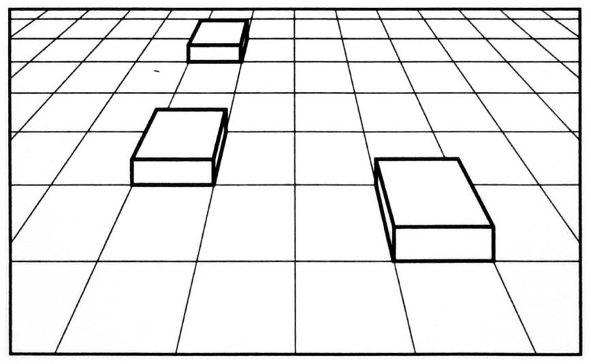
The three boxes are perceived as approximately the same size based on their invariant relationship to the surrounding ground texture. Source: Sedgwick (2021). Reproduced under the terms of the Creative Commons Attribution 4.0 License.
However, although Gibson is credited with noticing that the information within the proximal stimulus is richer than previously thought, the claim that constancies are achieved without mediating computation has been challenged in various ways (Ullman, 1980). Perhaps most straightforwardly, David Marr (1982, pp. 29–30) argued that even if the optic array contains invariants that fully specify worldly properties, this still would not obviate the need for computation in extracting those invariants from retinal stimulation.
Core concepts
In explaining any perceptual constancy capacity, one must answer three fundamental questions. First, what worldly property is the constancy capacity directed toward? At a first pass, the answer to this question individuates the constancy capacity under consideration, specifying what type of constancy it is (color constancy, shape constancy, size constancy, etc.). Second, which cues in the proximal stimulus does the constancy capacity capitalize on? The answer to this question reveals which aspects of the light reaching the eyes (or sound waves reaching the ears, etc.) carry information about the relevant worldly property. Third, what computational mechanisms operate on those cues to recover the worldly property: What sorts of representations do they produce, and what sources of information do they draw on? Models of perceptual constancy thus impact some of the deepest issues in cognitive science, including the format(s) of perceptual representation (e.g., whether they are imagistic, discursive, or map-like), the computational architecture of perceptual systems, and the extent to which perceptual systems have access to the agent’s background beliefs or goals.
Color constancy
On an orthodox conception of color constancy, the fundamental aim of visual color processing is to recover a surface’s stable spectral reflectance profile across changes in illumination or scene context (e.g., Byrne & Hilbert, 2003). A surface’s spectral reflectance profile consists of the proportion of light at each wavelength within the visible spectrum (roughly 400–700 nanometers) that it is disposed to reflect. Color constancy is challenging because the spectral power distribution (energy at each wavelength) of the light reaching the eyes, known as the color signal, is the joint product of a surface’s spectral reflectance profile and the spectral power distribution of the illuminant. The color signal received from a surface thus varies greatly across illumination conditions. The problem of color constancy is exacerbated by the fact that the visual system does not even have immediate access to the color signal. Rather, the incoming light is sampled by three classes of retinal cones maximally sensitive to short, medium, and long wavelengths of light, respectively. There is controversy surrounding the nature and reliability of the computational mechanisms that the visual system uses to recover invariant surface reflectance from these cone responses (Foster, 2011). Two approaches are particularly influential.
According to retinex theory (Land, 1977), the visual system estimates surface spectral reflectance by exploiting luminance intensity ratios across edges. A guiding assumption of the theory is that variations in illumination across the scene tend to be gradual, whereas changes in color tend to be abrupt. Accordingly, the visual system first segments the scene into regions bounded by sharp discontinuities in luminance intensity, assumed to derive from changes in surface reflectance. Having performed this segmentation, the system computes ratios of luminance intensity across each edge at short, medium, and long wavelengths, corresponding to the peak sensitivities of the three retinal cone classes. These ratios are then multiplied along paths to estimate reflectance ratios between nonadjacent surfaces. Because the ratio triplets are computed from local intensity values straddling edges, smooth changes in luminance within regions tend to be ignored, filtering out proximal variation due to gradual changes in lighting. Finally, the estimates for all three wavelengths are normalized (e.g., by assuming that the region of highest luminance is white) and combined, yielding estimates of surface reflectance that remain roughly invariant across lighting conditions.
Notably, the retinex algorithm entirely sidesteps the problem of computing the character of the illuminant, capitalizing solely on ratios of proximal luminance intensity between neighboring regions. On another approach, the visual system aims to recover the illuminant directly so that its contribution to the color signal can be factored out. Recently, this idea has figured prominently in Bayesian models of color constancy [see Bayesian Models of Cognition]. On one such model (Brainard et al., 2006), the visual system internalizes a prior distribution over illuminants that assigns higher probability to illuminant spectra that occur more often in typical environments (e.g., a “daylight” prior). The model estimates the illuminant from the color signal by combining simulated cone responses to that signal with the prior over illuminants and a separate prior over spectral reflectance profiles (based on measurements from various scenes). The model selects the illuminant that has maximum posterior probability and then divides this from the color signal to produce an estimate of surface spectral reflectance.
These theories of color constancy supply candidate answers to all three fundamental questions. First, both theories assume that color constancy is directed toward recovering surface spectral reflectance. Second, both models agree that the critical proximal cue for color constancy is the color signal, sampled through cone responses. However, the models diverge on the answer to the third question. Retinex theory proposes that the visual system computes surface reflectance by integrating luminance intensity ratios across edges and normalizing the outputs. The Bayesian approach proposes that the visual system estimates the illuminant through probabilistic inference and then factors out the illuminant to generate a representation of surface reflectance.
Constancy capacities can, at a first pass, be type-individuated by the worldly properties they are directed toward. An interesting implication of this approach is that familiar labels for types of perceptual constancy—color constancy, shape constancy, and so on—may end up picking out clusters of capacities directed toward subtly distinct properties. Such pluralist views have been defended for both color and shape constancy.
On the orthodox conception, color constancy is directed toward the monadic colors of surfaces—chromatic qualities of surfaces that do not constitutively depend on their relations to other parts of the scene, such as the property of being pure red. However, not all conceptions of color constancy make this assumption. Some employ the notion of relational color constancy, involving constancy for the perceived relations between surface colors under illuminant changes rather than constancy for the colors themselves (e.g., Foster, 2011, p. 680). For example, one might continue to perceive one region as redder than or yellower than a neighboring region, by an unchanging amount, across changes in illumination. Some have argued that relational color constancy is a simpler achievement for the visual system than absolute color constancy because it is more readily computed from ratios of cone excitation (Foster & Nascimento, 1994). It is thus possible that color constancy divides into distinct subtypes targeting monadic colors and color relations (Davies, 2022). This view is supported by evidence that the two kinds of constancy dissociate in cerebral achromatopsia, in which patients who have sustained cortical damage lose the ability to perceive monadic color but have partially spared capacities for perceiving color relations and chromatic edges (Kentridge et al., 2004).
Shape constancy
Likewise, what is called shape constancy divides into a collection of capacities directed toward properties of varying abstraction (Green, 2026). Traditionally, shape constancy has been identified with constancy for metric shape—that is, the geometrical property of an object that is retained only under rigid transformations and rescaling but not under nonrigid transformations like stretching, bending, or shearing (e.g., Epstein & Park, 1963). However, consider Figure 2a through c. In each case, the objects differ significantly in the 2D shapes they project to the retina and in their perceived metric shapes. However, the pairs of objects also appear to share deep structural similarities. These similarities mark further varieties of shape constancy; perception represents abstract geometrical properties of objects as remaining stable across changes in their more superficial metric properties (Green, 2026). Certain abstract forms of shape constancy may be explained by prominent skeletal models of shape representation, which explicitly encode shape at multiple levels of abstraction (Destler et al., 2023). On these views, shape is represented in terms of an underlying skeleton, resembling a “stick figure” version of the object. Studies indicate that perceivers are attuned to invariant skeletal structure across changes in orientation and metric shape (Lowet et al., 2018). Sensitivity to skeletal structure also appears within various visual brain regions (Ayzenberg & Lourenco, 2022) [see Visual Cognitive Neuroscience].
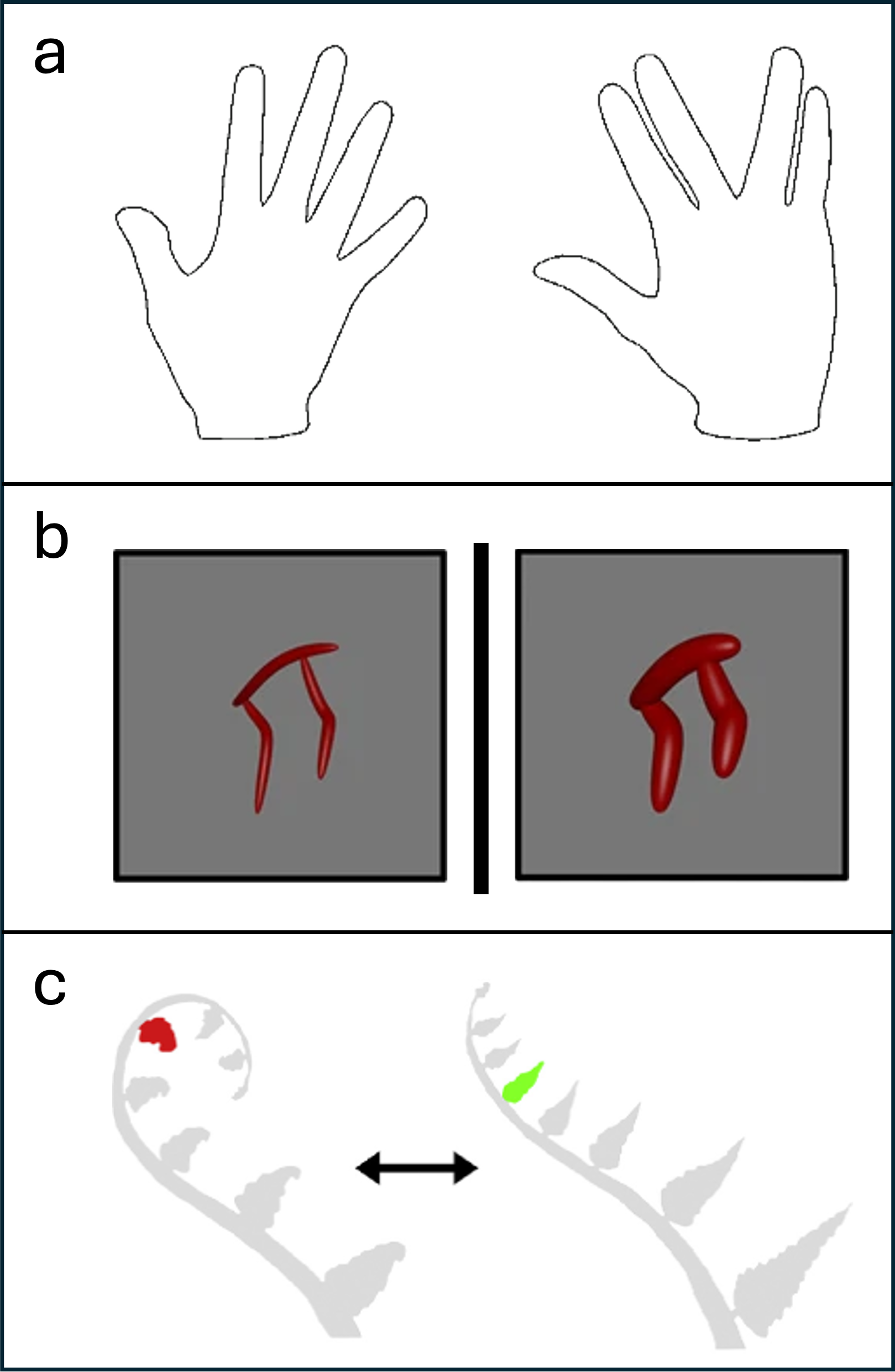
(a) Thanks to Chaz Firestone for this figure. (b) Source: Ayzenberg and Lourenco (2019). Reproduced under the Creative Commons Attribution 4.0 International License. (c) Source: Schmidt and Fleming (2016). Reproduced under the Creative Commons CC-BY-NC-ND license.
Questions, controversies, and new developments
There is significant disagreement surrounding the computational mechanisms responsible for perceptual constancy capacities. There are also controversies concerning the completeness of constancy, the role of constancy in perceptual experience, and its position along the perception–cognition border. Further disputes of significant interest to cognitive scientists involve the neural mechanisms underlying constancy (e.g., whether shape constancy is based in ventral or dorsal subsystems; Ayzenberg & Behrmann, 2022) and the kinds of representational structures responsible for constancy capacities (Todd & Petrov, 2022).
Is constancy complete or partial?
In a series of influential experiments, participants were shown a cardboard circle at various slants and asked either to draw the shape as it appeared from their perspective or to select the ellipse viewed head-on that best matched the apparent shape of the circle (Thouless, 1931). The question was whether subjects would select a perfect circle (showing complete constancy) or instead a flattened ellipse approximating the object’s retinal projection (showing a total absence of constancy). Interestingly, subjects’ responses fell between these extremes. Given a slanted circle, subjects tended to select a compressed ellipse but not one as compressed as the object’s retinal image. These results were taken to suggest that the perceived metric shape of a slanted object exhibits only partial constancy.
Subsequent studies have generally confirmed that the perception of metric shape exhibits underconstancy (i.e., inadequate compensation for compression within the 2D retinal image) with increasing distance or slant, insofar as objects are perceived as shorter in depth than they really are (Gilinsky, 1951; Norman et al., 1996). For example, subjects shown a rotating cylinder at various simulated distances were asked to judge whether the shape had a circular cross-section (i.e., was perfectly cylindrical) or was stretched or compressed along the depth axis (Johnston, 1991). For a shape to be deemed perfectly cylindrical at distances of 2 meters or more, it had to be elongated in depth, suggesting that its perceived shape became increasingly compressed. For a commonplace example of underconstancy in length perception, consider the appearance of dashed lines on a roadway. Although these lines are 10 feet long in the United States, the average driver estimates them to be only about 2 feet (Shaffer et al., 2008). In light of such findings, it has been suggested that visual space becomes increasingly compressed relative to physical space at greater distances (Hatfield, 2009, pp. 201–203).
Nonetheless, it has been argued that studies claiming to find imperfect shape constancy are flawed or, at best, nonrepresentative of shape perception with more naturalistic stimuli. For example, some have argued that ellipses should not be used in the study of shape constancy because of their geometrical simplicity (Pizlo, 2008, pp. 16–20). These theorists contend that more complex shapes are perceived veridically across changes in orientation by applying principles requiring the maximization of properties like symmetry or compactness (roughly, how much volume an object packs within a given surface area; Li et al., 2009). A prediction of this model is that metric shape constancy should be virtually perfect for mirror-symmetric 3D objects with planar faces (see Figure 3). It is controversial whether this is true, with certain studies finding support for the prediction (Li et al., 2009) and others finding that even planar, mirror-symmetric objects elicit increasing underconstancy at greater distances (Yu et al., 2021).
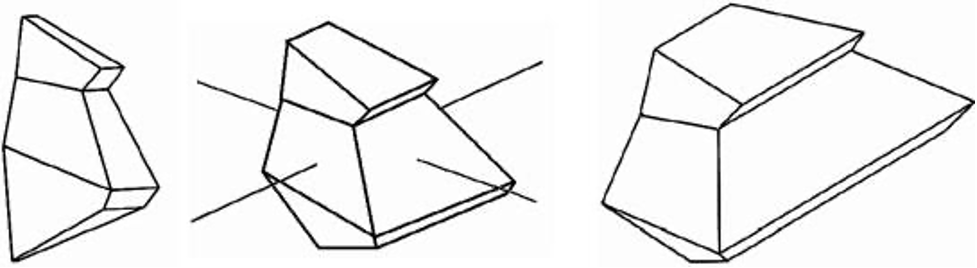
Examples of planar, mirror-symmetric 3D shapes used in some recent studies of shape constancy. Reprinted from “A Computational Model That Recovers the 3D Shape of an Object From a Single 2D Retinal Representation” by Li et al. (2009) with permission from Elsevier.
Constancy and perceptual experience
A second controversy concerns the role of constancy in conscious perceptual experience. Although constancy involves stability in the representation of worldly properties despite changes in proximal stimulation, one’s perceptual experience of an object generally does not remain wholly stable through these changes. Rather, experience is systematically altered by changes in viewpoint on an object or the circumstances under which it is perceived. In this sense, perceptual experience has a perspectival character that shifts with changes in perspective (Cohen, 2010; Green & Schellenberg, 2018; Lande, 2018).
For example, it has been suggested that when a coin is slanted relative to your viewpoint (Figure 4), it looks elliptical rather than circular (Broad, 1923, chapter 8). Taking these reports at face value, one might be tempted to conclude that constancy is simply absent from experience. Instead, perceptual experiences of size and shape are tied to the retinal images that objects project or the visual angles they subtend.

(Left) A coin viewed head-on and (right) at a slant.
Faced with these challenges, defenders of perceptual constancy have three options. First, they can concede that constancy is absent from conscious experience but maintain that constancies are computed unconsciously and used to guide recognition or behavior. Second, they can reject the phenomenological observations and maintain that experiences of size and shape are wholly unaffected by changes in perspective. The slanted penny does not “look elliptical” in any way; it just looks circular and slanted (Schwitzgebel, 2006, p. 590). An initial problem with this option is that the perceptual similarity between the slanted coin and a head-on ellipse has been found to impact performance on perceptual tasks such as visual search (Morales et al., 2020), and information about such perspectival shapes can be decoded from neural responses throughout the visual system (Lin et al., 2024). The third option is to grant the above phenomenological claims (e.g., that in some sense, the table looks smaller at greater distances) but argue that they are compatible with constancies also being present within experience. Let’s explore the third option.
Although it is hard to deny that there is some perceptual similarity between a slanted penny and a head-on ellipse, it is equally hard to deny that there is a sense in which the slanted penny simply appears circular. Likewise, as you recede from the table, there is a sense in which it looks smaller but also a sense in which it appears to remain the same size. These perceptual situations give rise to both a constancy reaction, wherein the object continues to look the same regarding some worldly property, and a coexisting inconstancy reaction, wherein one perceives the object differently across changing conditions (Cohen, 2010). The constancy reaction can be explained by the fact that perception continues to represent the object as having approximately the same worldly property. The trickier issue is how to explain the inconstancy reaction.
Some have argued that the inconstancy reaction can be explained by the perceptual representation of relational properties of objects which are in fact altered by variation in perspective (Cohen, 2010; Schellenberg, 2008). In the case of the slanted coin, perhaps perception represents the shape that it would project onto the frontoparallel plane (Noë, 2004, p. 84) or the solid angle it subtends (Jagnow, 2012, p. 242). Others have argued that perspectival character is not to be explained by the perceptual representation of relational properties but rather by the ways in which perception represents an object’s shape or size given one’s perspective. For example, the slanted coin and the head-on ellipse might be represented as having different shapes, but the vehicles responsible for representing them have structural features in common (Lande, 2018). Finally, some have suggested that perspectival character is to be explained by purely sensational aspects of experience distinct from their representational contents, such as awareness of mind-dependent sense data (Broad, 1923).
Perception or cognition?
A related issue concerns whether perceptual constancy is genuinely perceptual, an achievement of postperceptual cognition, or some amalgam of the two. It should be noted that the answer to this question may vary depending on the kind of constancy under consideration. Some constancies might be fully achieved in perception, whereas others depend critically on postperceptual judgment and inference.
There are strong reasons to reject any purely postperceptual view of constancy (see also Cohen, 2015, pp. 632–634). First, constancy has been found to impact paradigmatically perceptual processes such as visual search (Aks & Enns, 1996) and apparent motion perception (Hein & Moore, 2014). Moreover, neurons as early as primary visual cortex exhibit lightness constancy, remaining invariant across changes in illumination (MacEvoy & Paradiso, 2001). Finally, a substantial component of color constancy can be explained by adaptation at the level of retinal cones, which adjust their sensitivity in response to changes in background illumination (Rinner & Gegenfurtner, 2000). As such, it is unlikely that constancy mechanisms operate purely at postperceptual stages.
A more controversial question concerns how much constancy is achieved within perception and how much is contributed by postperceptual cognition. Size constancy offers an interesting case study of this issue. Visual perception exhibits nearly perfect size constancy for objects up to three meters away, after which size perception becomes increasingly underconstant (Granrud, 2009). However, older children and adults have acquired cognitive strategies to compensate for this perceptual underconstancy, deliberately inflating size judgments for more distant objects. This is shown by the fact that when children are given apparent instructions (to indicate how large the object looks) rather than objective instructions (to indicate how large the object really is), size underestimation occurs regardless of children’s level of knowledge about how size appearance relates to viewing distance. Hence, across all ages, perception may underestimate the sizes of distant objects, but these failures of perceptual constancy can be partially corrected at the level of cognition (Granrud, 2009).
Broader connections
Perceptual constancy plays a pivotal role in various debates within cognitive science. One contentious issue concerns how well contemporary deep neural network models approximate human perception. Biological vision is tolerant to changes in the circumstances in which distal properties are encountered, recovering stable shapes, sizes, and colors across changes in viewpoint, texture, distance, and lighting. A natural question is whether networks optimized for object recognition automatically produce this sort of invariance, as one might expect given evidence that activation patterns within the intermediate layers of deep neural networks predict neural activity within various areas of the primate visual system (Yamins et al., 2014). However, studies indicate that networks meeting impressive recognition benchmarks, such as AlexNet, may fail to form shape representations that remain invariant across changes in texture or contour noise (Baker et al., 2020). Thus, a central question in artificial vision research concerns why networks that match or exceed human recognition performance on natural images nonetheless fall short of human perception in recovering stable properties across changes in perceptual conditions (Bowers et al., 2023).
Constancy also relates to foundational questions about the influences of learning, language, and enculturation on mature perceptual capacities (Segall et al., 1963). Studies have examined the developmental trajectory of various constancy capacities, revealing tendencies toward shape and color constancy in infancy (Slater & Morison, 1985; Yang et al., 2013) and shape constancy in newly hatched chicks (Wood & Wood, 2020). Nonetheless, such findings do not preclude the view that constancy capacities are shaped through learning and language acquisition (e.g., Maule et al., 2023) [see Perceptual Learning; Language Acquisition].
Constancy also figures centrally in philosophical debates about the nature of mental representation [see Mental Representation]. A longstanding problem concerns how the mind manages to represent entities beyond itself. How does the concept DOG—a mental representation implemented somewhere in the brain—come to represent the class of dogs out in the world? In answering this question, philosophers have often appealed to tracking relations, such as causation or correlation, between the representation and its content. However, such tracking-based theories of representation face the problem that any deployment of a mental representation is caused by many things, including both a distal object and a pattern of proximal stimulation. The problem of distal content is, roughly, that of explaining why mental representations encode distal objects and properties rather than some proximal alternatives, such as the light reaching the retina (Neander, 2017, pp. 217–221).
The problem of distal content arises for perception. Perceptual representations typically represent distal objects and properties rather than their more proximal causes, and theorists have considered why this is so. One influential suggestion is that constancy mechanisms produce perceptual representations that carry more information about a worldly property than about any proximal alternative (Dretske, 1981, pp. 157–168). If the perceptual representation of cubicality occurs across varying patterns of proximal stimulation, then it raises the probability of a cube significantly more than the probability of any 2D retinal shape, favoring “cube” as the content of the representation. Subsequent theorists have adapted this insight that constancy mechanisms are important to explaining capacities for perceptual representation of the distal world (Schulte, 2018), with some even speculating that perceptual constancy is both necessary and sufficient for perceptual representation (Burge, 2010, p. 413). However, these more ambitious claims remain controversial (Ganson et al., 2014; Green, 2024).
Further reading
Cohen, J. (2015). Perceptual constancy. In M. Matthen (Ed.), Oxford handbook of philosophy of perception (pp. 621-639). Oxford University Press.
Foster, D. H. (2011). Color constancy. Vision Research, 51(7), 674-700. https://doi.org/10.1016/j.visres.2010.09.006
Hatfield, G., & Allred, S. (Eds.). (2012). Visual experience: Sensation, cognition, and constancy. Oxford University Press.
References
Aks, D. J., & Enns, J. T. (1996). Visual search for size is influenced by a background texture gradient. Journal of Experimental Psychology: Human Perception and Performance, 22(6), 1467-1481. https://doi.org/10.1037/0096-1523.22.6.1467
↩al-Haytham, I. (1989). The optics of Ibn al-Haytham, books I–III (A. I. Sabra, Trans.). Warburg Institute. (Original work published 1030)
↩Ayzenberg, V., & Behrmann, M. (2022). Does the brain’s ventral visual pathway compute object shape? Trends in Cognitive Sciences, 26(12), 1119-1132. https://doi.org/10.1016/j.tics.2022.09.019
↩Ayzenberg, V., & Lourenco, S. (2022). Perception of an object’s global shape is best described by a model of skeletal structure in human infants. eLife, 11, e74943. https://doi.org/10.7554/eLife.74943
↩Baker, N., Lu, H., Erlikhman, G., & Kellman, P. J. (2020). Local features and global shape information in object classification by deep convolutional neural networks. Vision Research, 172, 46-61. https://doi.org/10.1016/j.visres.2020.04.003
↩Berkeley, G. (1965). Essay towards a new theory of vision. In D. M. Armstrong (Ed.), Berkeley’s philosophical writings. Collier Books. (Original work published 1709)
↩Boring, E. G. (1942). Sensation and perception in the history of experimental psychology. Appleton-Century-Crofts.
↩Bowers, J. S., Malhotra, G., Dujmović, M., Montero, M. L., Tsvetkov, C., Biscione, V., Puebla, G., Adolfi, F., Hummel, J. E., Heaton, R. F., Evans, B. D., Mitchell, J., & Blything, R. (2023). Deep problems with neural network models of human vision. Behavioral and Brain Sciences, 46, e385. https://doi.org/10.1017/S0140525X22002813
↩Brainard, D. H., Longère, P., Delahunt, P. B., Freeman, W. T., Kraft, J. M., & Xiao, B. (2006). Bayesian model of human color constancy. Journal of Vision, 6(11), 1267-1281. https://doi.org/10.1167/6.11.10
↩Broad, C. D. (1923). Scientific thought. Harcourt, Brace, and Company.
↩Burge, T. (2010). Origins of objectivity. Oxford University Press.
↩Byrne, A., & Hilbert, D. R. (2003). Color realism and color science. Behavioral and Brain Sciences, 26(1), 3-21. https://doi.org/10.1017/s0140525x03000013
↩Cohen, J. (2010). Perception and computation. Philosophical Issues, 20(1), 96-124. https://doi.org/10.1111/j.1533-6077.2010.00185.x
↩Cohen, J. (2015). Perceptual constancy. In M. Matthen (Ed.), Oxford handbook of philosophy of perception (pp. 621-639). Oxford University Press.
↩Davies, W. (2022). The paradox of colour constancy: Plotting the lower borders of perception. Noûs, 56(4), 787-813. https://doi.org/10.1111/nous.12386
↩Descartes, R. (1637/2001). Discourse on method, optics, geometry, and meteorology. (P. J. Olscamp, Trans.). Hackett Publishing Company. (Original work published 1637)
↩Destler, N., Singh, M., & Feldman, J. (2023). Skeleton-based shape similarity. Psychological Review, 130(6), 1653-1671. https://doi.org/10.1037/rev0000412
↩Dretske, F. I. (1981). Knowledge and the flow of information. MIT Press.
↩Epstein, W., & Park, J. N. (1963). Shape constancy: Functional relationships and theoretical formulations. Psychological Bulletin, 60(3), 265-288. https://doi.org/10.1037/h0040875
↩Foster, D. H. (2011). Color constancy. Vision Research, 51(7), 674-700. https://doi.org/10.1016/j.visres.2010.09.006
↩Foster, D. H., & Nascimento, S. M. (1994). Relational colour constancy from invariant cone-excitation ratios. Proceedings of the Royal Society of London Series B: Biological Sciences, 257(1349), 115-121. https://doi.org/10.1098/rspb.1994.0103
↩Ganson, T., Bronner, B., & Kerr, A. (2014). Burge’s defense of perceptual content. Philosophy and Phenomenological Research, 88(3), 556-573. https://doi.org/10.1111/j.1933-1592.2012.00632.x
↩Gibson, J. J. (1979). The ecological approach to visual perception. Houghton Mifflin.
↩Gilinsky, A. S. (1951). Perceived size and distance in visual space. Psychological Review, 58(6), 460-482. https://doi.org/10.1037/h0061505
↩Granrud, C. E. (2009). Development of size constancy in children: A test of the metacognitive theory. Attention, Perception, & Psychophysics, 71(3), 644-654. https://doi.org/10.3758/APP.71.3.644
↩Green, E. J. (2024). Perceptual constancy and perceptual representation. Analytic Philosophy, 65(4), 473-513. https://doi.org/10.1111/phib.12293
↩Green, E. J. (2026). A pluralist perspective on shape constancy. The British Journal for the Philosophy of Science, 77(3). https://doi.org/10.1086/727427
↩Green, E. J., & Schellenberg, S. (2018). Spatial perception: The perspectival aspect of perception. Philosophy Compass, 13(2), e12472. https://doi.org/10.1111/phc3.12472
↩Hatfield, G. (2009). Perception and cognition. Oxford University Press.
↩Hein, E., & Moore, C. M. (2014). Evidence for scene-based motion correspondence. Attention, Perception, & Psychophysics, 76(3), 793-804. https://doi.org/10.3758/s13414-013-0616-9
↩Hilbert, D. (2012). Constancy, content, and inference. In G. Hatfield & S. Allred (eds.), Visual experience: Sensation, cognition, and constancy (pp. 199-211). Oxford University Press.
↩Howard, I. P. (1996). Alhazen’s neglected discoveries of visual phenomena. Perception, 25(10), 1203-1217. https://doi.org/10.1068/p251203
↩Hume, D. (2000). An enquiry concerning human understanding (T. L. Beauchamp, Ed.). Oxford University Press. (Original work published 1748)
↩Jagnow, R. (2012). Representationalism and the perspectival character of perceptual experience. Philosophical Studies, 157(2), 227–249. https://doi.org/10.1007/s11098-010-9634-9
↩Johnston, E. B. (1991). Systematic distortions of shape from stereopsis. Vision Research, 31(7-8), 1351-1360. https://doi.org/10.1016/0042-6989(91)90056-B
↩Kentridge, R. W., Heywood, C. A., & Cowey, A. (2004). Chromatic edges, surfaces and constancies in cerebral achromatopsia. Neuropsychologia, 42(6), 821-830. https://doi.org/10.1016/j.neuropsychologia.2003.11.002
↩Koffka, K. (1935). Principles of Gestalt psychology. Harcourt, Brace, and Company.
↩Land, E. H. (1977). The retinex theory of color vision. Scientific American, 237(6), 108-128. https://doi.org/10.1038/scientificamerican1277-108
↩Lande, K. J. (2018). The perspectival character of perception. Journal of Philosophy, 115(4), 187-214. https://doi.org/10.5840/jphil2018115413
↩Li, Y., Pizlo, Z., & Steinman, R. M. (2009). A computational model that recovers the 3D shape of an object from a single 2D retinal representation. Vision Research, 49(9), 979-991. https://doi.org/10.1016/j.visres.2008.05.013
↩Lin, Y., Hsu, Y. Y., Cheng, T., Hsiung, P. C., Wu, C. W., & Hsieh, P. J. (2024). Neural representations of perspectival shapes and attentional effects: Evidence from fMRI and MEG. Cortex, 176, 129-143. https://doi.org/10.1016/j.cortex.2024.04.003
↩Locke, J. (1975). An essay concerning human understanding (P. H. Nidditch, Ed.). Oxford University Press. (Original work published 1694)
↩Lowet, A. S., Firestone, C., & Scholl, B. J. (2018). Seeing structure: Shape skeletons modulate perceived similarity. Attention, Perception, & Psychophysics, 80(5), 1278-1289. https://doi.org/10.3758/s13414-017-1457-8
↩MacEvoy, S. P., & Paradiso, M. A. (2001). Lightness constancy in primary visual cortex. Proceedings of the National Academy of Sciences, 98(15), 8827-8831. https://doi.org/10.1073/pnas.161280398
↩Marr, D. (1982). Vision: A computational investigation into the human representation and processing of visual information. W. H. Freeman.
↩Maule, J., Skelton, A. E., & Franklin, A. (2023). The development of color perception and cognition. Annual Review of Psychology, 74(1), 87-111. https://doi.org/10.1146/annurev-psych-032720-040512
↩Morales, J., Bax, A., & Firestone, C. (2020). Sustained representation of perspectival shape. Proceedings of the National Academy of Sciences, 117(26), 14873-14882. https://doi.org/10.1073/pnas.2000715117
↩Neander, K. (2017). A mark of the mental: In defense of informational teleosemantics. MIT Press.
↩Noë, A. (2004). Action in perception. MIT Press.
↩Norman, J. F., Todd, J. T., Perotti, V. J., & Tittle, J. S. (1996). The visual perception of three-dimensional length. Journal of Experimental Psychology: Human Perception and Performance, 22(1), 173-186. https://doi.org/10.1037//0096-1523.22.1.173
↩Pizlo, Z. (2008). 3D shape: Its unique place in visual perception. MIT Press.
↩Rinner, O., & Gegenfurtner, K. R. (2000). Time course of chromatic adaptation for color appearance and discrimination. Vision Research, 40(14), 1813-1826. https://doi.org/10.1016/s0042-6989(00)00050-x
↩Schellenberg, S. (2008). The situation-dependency of perception. Journal of Philosophy, 105(2), 55-84. https://doi.org/10.5840/jphil200810525
↩Schulte, P. (2018). Perceiving the world outside: How to solve the distality problem for informational teleosemantics. The Philosophical Quarterly, 68(271), 349-369. https://doi.org/10.1093/pq/pqx052
↩Schwitzgebel, E. (2006). Do things look flat? Philosophy and Phenomenological Research, 72(3), 589-599. https://doi.org/10.1111/j.1933-1592.2006.tb00585.x
↩Segall, M. H., Campbell, D. T., & Herskovits, M. J. (1963). Cultural differences in the perception of geometric illusions. Science, 139(3556), 769-771. https://doi.org/10.1126/science.139.3556.769
↩Shaffer, D. M., Maynor, A. B., & Roy, W. L. (2008). The visual perception of lines on the road. Perception & Psychophysics, 70(8), 1571-1580. https://doi.org/10.3758/PP.70.8.1571
↩Slater, A., & Morison, V. (1985). Shape constancy and slant perception at birth. Perception, 14(3), 337-344. https://doi.org/10.1068/p140337
↩Thouless, R. H. (1931). Phenomenal regression to the real object. I. British Journal of Psychology, 21, 339-359.
↩Todd, J. T., & Petrov, A. A. (2022). The many facets of shape. Journal of Vision, 22(1), 1-30. https://doi.org/10.1167/jov.22.1.1
↩Ullman, S. (1980). Against direct perception. Behavioral and Brain Sciences, 3(3), 373-415. https://doi.org/10.1017/S0140525X0000546X
↩von Helmholtz, H. (1962). Helmholtz’s treatise on physiological optics. Dover. (Original work published 1867)
↩Wood, J. N., & Wood, S. M. (2020). One-shot learning of view-invariant object representations in newborn chicks. Cognition, 199, 104192. https://doi.org/10.1016/j.cognition.2020.104192
↩Yamins, D. L., Hong, H., Cadieu, C. F., Solomon, E. A., Seibert, D., & DiCarlo, J. J. (2014). Performance-optimized hierarchical models predict neural responses in higher visual cortex. Proceedings of the National Academy of Sciences, 111(23), 8619-8624. https://doi.org/10.1073/pnas.1403112111
↩Yang, J., Kanazawa, S., Yamaguchi, M. K., & Kuriki, I. (2013). Investigation of color constancy in 4.5-month-old infants under a strict control of luminance contrast for individual participants. Journal of Experimental Child Psychology, 115(1), 126-136. https://doi.org/10.1016/j.jecp.2012.11.013
↩Yu, Y., Todd, J. T., & Petrov, A. A. (2021). Failures of stereoscopic shape constancy over changes of viewing distance and size for bilaterally symmetric polyhedral. Journal of Vision, 21(6), 5. https://doi.org/10.1167/jov.21.6.5
↩