Vagueness, in its broadest sense, refers to the uncertainty present in various representations. A vague memory of a trip signifies uncertainty of what the trip involved or whether it even happened. A vague feeling that it will rain is an uncertain anticipation of that event. A vague answer is an utterance that does not settle a question, and a vague estimate is the result of an imprecise measurement. One kind of vagueness particularly prominent in cognitive science is lexical vagueness, which concerns uncertainty about lexical meaning. A sentence like, “Mary has 11 siblings,” has a precise meaning: to establish whether it is true or false, it suffices to count Mary’s siblings and to verify whether the total is 11. By contrast, a sentence like, “Mary has many siblings,” only has a vague meaning: “many” does not refer to any explicit number, and even after counting, it can remain unclear whether the sentence is true or false. Vague words are omnipresent in language, and they include gradable adjectives (like “tall,” “old,” and “beautiful”) but also verbs (“love” and “hate”) and nouns (“heap,” “game,” and “justice”), which all lack precise definition. A challenge is to explain how vague words can be informative when their meaning is uncertain.
History
The identification of vagueness dates back to the ancient Greeks, who recognized that a word like “heap” applied to grains means something like “many grains piled up” and who showed that vague terms have elusive boundaries. The paradox of the heap, or sorites (after soros, meaning heap in Greek, and attributed to Eubulides of Miletus who lived around 400 BCE), is the observation that the following three intuitively true judgments are contradictory:
Ten thousand grains make a heap.
If a collection of n grains makes a heap, then just adding or removing one grain will not change its status.
One grain does not make a heap.
By mathematical induction (technically, successive applications of modus ponens), judgments one and two should entail that a collection of one grain makes a heap, contradicting judgment three. Vague terms are often characterized as prone to soritical reasoning of this kind (Égré et al., 2019; Smith, 2008; Wright, 1976), and a problem is to explain on what basis vague words entitle one to draw boundaries when those do not seem to be part of their meaning [see Word Meaning].
Around 1900, some pioneers of statistical reasoning like Charles Peirce and Émile Borel got interested in vagueness. Peirce (1902) characterized vagueness as a form of uncertainty inherent in the meaning of vague words. Borel (1907/2014) described vague words as leaving room for variability in their application across speakers, viewing questions pertaining to the applicability of words like “heap” as “badly put, if one requires a yes or no answer.” He argued that probability is needed to represent vagueness and proposed a Gaussian model of categorization, trading discontinuous step functions for smooth sigmoid judgment curves (see Figure 1). Similar ideas were proposed later in fuzzy logic (using degrees of truth instead of probabilities; Zadeh, 1975) and in cognitive psychology, with different authors arguing that the structure of vague concepts is a matter of gradient similarity rather than categorical membership (Hampton, 1979; Hersh & Caramazza, 1976; McCloskey & Glucksberg, 1978; Rosch & Mervis, 1975, drawing on remarks by Wittgenstein, 1953).
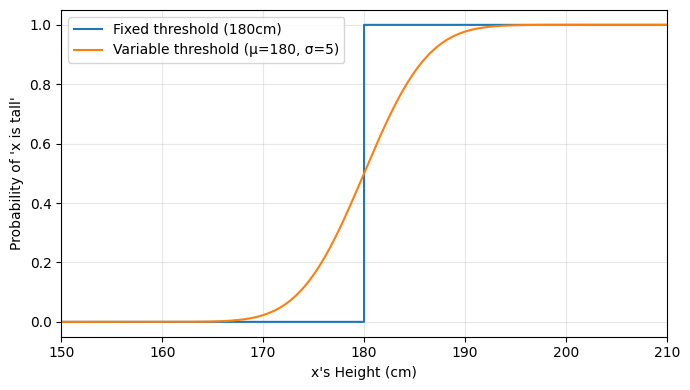
Step function (fixed threshold) versus sigmoid (variable threshold) for “tall.” The sigmoid can be obtained by computing the probability that x’s height exceed a variable threshold, drawn from a Gaussian density centered on 180 with SD = 5.
Concurrently, philosophers and linguists developed various semantic frameworks to deal with indeterminacy about meaning (Fine, 1975; Kamp & Partee, 1995) and to solve the sorites paradox (Cobreros et al., 2012; van Rooij, 2011). Recent years have witnessed combined efforts of cognitive scientists, philosophers, and linguists to clarify how vague expressions can be informative despite lacking determinate boundaries (Lassiter & Goodman, 2017), to characterize the relation between prototypicality and membership in vague categories (Douven, 2016; Verheyen & Égré, 2018), and to give a fine-grained typology of gradable expressions (Burnett, 2017; Kennedy, 2007; Leffel et al., 2019; Qing & Franke, 2014).
Core concepts
Borderline cases
The vagueness of a term is often manifested by the existence of so-called borderline cases of application, namely uncertain or doubtful cases giving rise to competing verdicts and ambivalent judgments. For example, whether a male adult with a height of 180 cm should be called tall or not has no absolute answer (Burnett, 2017; Kennedy, 2007). Whether a receptacle is a vase or a bowl can be unclear (Douven, 2016; Labov, 1975). And although a car is clearly and unambiguously called a vehicle, whether an elevator counts as a vehicle or not gives rise to between-subject disagreement and within-subject inconsistencies (McCloskey & Glucksberg, 1978).
Ambiguity
Lexical vagueness is a form of ambiguity; there is a one-many relation between a vague expression and the various more precise ways of interpreting it (Fine, 1975; Kamp & Partee, 1995; Russell, 1923). However, the different precise interpretations of a vague word are closely connected in conceptual space (compare “taller than 185 cm” and “taller than 186 cm” as ways of interpreting “tall”), whereas those of a lexically ambiguous word are usually distant and unrelated (compare the two separate meanings of the word form “bat,” as a baseball bat and as an animal bat; see Dautriche & Chemla, 2016).
Open meaning
Lexical vagueness can be characterized in terms of open meaning. The vague adjective “tall” can be taken to mean “whose height exceeds t,” in which t is an open threshold parameter. Compare with “taller than 173 cm,” which fixes the value of this parameter. The effect produced by a vague expression on interpretation differs from that of a precise expression accordingly, and one can model those in a Bayesian framework (Égré et al., 2023; Lassiter & Goodman, 2017). When learning that someone is taller than 173 cm, one categorically eliminates all heights below 173 cm. However, when learning that someone is tall, one does not eliminate any heights proper—instead one puts more probability on greater heights than one’s prior had it initially.
Multidimensionality
Vagueness concerns not just threshold setting but also how definitional features are selected and weighed against each other, particularly for multidimensional terms (consider a term like “good” as applied to a specific sport or “intelligent” as applied to behavior, both of which leave open which specific qualities matter and how to aggregate them to produce a coherent metric; see Alston, 1964 and Burks, 1946, who talk of multidimensional vagueness and combination vagueness, respectively).
Subjectivity
Vague meaning is very often subjective, leaving room for permissible disagreement (Raffman, 2014; Wright, 1995), as different individuals can set the definitional criteria and the threshold parameters of a vague word to different values. For example, who counts as “old” will vary depending on whether it is judged by a 16-year-old or by a 50-year-old person (Wettstein et al., 2024), and who counts as “tall” is partly influenced by one’s own height or by what height one views as ideal (Verheyen et al., 2018).
Questions, controversies, and new developments
Vagueness has multiple sources. One source is semantic, holding that vague expressions inherently have open meanings (Fine, 1975; Peirce, 1902). Another source is epistemic and concerns imperfect discrimination, which can explain soritical phenomena (Luce, 1956; Williamson, 1994). A third view, of lesser influence in cognitive science, argues that vagueness also concerns the world and not just our representations (this view is called ontic vagueness; Akiba, 2004).
On the representational side, some authors view vagueness fundamentally as a form of ignorance of determinate boundaries (viz., Williamson, 1994); this view, called epistemicism about vagueness, is controversial because it assumes that there is a fact of the matter as to whether someone is tall (Wright, 1995). However, there are good reasons to think that the best description of lexical vagueness is a combination of semantic and epistemic factors. Consider a sentence like “Safia is tall”; the judgment will typically involve a joint probability distribution on Safia’s height and on the open threshold for “tall.” In addition, a central but easily overlooked distinction concerns semantic versus pragmatic vagueness; an expression like “two or four or six” expresses uncertainty regarding which of these numbers hold, but semantically, it is not vague—it has precise truth conditions. An expression like “many” is semantically vague because its truth conditions involve a random variable absent from the former (Égré et al., 2023).
Two central questions about vagueness are: (1) How can vague expressions be informative if they lack determinate boundaries? (2) What is the function of vague words in language? A Bayesian answer to question one is that a vague proposition like “Safia is tall” can modify one’s interlocutor’s prior on Safia’s height, even if it does not allow the interlocutor to locate Safia’s height precisely (Lassiter & Goodman, 2017) [see Bayesianism]. A functionalist answer to question two is that vague words not only allow speakers to remain truthful when they are uncertain but also allow them to communicate probabilistic information in a way that is not explicitly probabilistic (see Égré et al., 2023, who contrasts “around 70” to what would be a complete description of a probability distribution centered on 70). Relatedly, the use of categories with flexible boundaries may present advantages in terms of adaptation for learning and for generalization (Barner & Snedeker, 2008; Hahn & Chater, 1998).
Broader connections
With the success of classification models in artificial intelligence, it is instructive to look at how machine learning and deep learning techniques establish membership for categories defined from exemplars rather than from explicit definitions. Consider a classification algorithm for images of plants that uses supervised learning techniques. The model is first trained on labeled images of plants to associate to each new image a probability of class membership, based on the minimization of a cost function. The intermediate layers of the model extract features in images, and then the final layer produces a score for each class (the logit), which is converted to a probability distribution—similarly to what happens with multinomial logistic regression (see Figure 2 for a toy illustration involving just two classes and Molnar, 2025, chapter 7 for an introduction). Usually, the class with the highest probability provides the label assigned to the new exemplar. Practically, however, vagueness remains present at different levels. It recurs in case of ties or close scores between different classes; it also arises when the most probable class itself has a very low probability so that the new exemplar does not appear to correspond to any pre-existing category (this is known as the problem of open texture; see Waismann, 1945). Finally, even in the case of just two classes (see Figure 2), membership decisions are relative to the choice of a threshold for probabilities, whose setting partly depends on utility considerations. Similar vagueness issues can arise, mutatis mutandis, for clustering methods used in unsupervised learning.
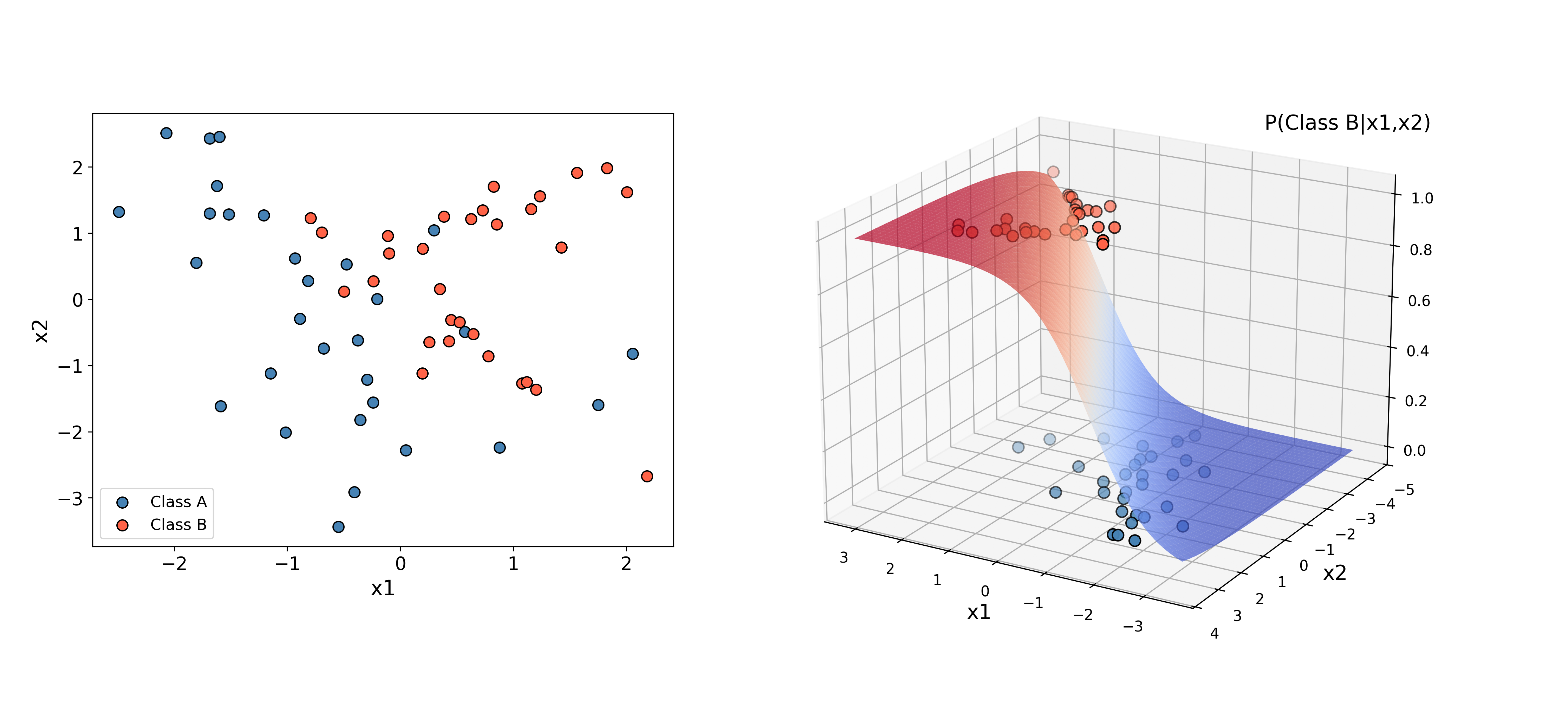
An example of a binary classification problem involving two variables (left), with logistic regression estimating the probability of membership in one of the two classes (right).
Acknowledgments
The author would like to thank Asifa Majid for very helpful comments and Melbourne University (Department of Electrical and Electronic Engineering), Monash University (Philosophy Department), the PLEXUS network (Grant 101086295), and the program TRUSTEDNEWS (ANR-25-ASM2-0003-01) for support.
Further reading
Burks, A. W. (1946). Empiricism and vagueness. The Journal of Philosophy, 43(18), 477-486. https://doi.org/10.2307/2018954
Douven, I. (2016). Vagueness, graded membership, and conceptual spaces. Cognition, 151, 80-95. https://doi.org/10.1016/j.cognition.2016.03.007
Égré, P., Spector, B., Mortier, A., & Verheyen, S. (2023). On the optimality of vagueness: “around,” “between” and the Gricean maxims. Linguistics and Philosophy, 46(5), 1075-1130. https://doi.org/10.1007/s10988-022-09379-6
Lassiter, D., & Goodman, N. D. (2017). Adjectival vagueness in a Bayesian model of interpretation. Synthese, 194(10), 3801-3836. https://doi.org/10.1007/s11229-015-0786-1
References
Akiba, K. (2004). Vagueness in the world. Noûs, 38(3), 407-429. https://doi.org/10.1111/j.0029-4624.2004.00476.x
↩Alston, W. (1964). Philosophy of language. Prentice-Hall.
↩Barner, D., & Snedeker, J. (2008). Compositionality and statistics in adjective acquisition: 4-year-olds interpret tall and short based on the size distributions of novel noun referents. Child Development, 79(3), 594-608. https://doi.org/10.1111/j.1467-8624.2008.01145.x.
↩Borel, É. (2014). An economic paradox: The sophism of the heap of wheat and statistical truths. Erkenntnis, 79(Suppl 5), 1081-1088. https://doi.org/10.1007/s10670-014-9615-z (Original work published 1907)
↩Burks, A. W. (1946). Empiricism and vagueness. The Journal of Philosophy, 43(18), 477-486. https://doi.org/10.2307/2018954
↩Burnett, H. (2017). Gradability in natural language: Logical and grammatical foundations. Oxford University Press.
↩Cobreros, P., Egré, P., Ripley, D., & Van Rooij, R. (2012). Tolerant, classical, strict. Journal of Philosophical Logic, 41(2), 347-385. https://doi.org/10.1007/s10992-010-9165-z
↩Dautriche, I., & Chemla, E. (2016). What homophones say about words. PLoS One, 11(9), e0162176. https://doi.org/10.1371/journal.pone.0162176
↩Douven, I. (2016). Vagueness, graded membership, and conceptual spaces. Cognition, 151, 80-95. https://doi.org/10.1016/j.cognition.2016.03.007
↩Égré, P., Ripley, E., & Verheyen, S. (2019). The sorites paradox in psychology. In S. Oms & E. Zardini (Eds.), The sorites paradox (pp. 263-286). Cambridge University Press.
↩Égré, P., Spector, B., Mortier, A., & Verheyen, S. (2023). On the optimality of vagueness: “around,” “between” and the Gricean maxims. Linguistics and Philosophy, 46(5), 1075-1130. https://doi.org/10.1007/s10988-022-09379-6
↩Fine, K. (1975). Vagueness, truth and logic. Synthese, 30(3-4), 265-300. https://doi.org/10.1007/bf00485047
↩Hahn, U., & Chater, N. (1998). Similarity and rules: Distinct? Exhaustive? Empirically distinguishable? Cognition, 65(2-3), 197-230. https://doi.org/10.1016/S0010-0277(97)00044-9
↩Hampton, J. A. (1979). Polymorphous concepts in semantic memory. Journal of Verbal Learning and Verbal Behavior, 18(4), 441-461. https://doi.org/10.1016/S0022-5371(79)90246-9
↩Hersh, H. M., & Caramazza, A. (1976). A fuzzy set approach to modifiers and vagueness in natural language. Journal of Experimental Psychology: General, 105(3), 254-276. https://doi.org/10.1037/0096-3445.105.3.254
↩Kamp, H., & Partee, B. (1995). Prototype theory and compositionality. Cognition, 57(2), 129-191. https://doi.org/10.1016/0010-0277(94)00659-9
↩Kennedy, C. (2007). Vagueness and grammar: The semantics of relative and absolute gradable adjectives. Linguistics and Philosophy, 30(1), 1-45. https://doi.org/10.1007/s10988-006-9008-0
↩Labov, W. (1975). The boundaries of words and their meanings. In C.-J. Bailey & R. Shuy (Eds.), New ways of analyzing variation in English (pp. 340-373). Georgetown University Press.
↩Lassiter, D., & Goodman, N. D. (2017). Adjectival vagueness in a Bayesian model of interpretation. Synthese, 194(10), 3801-3836. https://doi.org/10.1007/s11229-015-0786-1
↩Leffel, T., Cremers, A., Gotzner, N., & Romoli, J. (2019). Vagueness in implicature: The case of modified adjectives. Journal of Semantics, 36(2), 317-348. https://doi.org/10.1093/jos/ffy020
↩Luce, R. D. (1956). Semiorders and a theory of utility discrimination. Econometrica, 24(2), 178-191. https://doi.org/10.2307/1905751
↩McCloskey, M. E., & Glucksberg, S. (1978). Natural categories: Well defined or fuzzy sets? Memory & Cognition, 6(4), 462-472. https://doi.org/10.3758/BF03197480
↩Molnar, C. (2025). Interpretable machine learning: A guide for making black box models explainable (3rd ed.). Christoph Molnar.
↩Peirce, C. S. (1902). Vague. In C. Baldwin (Ed), Dictionary of philosophy and psychology (Vol. 2, p. 748). Macmillan.
↩Qing, C., & Franke, M. (2014). Gradable adjectives, vagueness, and optimal language use: A speaker-oriented model. In T. Snider, S. D’Antonio, & M. Weigand (Eds.), Proceedings of the 24th Semantics and Linguistic Theory Conference (pp. 23-41). Linguistic Society of America.
↩Raffman, D. (2014). Unruly words: A study of vague language. Oxford University Press.
↩Rosch, E., & Mervis, C. B. (1975). Family resemblances: Studies in the internal structure of categories. Cognitive Psychology, 7(4), 573-605. https://doi.org/10.1016/0010-0285(75)90024-9
↩Russell, B. (1923). Vagueness. Australasian Journal of Psychology and Philosophy, 1(2), 84-92. https://doi.org/10.1080/00048402308540623
↩Smith, N. J. J. (2008). Vagueness and degrees of truth. Oxford University Press.
↩van Rooij, R. (2011). Vagueness and linguistics. In G. Ronzitti (Ed.), Vagueness: A guide (pp. 123-170). Springer.
↩Verheyen, S., & Égré, P. (2018). Typicality and graded membership in dimensional adjectives. Cognitive Science, 42(7), 2250-2286. https://doi.org/10.1111/cogs.12649
↩Verheyen, S., Dewil, S., & Égré, P. (2018). Subjectivity in gradable adjectives: The case of tall and heavy. Mind & Language, 33(5), 460-479. https://doi.org/10.1111/mila.12184
↩Waismann, F. (1945). Symposium: Verifiability (Part II). Proceedings of the Aristotelian Society, 19, 119-150. https://doi.org/10.1093/aristoteliansupp/19.1.101
↩Wettstein, M., Park, R., Kornadt, A. E., Wurm, S., Ram, N., & Gerstorf, D. (2024). Postponing old age: Evidence for historical change toward a later perceived onset of old age. Psychology and Aging, 39(5), 526-541. https://doi.org/10.1037/pag0000812
↩Williamson, T. (1994). Vagueness. Routledge.
↩Wittgenstein, L. (1953). Philosophical investigations. Wiley Blackwell.
↩Wright, C. (1976). Language-mastery and the sorites paradox. In C. Wright (Ed.), The riddle of vagueness: Selected essays 1975-2020 (pp. 79-102). Oxford University Press.
↩Wright, C. (1995). The epistemic conception of vagueness. The Southern Journal of Philosophy, 33(Suppl 1), 133-160.
↩Zadeh, L. A. (1975). The concept of a linguistic variable and its application to approximate reasoning—I. Information Sciences, 8(3), 199-249. https://doi.org/10.1016/0020-0255(75)90036-5
↩