The phenomena that comprise emotions, moods, and affective states are united by their valence—their pleasantness or unpleasantness—such as the pleasure of seeing a baby laugh or the aversion to smelling feces. Beyond this broadly accepted defining characteristic, the researchers who study them have a multitude of ideas about how to best define their constructs, what shapes them, and the most promising path toward understanding them scientifically. For instance, many researchers agree that emotions should be distinguished from moods, but not all agree on the criteria that differentiate them. Similarly, some restrict the terms emotion and mood to instances in which subjective experience is evident (and thus to humans capable of subjective report), whereas others apply them more broadly (to nonhuman animals and human infants). Still others propose abandoning categories like emotion, arguing that they are not groups around which theories can be shaped. The rationales behind these conceptual disputes underscore the multifaceted complexity of these important but little-understood phenomena, as does their contrast with functions with more widely settled terminology such as memory. The concepts and terms used to describe affective phenomena carry important legal and ethical implications.
History
Many contemporary ideas about emotions and moods emerged in the 19th century [see Foundations of Emotion]. Before this period, the same phenomena were referred to with differentiated terms, including appetites, passions, affections, and sentiments (Dixon, 2003). Prior to this 19th century transition, these phenomena were the focus of many religious texts, in which discussions of their nature intertwined with discussions of moral responsibility. As one example, René Descartes defined passions as “perceptions or sensations of the soul” caused by “movement of the spirits.” He emphasized that passions were controllable (Descartes, 1649/2009). Descartes contemplated the number and types of passions and concluded there were six primary ones (wonder, love, hate, desire, joy, and sadness) and 41 altogether.
The modern category of emotion was created as part of the development of secularized psychology in the mid-1800s, when it came to encompass both feelings that were nonvoluntary and morally disengaged as well as those that were under voluntary control and moral scrutiny (Dixon, 2003). This notion of emotion is reflected in Charles Darwin’s work The Expression of the Emotions in Man and Animals (Darwin, 1872). In it, Darwin analyzed emotional behaviors like facial expressions, emphasizing their universal signatures across age, individuals, cultures, and even, in some instances, species.
In the same era, William James helped shape the nonsecular, umbrella category of emotion with his article, “What is an Emotion?” (James, 1884). James listed examples of emotion as rapture, fear, anger, lust, greed, surprise, and curiosity, showing that, despite differences in detail, his categorical boundaries of emotion largely retained the same general terms as used by Descartes. Although James’s ideas about emotions are best known in the context of their connection to bodily reactions (such as facial expressions), he acknowledged that not all emotions are accompanied by them, holding up the example of “intellectual delight to get a problem solved.”
In parallel to the secular development of emotion-related ideas, the mood disorder depression was reconceptualized. Prior to the mid-1800s, the condition was often called melancholia, and it was regarded as a disorder of the intellect and a form of partial insanity (Kendler, 2020). In the mid-1800s, the condition shifted to a disorder primarily of mood with other faculties intact. Around the same time, the term depression began to appear in medical textbooks, both to refer to the symptom of low mood as well as a condition that individuals are afflicted with (Berrios, 1988).
Today, the term affect is often used by researchers as an umbrella category superordinate to emotion and mood (American Psychological Association, n.d.-a). That usage dates back to the 1700s. During that era, Immanuel Kant and others categorized the mind into tripartite functions: cognition (knowing), affection (feeling), and conation (willing; Hilgard, 1980). A key feature that distinguishes affect from other mental functions (like cognition) is that affective states have a valence that can be pleasant or unpleasant. In the late 1800s, Wilhelm Wundt emphasized valence as a defining affective feature (Wundt, 1897). He also proposed an early version of contemporary dimensionality theories of emotion. In these proposals, emotion exemplars lie along continuous dimensions of lower-dimensional primitives rather than each type of emotion being supported by a unique system.
Criticisms of these 19th-century ideas about emotion, mood, and affect began to emerge soon after they were introduced. One example is the publication of Max Meyer's (1933) paper, “That Whale Among the Fishes—The Theory of Emotions.” In it, Meyer launched with the observation that from far away, a whale looks like a fish, but upon close inspection, you see it is not a fish at all. By analogy, Meyer argued that emotion appears to be a reasonable description of a mental function until it is scrutinized. As a behaviorist (who believed that behavior was learned and reflexive), Meyer argued that the term emotion was unnecessary because it could be explained away using other scientific terms. As such, he predicted that the term emotion would be eliminated from scientific discourse by 1950—clearly, this did not come to pass. However, concepts and terms about emotion, mood, and affect remain controversial.
Core concepts
Within the umbrella category that encompasses emotions, moods, and affective states, key concepts include those terms as well as feeling and affect. One popular undergraduate psychology textbook, Psychological Science (Phelps et al., 2022), defines these terms, although some aspects of their definitions are controversial. As defined, an emotion is an immediate positive or negative response to internal thoughts or environmental events. The term is interchangeable with affect (or equivalently, affective state), and it has three components: (1) physiological changes (such as pupil dilation or changes in heart rate), (2) a behavioral response (such as running away or a facial expression), and (3) feelings. Feelings and emotions differ in that feelings are experienced consciously, whereas emotions can also be subconscious, manifesting in behavior or brain activity [see Consciousness]. In contrast to emotions, moods are diffuse, long-lasting emotional states that lack an identifiable trigger.
The definitions in the Psychological Science textbook reflect one (of many) proposed frameworks for thinking about emotions, moods, and affective states (Berner, 1988; Kleinginna & Kleinginna, 1981; Schiller et al., 2024). Disagreements about these concepts and terms can be understood as departures from this proposal.
Criteria for inclusion and differentiation in the umbrella category (often called “affect”)
Although the Psychological Science textbook suggests that the terms emotion and affect are interchangeable, other schemes define affect as an umbrella category of emotions, moods, and other affective states that do not qualify as either of the first two (Schiller et al., 2024). Neither seeing an unremarkable chair nor summing 2 + 2 is generally affective, whereas seeing a movie that makes you cry is. Across terminological differences, there is broad agreement that the defining feature of the superordinate class of emotions, moods, and affective states is valence: they are pleasant or unpleasant (not neutral). Valence is thought to exist, in part, to support survival by encouraging an approach toward good things and the avoidance of bad ones—the hedonic principle (Schacter et al., 2010). By extension, the valence of emotions reflects what an organism values (Deonna & Teroni, 2015).
Within the superordinate category of emotions, moods, and affective states, subcategories are differentiated from one another by additional factors. Among them is arousal: a state of heightened activation. Some proposals build on earlier ideas about dimensionality theories of emotion (see the section “History”) to propose that combinations of valence and arousal define a continuous two-dimensional space called the core affect plane (Figure 1; Russell, 1980, 2003). On this plane, excited and relaxed both have positive valence but differ in arousal (high versus low). In comparison, distressed has high arousal (like excited) but negative valence. In some schemes, this framework also captures differences between emotions and moods, in which emotions are proposed to reflect short-term episodes defined by their combinations of valence and arousal, and moods are proposed to reflect longer-term episodes determined by a running average of these shorter-term events (Mendl et al., 2010).
In some proposals, the core affect plane is shaped by two arousal processes, one positive and the other negative, to account for a variety of (but not all) affective and motivational states (Knutson & Srirangarajan, 2019). Other schemes extend dimensionality theories to propose that all affective states are constructed in this way ad hoc, in the service of metabolic efficiency to control action, with details acquired via learning (Barrett et al., 2025). At odds with dimensionality theories, other schemes propose that distinct, innate processes underpin “basic” emotions such as anger, disgust, fear, happiness, sadness, and surprise (Ekman, 1999).
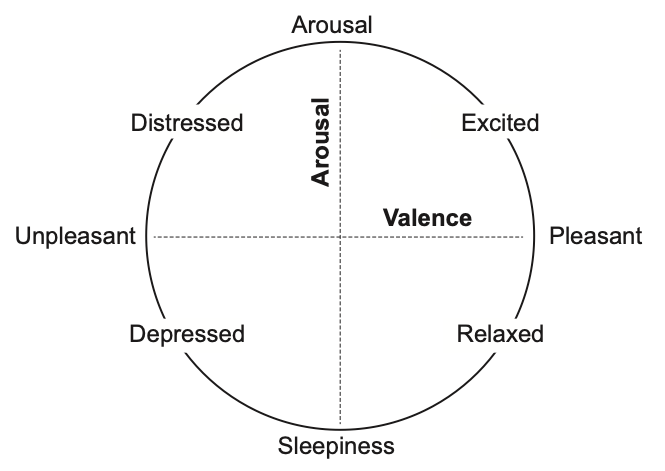
The two-dimensional core affect plane. The first dimension is defined by valence and traverses from unpleasant to pleasant. The second dimension is defined by arousal and traverses from sleepiness to arousal. Emotions such as relaxed, excited, distressed, and depressed are created as continuous combinations of these two dimensions. Inspired by Russell (1980), with the term pleasantness replaced with the now more widely adopted term valence.
Some frameworks propose the existence of short-term states that are valenced and thus qualify as affective but do not meet additional criteria. Among those criteria is the idea that an emotion generalizes across details and persists beyond the sensory event that triggers it (Adolphs & Anderson, 2018). If a dog bites you, you are likely to develop a fear of many dogs of the same type, and when you see one, you will remain afraid for a period after the dog is no longer present.
Edge cases include hunger, tiredness, and pain. In some schemes, they are considered affective states but not emotions. As reflected in the Psychological Science definitions, the idea is that emotions are triggered by external events (e.g., fear is triggered by seeing a tiger) that are real, remembered, or imagined rather than by events internal to the body. However, some argue that hunger can be triggered not only by low blood sugar but also by the sight and smell of delicious food, suggesting it should be regarded as an emotion.
A related criterion that speaks to these edge cases is the idea that to qualify as an emotion, the experience needs to be influenced by cognitive (as opposed to purely reflexive) processing (Lazarus, 1991). The emotions evoked by seeing a tiger are contextual insofar as seeing one can trigger fear if it is directly in front of you or excitement if you are safe within an enclosure on a safari. In contrast, the unpleasant experience that follows from nails running along a chalkboard is more reflexive, occurring largely regardless of context. In support of the inclusion of edge cases like pain as emotions, some point out that the experience of pain does not just depend on the activation of pain receptors and peripheral pain pathways (nociception) but also has strong cognitive influences (Gilam et al., 2020) [see Interoception].
Emotion versus mood versus temperament
Consistent with Psychological Science definitions, emotions and moods are generally thought to differ; however, researchers have not reached consensus about how (Berner, 1988; Ekman & Davidson, 1994; Fox et al., 2018; Stephan, 2017). One prominent proposal is that moods last longer than emotions—for instance, the third edition of the Diagnostic and Statistical Manual of Mental Disorders (DSM-III) defined affect as an “expressed emotion” and distinguished it from mood, “A pervasive and sustained emotion” (American Psychiatric Association, 1980). To illustrate, the DSM-III likened emotions to the weather and moods to climate. Not all researchers agree with this distinction. A psychopathology textbook published the same year defined affect, emotion, feeling, and mood as all the same, emphasizing that mood could be used interchangeably with “feelings of the moment” (Scharfetter, 1980). Today, the American Psychological Association offers two different definitions of mood: the first, “A short-lived emotional state,” and the second, “A disposition to respond emotionally in a particular way that may last for hours, days or even weeks” (American Psychological Association, n.d.-b). At even longer timescales than moods, some researchers describe temperaments as the predisposition to experience particular affective reactions (Kagan, 1994). In this scheme, someone who has a tendency toward anxiety is thought to have an anxious temperament.
Another prominent proposal about what differentiates emotions from moods, reflected in the Psychological Science definition, is that emotions are directed at specific objects (such as the fear of a tiger), whereas it is often less clear what causes a particular mood (Ekman & Davidson, 1994). At odds with that emphasis, definitions of mood by mental health researchers emphasize what causes typical and disordered mood states (Sekhon & Gupta, 2025). One proposed resolution for these seemingly different ideas about mood is the notion that emotions follow from an appraisal of (and help us adapt to) specific instances of environmental encounters, whereas moods are an appraisal of (and help us adapt to) how things are going overall (Lazarus, 1994). For instance, although the emotion fear is triggered by seeing a tiger and elicits the response to run, a low mood follows from averaging across a series of net-negative events to modulate cognitive functions like motivation and risk-taking (Bennett et al., 2022). As such, the triggers of mood may be less clear following averaging.
Questions, controversies, and new developments
Debates about terminology as it relates to subjective experience
To measure emotion, the most extensively used approach involves subjective report, such as, “On a scale from 1 to 5, how upset are you?” (Thompson, 2007). A second type of emotion measure quantifies biological reactions triggered by emotions, including facial expressions or galvanic skin responses—but often, these responses do not map cleanly onto subjective reports (Barrett et al., 2019). Other physiological measures quantify how emotions are reflected in patterns of brain activity (Nair et al., 2023) or their proxies, like functional magnetic resonance imaging (Kragel & LaBar, 2016). A final way to measure emotion is to induce one and measure how it changes a subject’s behavior on a well-defined task with an objective benchmark, such as a risky decision-making paradigm (Paul et al., 2005). These different ways of measuring emotions inform debates about what these different measures should be called, centered around the evidence they provide.
The Psychological Science textbook definitions follow from the idea that events trigger emotions that, when strong enough, can be experienced consciously as feelings (Adolphs & Anderson, 2018). The corollary is that emotions can also exist subconsciously (to influence behavior). Accordingly, emotions and moods can be studied in animals—guided by well-defined criteria for what constitutes them—but in animals, feelings cannot be studied because their subjective experience cannot be probed (Adolphs & Anderson, 2018; Nettle & Bateson, 2012).
Some researchers argue against this framing, proposing that the terms emotion and their exemplars (like fear) should be reserved for cases in which evidence of conscious experience exists (LeDoux, 2020). Because animal subjective experience cannot be probed, animals, by this definition, cannot have emotions. Instead, proponents argue that they have affective states (Bliss-Moreau & Rudebeck, 2021; Mendl & Paul, 2020). One rationale behind this position is to prevent the downstream consequences that can follow from misattributing emotion-related behavior as conscious. After all, the neural mechanisms supporting affective behavior and subjective experience are not entirely overlapping. Affective behaviors (like smiling) can reflect social communication rather than affective states, and a variety of human disorders can lead to involuntary laughing or crying dissociated from the subjective experience of happiness and sadness (Parvizi et al., 2006). Likewise, some evidence suggests that in the case of fear, the subcortical neural circuits that support behaviors related to it, like threat-related freezing, may be distinct from the cortical circuits that support the conscious experience of fear (Taschereau-Dumouchel et al., 2022). As such, the recommendation is that behavioral measures such as freezing in response to a threatening stimulus should be referred to as threat-related freezing behavior (as opposed to fear or fear-related behavior ;Taschereau-Dumouchel et al., 2022). The concern is that mistaking the subcortical circuits that support freezing behavior as “fear circuits” and targeting them for therapeutic interventions to relieve conditions such as posttraumatic stress disorder will be misguided.
By the same logic, some argue that the longer-lasting state called mood in humans should be called a temporally extended affective state in animals (Bliss-Moreau & Rudebeck, 2021). These researchers emphasize that the subjective experience of animals and humans who are incapable of subjective reports is unknowable and that presumptions should not be made about it. Proponents argue that reserving the terms emotion and mood (along with fear and happiness) for what humans consciously experience also ensures that researchers keep focused on explaining that as the goal.
Others counter that, although reserving emotion and mood in this way is intended to expedite impactful progress, it may in fact limit it by holding the bar to studying “real” phenomena in this space higher than it is held for other brain functions. For instance, evidence for memory can come in forms that do not include evidence of conscious awareness, including how much longer a monkey will look at an image they have never seen before versus one they have (a measure of recognition memory; Jutras & Buffalo, 2010) [see Memory]. A concern is that this higher bar might disincentivize connections to scientific discoveries made in nonhuman animals. Another concern is that criteria designed around subjective report measures unique to humans risks entrenching emotion research in a form of human exceptionalism (De Waal, 2018).
One proposed resolution to these disputes is to ground investigations of emotions, moods, and affective states in human subjective reports but combine them with other measures, including those in animals, via explicit linking hypotheses (Badre et al., 2015; Drzewiecki & Fox, 2024; Kauvar et al., 2025; LoBue & Adolph, 2019; Rust et al., 2026). In these proposals, linking hypotheses can manifest as behavioral signatures, brain activity patterns, or other physiological measures (like pupil diameter), and computational models can be used to explicitly lay out assumptions and evidence.
Arguments that the category of emotion is not scientifically fruitful
A final challenge to the Psychological Science framework argues that emotion is not a productive scientific category and should thus be eliminated and replaced (Griffiths, 1998; Moors, 2022) [see Mechanistic Explanation]. Advocates of this proposal do not deny the existence of phenomena such as fear, anger, and sadness, and they agree that they are worthy of scientific explanation. Rather, they argue that the category emotion is not a useful explanatory target. The rationale is that targets of explanation should be formulated in a way that allows theories to explain, in a principled manner, what makes something a member or not of a group. For instance, the properties of water are explained by the theory that its molecular structure is H2O, indicating that water is a fruitful scientific category. In contrast, the ancient Greek proposal of a “superlunary” cosmological parsing of the cosmos based on that which fell in a sphere above versus below the moon was abandoned because there is ultimately nothing that things lying above the moon have in common that distinguishes them from things that lie below (Griffiths, 1998). Analogously, the argument is that the category emotion is an arbitrary grouping of mental functions, and as such, no principled theory that differentiates emotions from other functions can be created.
One suggested solution is to eliminate the category emotion and replace it with goal-directed behavior more broadly defined (Moors, 2022). Another suggestion is to maintain the category emotion but create a more refined and explicit list of criteria for membership that captures how emotions differ from other functions in terms of their functional characteristics (i.e., what they do; Adolphs & Anderson, 2018). From there, the proposal is to create a theory that explains how emotions come to have their unique set of functional properties (analogous to how H2O leads to understanding water).
An alternative framing, reflected in the study of memory, emphasizes the distinction between terminology and explanatory targets. Here, researchers apply a functional definition to the term memory, defining it as any system that stores information so it can be used later. Different types of memory, supported by different processes, are then differentiated by modifiers such as recollection memory, recognition memory, and working memory. Consequently, memory researchers are unlikely to formulate a theory for all types of memory; instead, they are more likely to consider a specific type of memory (such as recollection) as a theoretical target. In that light, many researchers advocate for using terms like emotion and affect analogously as umbrella terms to refer to all functions that have the property of, for example, pleasant and/or unpleasant valence, without committing to whether the category is a single process and/or a theoretical target. This position can be contrasted with researchers who aspire to develop explicit theories “of emotion,” and many such theories exist (Moors, 2022).
Yet another approach eschews the idea that the path to understanding emotions requires defining the category from the outset (Barrett & Russell, 2015). As described, instead of asking, “What is an emotion?” this research program asks, “How is an emotional episode made?” Advocates of this approach reject frameworks that build on metaphors of the brain as a machine, in which emotions are thought of as triggered by events in the world that are conveyed to the brain via sensory input and are processed by distinct emotion systems. Instead, they focus on understanding how interacting operations construct emotional episodes in ways that capture their uniqueness across episodes, individuals, and cultures.
Broader connections
A common way to conceptualize cognition is to distinguish between “cold” scenarios, which are presumed not to involve emotion or other affective states, and “hot” scenarios, which do (Abelson, 1963). Within this framework, cognition is considerably “warmer” than often assumed. Emotions, moods, and other affective states can be elicited in a wide range of seemingly mundane situations, such as viewing images (Kurdi et al., 2017) or experiencing reward-related wins and losses (Mellers et al., 1997). In turn, affective states pervasively influence motivation, attention, memory, and decision-making (Paul et al., 2005). Consequently, it is difficult to study other cognitive functions without evoking an affective response. Understanding the nature and types of affective responses is thus crucial for understanding cognition, both in real-world contexts and under well-controlled experimental conditions.
Nuanced definitions of affective phenomena are important when considering emerging technologies, including large language model–based artificial intelligence [see Large Language Models]. Although these models can appear to express emotions when interacting with users, the expert consensus is that they lack subjective awareness (Li & Etchemendy, 2024). Nevertheless, functional definitions of emotion that do not require awareness have been applied to these models to investigate how they adaptively solve problems and what factors cause their behavior to become misaligned with desired outcomes (Sofroniew et al., 2026). When communicating the results of such studies, it is important that terms like “emotion” are not misunderstood.
Clear communication about affective phenomena also has important implications for ethical decisions concerning living beings who cannot report their feelings, including human infants, nonverbal adults, and nonhuman animals. The terms and concepts used in this context help shape welfare laws, clinical practice, and everyday interactions. For example, legally recognizing that animals are capable of suffering supports the view that they have rights beyond property. Conversely, anthropomorphizing animal emotions can lead to negative impacts on their physical and mental health (Mota-Rojas et al., 2021).
Acknowledgments
This work was supported by a Simons Foundation Pivot Fellowship to the author.
Further reading
Adolphs, R., & Anderson, D. J. (2018). The neuroscience of emotion. Princeton University Press.
Ekman, P., & Davidson, R. J. (1994). The nature of emotion: Fundamental questions. Oxford University Press.
Schiller, D., Yu, A. N. C., Alia-Klein, N., Becker, S., Cromwell, H. C., Dolcos, F., Eslinger, P. J., Frewen, P., Kemp, A. H., Pace-Schott, E. F., Raber, J., Silton, R. L., Stefanova, E., Williams, J. H. G., Abe, N., Aghajani, M., Albrecht, F., Alexander, R., Anders, S., … Lowe, L. (2024). The human affectome. Neuroscience & Biobehavioral Reviews, 158, 105450. https://doi.org/10.1016/j.neubiorev.2023.105450
References
Abelson, R. P. (1963). Computer Simulation of ‘Hot’ Cognition. In Computer Simulation of Personality: frontier of psychological theory, S. S. Tomkins, S. Messick, Eds. (pp. 277–298). Wiley.
↩Adolphs, R., & Anderson, D. J. (2018). The neuroscience of emotion. Princeton University Press.
↩American Psychiatric Association. (1980). Diagnostic and statistical manual of mental disorders (3rd ed.). American Psychiatric Association.
↩American Psychological Association. (n.d.-a). Affect. In APA dictionary of psychology. Retrieved June 23, 2026, from https://dictionary.apa.org/affect
↩American Psychological Association. (n.d.-b). Mood. In APA dictionary of psychology. Retrieved June 23, 2026, from https://dictionary.apa.org/mood
↩Badre, D., Frank, M. J., & Moore, C. I. (2015). Interactionist neuroscience. Neuron, 88(5), 855–860. https://doi.org/10.1016/j.neuron.2015.10.021
↩Barrett, L. F., & Russell, J. A. (Eds.). (2015). The psychological construction of emotion. Guilford Press.
↩Barrett, L. F., Adolphs, R., Marsella, S., Martinez, A. M., & Pollak, S. D. (2019). Emotional expressions reconsidered: Challenges to inferring emotion from human facial movements. Psychological Science in the Public Interest, 20(1), 1–68. https://doi.org/10.1177/1529100619832930
↩Barrett, L. F., Atzil, S., Bliss-Moreau, E., Chanes, L., Gendron, M., Hoemann, K., Katsumi, Y., Kleckner, I. R., Lindquist, K. A., Quigley, K. S., Satpute, A. B., Sennesh, E., Shaffer, C., Theriault, J. E., Tugade, M., & Westlin, C. (2025). The theory of constructed emotion: More than a feeling. Perspectives on Psychological Science, 20(3), 392–420. https://doi.org/10.1177/17456916251319045
↩Bennett, D., Davidson, G., & Niv, Y. (2022). A model of mood as integrated advantage. Psychological Review, 129(3), 513–541. https://doi.org/10.1037/rev0000294
↩Berner, P. (1988). Emotion, affect and mood: A terminological introduction. Psychopathology, 21(2–3), 65–69. https://doi.org/10.1159/000284544
↩Berrios, G. E. (1988). Melancholia and depression during the 19th century: A conceptual history. The British Journal of Psychiatry, 153, 298–304. https://doi.org/10.1192/bjp.153.3.298
↩Bliss-Moreau, E., & Rudebeck, P. H. (2021). Animal models of human mood. Neuroscience and Biobehavioral Reviews, 120, 574–582. https://doi.org/10.1016/j.neubiorev.2020.06.024
↩Darwin, C. (1872). The expression of the emotions in man and animals. John Murray.
↩De Waal, F. (2018). Mama’s last hug. W. W. Norton & Company.
↩Deonna, J. A., & Teroni, F. (2015). Value and emotion. In T. Brosch & D. Sander (Eds.), Handbook of value: Perspectives from economics, neuroscience, philosophy, psychology and sociology. Oxford University Press.
↩Descartes, R. (2009). The passions of the soul. In B. F. Gentile & B. O. Miller (Eds.), Foundations of psychological thought: A history of psychology (pp. 5–21). Sage Publications. (Original work published 1649)
↩Dixon, T. (2003). From passions to emotions: The creation of a secular psychological category. Cambridge University Press.
↩Drzewiecki, C. M., & Fox, A. S. (2024). Understanding the heterogeneity of anxiety using a translational neuroscience approach. Cognitive, Affective & Behavioral Neuroscience, 24(2), 228–245. https://doi.org/10.3758/s13415-024-01162-3
↩Ekman, P. (1999). Basic emotions. In T. Dalgleish & M. J. Power (Eds)., Handbook of cognition and emotion (pp. 45–60). Wiley.
↩Ekman, P., & Davidson, R. J. (Eds.). (1994). The nature of emotion: Fundamental questions. Oxford University Press.
↩Fox, A. S., Lapate, R. C., Shackman, A. J., & Davidson, R. J. (Eds.). (2018). The nature of emotion: Fundamental questions (2nd ed.). Oxford University Press.
↩Gilam, G., Gross, J. J., Wager, T. D., Keefe, F. J., & Mackey, S. C. (2020). What is the relationship between pain and emotion? Bridging constructs and communities. Neuron, 107(1), 17–21. https://doi.org/10.1016/j.neuron.2020.05.024
↩Griffiths, P. E. (1998). What emotions really are: The problem of psychological categories. University of Chicago Press.
↩Hilgard, E. R. (1980). The trilogy of mind: Cognition, affection, and conation. Journal of the History of the Behavioral Sciences, 16(2), 107–117. https://doi.org/10.1002/1520-6696(198004)16:2<107::aid-jhbs2300160202>3.0.co;2-y
↩James, W. (1884). II.—What is an emotion ? Mind, os-IX(34), 188–205. https://doi.org/10.1093/mind/os-IX.34.188
↩Jutras, M. J., & Buffalo, E. A. (2010). Recognition memory signals in the macaque hippocampus. Proceedings of the National Academy of Sciences, 107(1), 401–406. https://doi.org/10.1073/pnas.0908378107
↩Kagan, J. (1994). Distinctions among emotions, moods, and temperamental qualities. In P. Ekman & R. J. Davidson (Eds.), The nature of emotion: Fundamental questions (pp. 74–88). Oxford University Press.
↩Kauvar, I., Richman, E. B., Liu, T. X., Li, C., Vesuna, S., Chibukhchyan, A., Yamada, L., Fogarty, A., Solomon, E., Choi, E. Y., Mortazavi, L., Chau Loo Kung, G., Mukunda, P., Raja, C., Gil-Hernández, D., Patron, K., Zhang, X., Brawer, J., Wrobel, S., … Deisseroth, K. (2025). Conserved brain-wide emergence of emotional response from sensory experience in humans and mice. Science, 388(6750), eadt3971. https://doi.org/10.1126/science.adt3971
↩Kendler, K. S. (2020). The origin of our modern concept of depression-The history of melancholia from 1780-1880: A review. JAMA Psychiatry, 77(8), 863–868. https://doi.org/10.1001/jamapsychiatry.2019.4709
↩Kleinginna, P. R., & Kleinginna, A. M. (1981). A categorized list of emotion definitions, with suggestions for a consensual definition. Motivation and Emotion, 5(4), 345–379. https://doi.org/10.1007/BF00992553
↩Knutson, B., & Srirangarajan, T. (2019). Toward a deep science of affect and motivation. In M. Neta & I. J. Haas (Eds.), Emotion in the mind and body (pp. 193–220). Springer.
↩Kragel, P. A., & LaBar, K. S. (2016). Decoding the nature of emotion in the brain. Trends in Cognitive Sciences, 20(6), 444–455. https://doi.org/10.1016/j.tics.2016.03.011
↩Kurdi, B., Lozano, S., & Banaji, M. R. (2017). Introducing the Open Affective Standardized Image Set (OASIS). Behavior Research Methods, 49(2), 457–470. https://doi.org/10.3758/s13428-016-0715-3
↩Lazarus, R. (1994). The stable and the unstable in emotion. In P. Ekman & R. J. Davidson (Eds.), The nature of emotion: Fundamental questions (pp. 79–85). Oxford University Press.
↩Lazarus, R. S. (1991). Emotion and adaptation. Oxford University Press.
↩LeDoux, J. E. (2020). Thoughtful feelings. Current Biology, 30(11), R619–R623. https://doi.org/10.1016/j.cub.2020.04.012
↩Li, F.-F., & Etchemendy, J. (2024, May 22). No, today’s AI isn’t sentient. Here’s how we know. TIME. https://time.com/collections/time100-voices/6980134/ai-llm-not-sentient/
↩LoBue, V., & Adolph, K. E. (2019). Fear in infancy: Lessons from snakes, spiders, heights, and strangers. Developmental Psychology, 55(9), 1889–1907. https://doi.org/10.1037/dev0000675
↩Mellers, B. A., Schwartz, A., Ho, K., & Ritov, I. (1997). Decision affect theory: Emotional reactions to the outcomes of risky options. Psychological Science, 8(6), 423–429. https://doi.org/10.1111/j.1467-9280.1997.tb00455.x
↩Mendl, M., & Paul, E. S. (2020). Animal affect and decision-making. Neuroscience & Biobehavioral Reviews, 112, 144–163. https://doi.org/10.1016/j.neubiorev.2020.01.025
↩Mendl, M., Burman, O. H. P., & Paul, E. S. (2010). An integrative and functional framework for the study of animal emotion and mood. Proceedings of the Royal Society B: Biological Sciences, 277(1696), 2895–2904. https://doi.org/10.1098/rspb.2010.0303
↩Meyer, M. (1933). That whale among the fishes—The theory of emotions. Psychological Review, 40(3), 292–300. https://doi.org/10.1037/h0071608
↩Moors, A. (2022). Demystifying emotions: A typology of theories in psychology and philosophy. Cambridge University Press.
↩Mota-Rojas, D., Mariti, C., Zdeinert, A., Riggio, G., Mora-Medina, P., del Mar Reyes, A., Gazzano, A., Domínguez-Oliva, A., Lezama-García, K., José-Pérez, N., & Hernández-Ávalos, I. (2021). Anthropomorphism and its adverse effects on the distress and welfare of companion animals. Animals , 11(11), 3263. https://doi.org/10.3390/ani11113263
↩Nair, A., Karigo, T., Yang, B., Ganguli, S., Schnitzer, M. J., Linderman, S. W., Anderson, D. J., & Kennedy, A. (2023). An approximate line attractor in the hypothalamus encodes an aggressive state. Cell, 186(1), 178–193.e15. https://doi.org/10.1016/j.cell.2022.11.027
↩Nettle, D., & Bateson, M. (2012). The evolutionary origins of mood and its disorders. Current Biology, 22(17), R712–R721. https://doi.org/10.1016/j.cub.2012.06.020
↩Parvizi, J., Arciniegas, D. B., Bernardini, G. L., Hoffmann, M. W., Mohr, J. P., Rapoport, M. J., Schmahmann, J. D., Silver, J. M., & Tuhrim, S. (2006). Diagnosis and management of pathological laughter and crying. Mayo Clinic Proceedings, 81(11), 1482–1486. https://doi.org/10.4065/81.11.1482
↩Paul, E. S., Harding, E. J., & Mendl, M. (2005). Measuring emotional processes in animals: The utility of a cognitive approach. Neuroscience and Biobehavioral Reviews, 29(3), 469–491. https://doi.org/10.1016/j.neubiorev.2005.01.002
↩Phelps, E. A., Berkman, E., & Gazzaniga, M. S. (2022). Psychological science. W. W. Norton.
↩Russell, J. A. (1980). A circumplex model of affect. Journal of Personality and Social Psychology, 39(6), 1161–1178. https://doi.org/10.1037/h0077714
↩Russell, J. A. (2003). Core affect and the psychological construction of emotion. Psychological Review, 110(1), 145–172. https://doi.org/10.1037/0033-295x.110.1.145
↩Rust, N. C., Yang, Y.-P. C., Hacker, C. M., & Stuphorn, V. (2026). The representation of estimated mood in primate anterior insular cortex. bioRxiv. https://doi.org/10.1101/2025.04.22.650010
↩Schacter, D. L., Gilbert, D. T., & Wegner, D. M. (2010). Psychology (2nd ed.). Worth Publishers.
↩Scharfetter, C. (1980). General psychopathology. Cambridge University Press.
↩Schiller, D., Yu, A. N. C., Alia-Klein, N., Becker, S., Cromwell, H. C., Dolcos, F., Eslinger, P. J., Frewen, P., Kemp, A. H., Pace-Schott, E. F., Raber, J., Silton, R. L., Stefanova, E., Williams, J. H. G., Abe, N., Aghajani, M., Albrecht, F., Alexander, R., Anders, S., … Lowe, L. (2024). The human affectome. Neuroscience & Biobehavioral Reviews, 158, 105450. https://doi.org/10.1016/j.neubiorev.2023.105450
↩Sekhon, S., & Gupta, V. (2025). Mood disorder. In StatPearls. StatPearls Publishing. http://www.ncbi.nlm.nih.gov/books/NBK558911/
↩Sofroniew, N., Kauvar, I., Saunders, W., Chen, R., Henighan, T., Hydrie, S., Citro, C., Pearce, A., Tarng, J., Gurnee, W., Batson, J., Zimmerman, S., Rivoire, K., Fish, K., Olah, C., & Lindsey, J. (2026, April 2). Emotion concepts and their function in a large language model. Transformer Circuits. https://transformer-circuits.pub/2026/emotions/index.html
↩Stephan, A. (2017). Moods in layers. Philosophia, 45(4), 1481–1495. https://doi.org/10.1007/s11406-017-9841-0
↩Taschereau-Dumouchel, V., Michel, M., Lau, H., Hofmann, S. G., & LeDoux, J. E. (2022). Putting the “mental” back in “mental disorders”: A perspective from research on fear and anxiety. Molecular Psychiatry, 27(3), 1322. https://doi.org/10.1038/s41380-021-01395-5
↩Thompson, E. R. (2007). Development and validation of an internationally reliable short-form of the positive and negative affect schedule (PANAS). Journal of Cross-Cultural Psychology, 38(2), 227–242. https://doi.org/10.1177/0022022106297301
↩Wundt, W. M. (1897). Outlines of psychology. Williams and Norgate.
↩