4E cognition refers to the idea that cognition is embodied, embedded, enacted, and extended. Each of these four theses has been advanced in opposition to the idea that cognition is primarily a matter of what goes on in the head, and each draws attention to the fact that the body and the world play a crucial role in many forms of cognition. Although there are significant differences among these approaches and each of these theses has been defended individually, many theorists view them as a relatively coherent package best held together. In addition to advancing new psychological hypotheses, 4E theorists have played an important role in philosophical theorizing; the focus on the active body in the world has numerous consequences for theories of representation, language, and cognition in general.
History
The 4E perspective (sometimes called the situated cognition perspective) developed in opposition to classical neurocentric views, which assert that the essential features (in technical terms, constitutive features) of a cognitive process are all realized in the brain (Adams & Aizawa, 2001). According to a standard version of a neurocentric theory, this involves computational mechanisms and their realizations in a set of neural processes in the brain. In the context of cognitive science, diverse embodied and embedded approaches emerged in the 1980s, often drawing on resources found in ecological psychology (Gibson, 1979) and phenomenology (e.g., Merleau-Ponty, 2012) and then further developed by many authors, including Varela et al. (1991), Margaret Wilson (2002), Shaun Gallagher (2005), and Larry Shapiro (2007). The enactive approach can be dated to the publication of Varela and colleagues' (1991) The Embodied Mind, and the idea of the extended mind is usually attributed to Clark and Chalmers' (1998) essay, “The extended mind.” The label “4E cognition” originated at academic meetings held in 2006 to 2007 as a way to gather together different approaches that shared the aim of rethinking cognition beyond classical cognitivism (Menary, 2010; Rowlands, 2010).
The core idea of embodied cognition is that to understand the mind, it is important to look beyond neural processes by integrating nonneural bodily processes and the interaction of brain and body as part of the constitutive features for many cognitive phenomena; cognition is body based and cannot be reduced to brain processes alone. Furthermore, embedded and extended views of cognition contend that cognitive processes are strongly dependent on the environment. Environmental features can also play a significant (causal or constitutive) role in the realization of cognitive phenomena (Clark, 2008; Clark & Chalmers, 1998). A final E, which Varela et al. (1991) termed the enactive approach, highlights the action-oriented nature of a cognitive agent and the role of bodily skills and behavioral abilities for some cognitive phenomena.
A key example motivating the enactive view is perceptual experience. The four Es often draw on James Gibson's (1979) notion of affordances to highlight that the perception of an object is shaped by what an individual can do with it [see Affordances]. For example, a chair affords sitting for a human being, and it can also afford standing on (if the task demands this), but it does not afford conversing with. Enactive approaches also draw upon phenomenology, especially Maurice Merleau-Ponty's (2012) phenomenological approach to perception and intersubjectivity. With respect to social cognition, the social understanding of others has been conceived in the cognitivist approach as an intellectualistic cognitive ability. Identifying or recognizing the mental states of others was described as relying on observation only, using either the strategy of simulation (simulation theory) or folk psychological inference (theory-theory). Embodied–enactive perspectives, in contrast, emphasize social interaction. They appeal to developmental studies demonstrating that infants start understanding others by actively engaging with them and forming interaction patterns that involve joint attention and joint action (De Jaegher et al., 2010), patterns that not only foster intersubjective understanding but also contribute to “mindshaping” in that understanding another’s mind is intertwined with shaping their mind (Zawidzki, 2013).
Core concepts
Embodied cognition
The embodiment of cognitive processes can be subcategorized as weak or strong. Weak embodiment involves a less radical modification of classical cognitive science because it remains within the framework of neural representations. An important shift from standard representationalism is the integration of unexpected brain areas, namely sensorimotor or body-related representations in the brain, as relevant for higher-order, abstract cognition and linguistic understanding. To understand linguistic utterances, the classic cognitivist account argues that this is solely based on the activation of abstract symbols and their combinations. They form a language of thought (Fodor, 1975) that is supposed to be realized in higher-order (e.g., prefrontal) brain areas but not in areas typically processing sensory–motor and perceptual experiences [see Language of Thought Hypothesis]. However, linguistic understanding systematically involves the activation of sensorimotor-related neural processes (Barsalou, 1999; Pulvermüller, 2005). For example, the understanding of action words is correlated with the activation of sensorimotor neural processes representing relevant body parts when hearing action verbs such as “to kick” (neural foot area), “to pick” (neural hand area), and “to lick” (neural head/mouth area; Hauk et al., 2004). Such observations triggered the central claim of weak embodiment that can be described as follows.
A high-level cognitive phenomenon—like linguistic understanding—is weakly embodied if it is at least partially realized and constituted by neural activations that are typical for sensorimotor processing.
In contrast to weak embodied cognition, strong embodied cognition points to processes that are beyond the brain.
A cognitive phenomenon is strongly embodied if it is at least partially realized and constituted by extraneural bodily features that may involve anatomical structure, posture, and movement as well as, for example, autonomic, basic physiological processes like those related to the enteric (or gut) system as well as to affective processes.
Embodiment in this case means that extraneural features of the body shape our cognitive experience (Gallagher, 2005). For example, the fact that humans have two eyes, positioned as they are, delivers high-level binocular vision for the large visual field of roughly 135 degrees when both eyes receive input. This enables humans to perceive relative depth in this binocular visual field. In many species, this overlap is much smaller because of lateral positioning of the eyes. In the case of horses, each eye sees across an arc of approximately 200 to 210 degrees around the body with an overlapping visual field of both eyes only between 65 and 80 degrees (Timney & Keil, 1999). This results in a view that includes almost the whole body and almost the entire immediate environment. Being able to scan almost the whole environment is advantageous because the horse is a prey animal. Although depth perception is not impossible in the monocular visual field, it is much less developed. When depth thresholds were tested in horses, binocular thresholds were several times superior to those obtained monocularly (Timney & Keil, 1999). Position of the eyes is thus an embodied feature shaping perception.
Extended and embedded cognition
Extended cognition requires that an environmental feature is a constitutive (essential) part of a cognitive phenomenon. This claim goes beyond the idea of embedded cognition—that the environment may be a causal influence on the brain–body processes that constitute cognition.
A cognitive phenomenon is extended if it is (partially) constituted by environmental (i.e., extra-agentive) components or tools, often realized by the use of artifacts or technologies.
A cognitive phenomenon is embedded if it is (partially) causally dependent upon environmental (i.e., extra-agentive) components or tools.
To illustrate extendedness, imagine Otto, who suffers from Alzheimer’s and who uses his notebook to remember the location of the Museum of Modern Art (MoMA). According to the extended mind hypothesis, the notebook is constitutively involved in Otto’s ability to remember the address of the MoMA, in the same way that biological memory functions in the typical case of remembering (Clark & Chalmers, 1998). The claim that the use of a notebook can be constitutive of memory in this kind of case is based on the parity principle, which is the idea that an external resource extends the mind if using this resource plays the same role for the relevant cognitive ability (e.g., remembering) as a certain brain process would normally do (if not impaired). Thus, the resource substitutes (providing an equivalent function) or enriches (supplements) a brain process. There are three further criteria to the parity principle: (1) that the resource (e.g., the notebook) is reliably available (reliability), (2) that any information retrieved from the notebook be more-or-less automatically endorsed (trustworthiness), and (3) that the information is easily accessible (accessibility; Clark & Chalmers, 1998).
Some extended cognition theorists take issue with the parity principle and argue that the use of environmental resources can be functionally different (rather than functionally equivalent) and can be integrated into cognitive processes in a complementary fashion (Sutton, 2010). For example, with a translation app on my mobile device, I can communicate online with a Japanese colleague, an ability I did not previously have. This complementary conception of extended mind is made especially clear when engagement with cultural practices (Menary, 2010) and social interactions (Gallagher, 2013)—processes that could not be accomplished simply in one’s head—extend cognitive processes.
The claim of embedded cognition is only minimally different from extended cognition from the perspective of cognitive science but marks an important difference for philosophical reasoning, namely the difference between being constitutive (to have a motor is constitutive for being an automobile) and being causally relevant (to have fuel in the tank is causally relevant for the functioning of a car but not constitutive; it still is an automobile that can be used for driving even if the tank is empty at the moment). Thus, being embedded highlights that cognitive abilities are often causally enhanced, accelerated, or intensely widened by environmental conditions. A person can learn everyday calculations without any supporting conditions. However, if the calculations involve larger numbers, calculations are enhanced by using pen and paper. If someone then also uses a calculator, then that tool obviously radically enhances the ability to calculate; such tools are also called scaffolds for an ability (Newen & Fabry, 2023). At a certain point, such an enhancement of calculation is transformed into enabling a new ability; for example, calculating a logarithm of a large number is something most people may not be able to do without a calculator, which then extends their mind for this ability. Thus, extended and embedded approaches can be distinguished by their respective claims concerning the role of the environment; is a feature of the environment strongly involved, that is, constitutive for the cognitive phenomenon, or only weakly involved, that is, being (merely) causally relevant for the cognitive phenomenon but not essential (constitutive)?
Enacted cognition
The enactive approach goes beyond the other three Es by integrating the idea that the cognitive abilities of a human being are intensely shaped by the fact that we are acting in the world; cognition is primarily for action. The enactive approach acknowledges most of the processes highlighted by strong embodied cognition but adds an emphasis on action-oriented processes and the affordances offered by any particular environment.
A cognitive phenomenon is enacted if it is at least partially realized and constituted by behavioral abilities or dispositions of the agent.
The action-oriented character of perception is key to self-organizing sense-making processes of the organism in the environment (Varela et al., 1991). A key concept is action-perception coupling, which involves the claim that perception is a skill constituted by sensorimotor abilities. An agent who perceives or interacts with an object anticipates and keeps track of the contingent sensorimotor feedback (i.e., the agent integrates the systematic changes that result from their own self-generated actions). For example, when I move around a table, there is a correlated perspectival change in my perception of the table in relation to my action. The integration of these correlated changes results in a learning of so-called sensorimotor contingencies (Hurley, 1998; Noë, 2004), that is, the integration of the correlation between a spatial position relative to the table and the perspectival information about the table received from this position. The enactivist claim is that these sensorimotor contingencies are core contributions for perceptual experiences.
A good example of the enactment of perceptual experience concerns sensory substitution (Bach-y-Rita et al., 1969). A person who lost vision and had damage in the neural visual system was connected to a technology (a tactile vision substitution system) in which visual signals from a camera mounted on the head were transformed into tactile signals on the skin or tongue, which then could be processed in the normal way because tactile processing was still intact. After only hours of practice, the person developed a new vision-like sense of spatial relations; although color impressions did not return, the person could recognize the shape of a table and chairs around it. For the system to work, it was necessary for the subject to control the sensor’s movements and orientation (Bach-y-Rita & Kercel, 2002). This is possible because the same rules of sensorimotor contingencies govern both vision and the quasi-vision provided by the tactile vision substitution system at an appropriate level of abstraction (Noë, 2004, p. 112). Perception is closely tied to the sensorimotor contingencies that all cognitive systems learn through connecting perceptual processing with their actions.
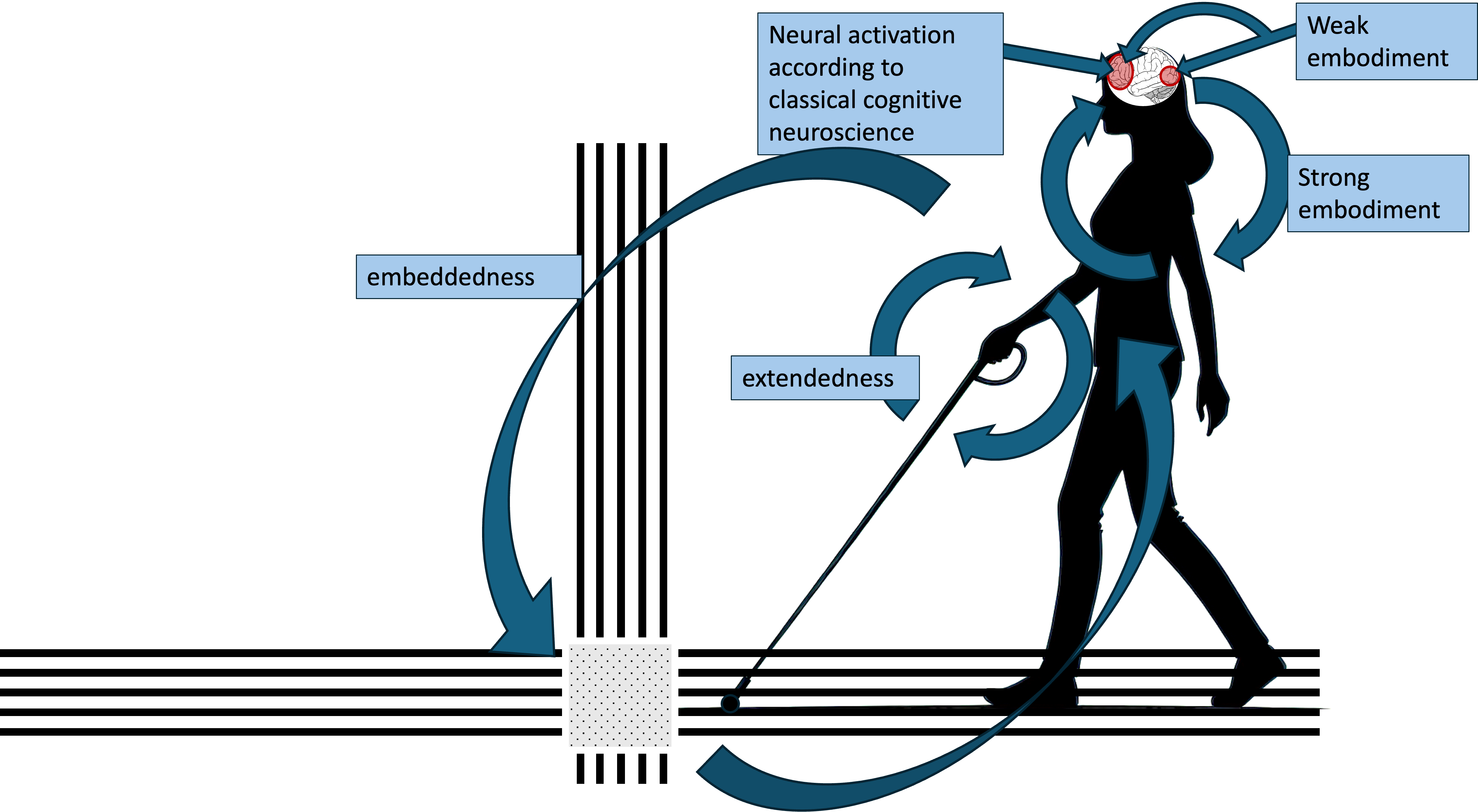
Overview of classical cognitive neuroscience in contrast to 4E cognition: In the case of higher-level cognitive abilities like linguistic understanding, classical cognitive neuroscience claims that the essential activation of relevant brain areas includes only frontal brain areas and does not involve sensorimotor and perceptual processing areas. The latter are included as relevant activation areas by weak embodiment accounts. The strong embodiment account claim that these higher-level processes are in addition based on brain-body interactions. Embeddedness is the claim that cognitive processes are furthermore dependent on the physical and social environment; extendedness is the special claim that the physical or social environmental tools can extend the mind if those are essentially involved in enabling or fostering the cognitive ability. Finally, enactment is the claim that some cognitive abilities, e.g. perceiving an object, is depending on the dispositions to act, namely via a perception-action coupling.
Relations between the four Es
To understand the relations between the four Es, consider linguistic understanding. The classical background of cognitive science is the claim that linguistic understanding consists in abstract symbol processing and that this is essentially processed in the prefrontal cortex and some supporting language areas but not in brain areas that are typically involved in perceptual and sensorimotor processing (see Figure 1 for illustration). This was supported by neuroscientific evidence before 2000 (Gabrieli et al., 1998). Then, new evidence demonstrated the involvement of perceptual and sensorimotor brain areas in linguistic understanding (Barsalou, 1999; Hauk et al., 2004). This motivated the weak embodiment claim that perceptual and sensorimotor processing realized in typical brain areas are constitutive for linguistic understanding.
The strong embodiment claim—that body parts and bodily processes outside of the brain are essentially involved in a cognitive ability—can be best illustrated for forming and expressing a thought. Thinking is supposed to be the paradigmatic case of an “internal” process, but thinking does not rely only on internal brain processes. This is demonstrated through the essential role of gestures for forming and expressing thoughts (Goldin-Meadow, 2023). Enactive approaches would endorse this insight from gesture research and would also claim that both thinking and linguistic understanding are constitutively shaped by communicative actions in social and cultural contexts that depend on embodied and intersubjective interactions with other people. Because gestures are activities of embodied and situated interlocutors, the enactive thesis shifts the focus from bodily anatomy and physiology to the agent’s actions and interactions (in this case, communicative actions, speech acts, and gestures) and their role in understanding.
Furthermore, in cases of understanding the utterances of others in communication, at least my communicative contributions are a crucial context of understanding. This motivates the embeddedness of linguistic understanding: the claim that the physical, social, and cultural environment is causally involved. This is obvious given the commonly accepted context dependence of communicative understanding including, for example, the determination of reference of a linguistic expression. Extended cognition considers that a certain artifact or resource that can easily be used in linguistic communication (e.g., a phone translation app) is constitutive of the cognitive processes for linguistic understanding of others in a language one does not understand.
A second example concerns the spatial navigation of a blind person using a white cane. This is an example that can be used to describe all four Es for this specific ability. Weak embodied cognition would claim that the neural processes can be shown to be modified and that they integrate a body-related representation of the white cane during spatial navigation. The neural representation of what is registered as being part of me undergoes plastic changes and is enlarged such that not only the arm but the arm together with the white cane is neurally processed as part of the person during the navigation process. Strong embodiment would claim that not only modified neural processes but body parts and their physical conditions are essential for navigating successfully and efficiently; if the navigating arm were shorter (e.g., after a medical operation), then the agent would have to relearn the navigation with the white cane. An enactive approach would emphasize that the cane changes body-schematic processes in perception and cognition through its active use, which also changes the field of affordances available for the agent. The ability is extended because it is essentially dependent on having a white stick as the navigation tool. Finally, embeddedness is the claim that this ability can be intensely shaped by the environment; nowadays, many stations and streets have physical indicators of crossings and directions that support or supplement the use of the cane for navigation.
A third very convincing example illustrating the fruitfulness of 4E-situated cognition is the navigation belt, the effect of which was predicted on the basis of the theory of sensorimotor coupling; if perceptual experience is significantly shaped by sensorimotor contingencies, then radically new sensorimotor contingencies, for example, the integration of magnetic field information, should lead to radically new perceptual experiences. This is realized in the navigation tool called the feelSpace belt (Kärcher et al., 2012; König et al., 2016). Participants wear a belt around the waist that contains 30 vibrotactile mini motors. Only the one exactly directed north in a situation (because of compass measure) vibrates and produces vibrotactile stimulation at the waist. Turning 360 degrees makes every motor vibrate in sequence. After wearing the belt during the day for six weeks in their natural environment (without any instructions), participants were tested concerning their performance on spatial navigation tasks, change of subjective experience, and modification of neural activations (König et al., 2016). Concerning performance, the most telling effects have been shown with a participant who is congenitally blind and a participant who became blind later in life (Kärcher et al., 2012). Both showed significant performance improvement after the long training period and when tested wearing the belt.
In a recent study, normal participants were tested in a virtual reality environment after wearing the belt for six weeks and compared to a contrast group without any belt experience (Schmidt et al., 2023). Testing spatial orientation, they found that the belt group acquired significantly more accurate cardinal and survey knowledge in the virtual reality environment, which was measured in pointing accuracy, distance, and rotation estimates. Because the enhanced ability of spatial orientation is only possible wearing the belt, the feelSpace belt extends spatial cognitive ability when used for spatial orientation after the training phase. This result is also supported by a change of perceptual experience. After seven weeks of training, eight out of nine belt-wearing (normal) participants attested to having developed a new spatial sense—according to specific standardized measures (Kaspar et al., 2014). Some reports involve the characterization of the new sense as a far (not near) sense of receiving spatial information, similar to visual (far-sense) rather than tactile (near-sense) information about spatial relations.
Finally, in line with these observations, functional magnetic resonance imaging measurement revealed a differential activation of brain areas known to be involved in sensory processing and in sensorimotor integration (König et al., 2016). The navigation belt illustrates important aspects of all four Es: bodily movement and neural changes demonstrate the embodiment of the navigation skill, and increased performance and change of subjective experience after long training demonstrates that perceptual experiences are based on enactive sensorimotor contingencies. Finally, taken together, improved performance, change of subjective experience, and neural modifications show that the feelSpace belt extends the mind when used for spatial orientation after training because wearing the belt enables a new spatial sense that cannot be accomplished by neural processes alone.
Questions, controversies, and new developments
There are two major ongoing debates about 4E cognition. First, the claim that extended and enactive approaches commit a causal-constitution fallacy, and second, the question of whether theorists need mental representations to explain cognition.
Constitution versus causal dependency
The first debate concerns the ontological status of cognition and whether neural processes alone are sufficient for its realization basis. To spell out the ontological debate about the relevance of a feature as the realization basis for a cognitive phenomenon, 4E theorists need a strict distinction between “being constituted by” and “being causally dependent on.” This is because, although everyone accepts that there are many features that causally influence cognitive processes, not all causal relationships are relevant to this issue. For example, without the right amount of oxygen in the air, humans cannot be mentally active. With respect to explaining cognition, this is an uninteresting background condition. The notion of constitution is supposed to pick out the essential realization basis of a cognitive process. A cognitive process is constituted by a feature if that feature is an essential part of the realization basis of the process, and this is understood (as per a classical metaphysical concept of compositional constitution) as being part of the realization basis of the process in all possible worlds. This means that in the case of a constitutive feature F for a phenomenon P, you cannot even imagine a situation in which P is realized without F being realized; F is necessary for having P.
The core criticism argues that extended and enactive explanations commit a fallacy because they take causally relevant aspects of the environment to be constitutive parts of a cognitive phenomenon (Adams & Aizawa, 2001). Otto’s notebook, for example, may causally support or scaffold cognition, but it is not a working part of cognition—something they associate only with neural or representational processes. One response to this objection is to reject the strict distinction between causality and constitution and to define constitution as involving dynamical (reciprocal or circular) causal relations rather than compositional (Chemero, 2009; Gallagher, 2023). Extended and enactive cognition, as in the example of the navigation belt, questions the focus on neural processes alone and considers the dynamical coupling of brain–body–environment in agentive behavior as constitutive. The changes in perception and behavior from acting with the belt are enabled by processes of neural plasticity that are causally dependent on using environmental features and the feedback based on skilled use of the navigation belt in the environment. The results are recursively enhanced and modified neural processes. This tight coupling is constitutive of cognition. Like many debates, this is one that remains unresolvable until an agreement is reached on some of the central concepts (Newen et al., 2018).
Mental representation
The debate about whether mental representations are explanatory for cognition is, in relation to 4E cognition, both an external debate (with classic cognitivist views) and an internal debate (between enactivist anti-representationalist views and the varied representationalist views of weak embodied cognition and extended cognition). The theoretical landscape is such that almost all 4E accounts are compatible with some kind of understanding of mental representations. This does not make this debate superfluous because to clarify the role of mental representation is important for any account of cognition. For now, the question remains whether mental representation, on some view, genuinely explains cognition.
The most traditional understanding of mental representation is the computational concept of representation going back to the idea of a language of thought (Fodor, 1975). Although this started out as an internalist account, it informs the view of extended functionalism (Clark, 2008), which holds that the mind and its representational content should be understood as the joint product of neural, bodily, and environmental processes.
The opposing claim consists in challenging the traditional view of representations as having semantic content and denying their usefulness for explaining basic cognition, that is, patterns of dynamic sensory–motor interactions between organisms and their environments (Hutto & Myin, 2013). The alternative is to argue that affordances (as possibilities for action) and further action–perception couplings form the basis of all cognitive phenomena. Proponents of dynamic systems theory in ecological and enactive approaches (e.g., Chemero, 2009) argue that this perspective is incompatible with representational explanations [see Complex Dynamical Systems]. In contrast, proponents of weak embodied cognition and the concept of body-formatted representations (e.g., Alsmith & de Vignemont, 2012; Goldman, 2014) and extended mind views of “action-oriented representations” aim to integrate new understandings of mental representation into some version of 4E cognition.
More recent alternatives that may fit with some 4E approaches include the deflationary account of representation (Egan, 2025), which argues that representational contents are just a gloss based on the computational mechanisms of cognition, and the account of situated mental representations (Newen & Vosgerau, 2020), in which the representational content is described as a constraint in relation to the underlying mechanisms. Such accounts defend the explanatory use of mental representations. The alternative is to develop more nonrepresentational accounts, which may be plausible for basic cognitive phenomena described as perception–action couplings. This still leaves an open question about how to account for complex cognitive phenomena (like decision-making, problem-solving, episodic memory, and linguistic understanding, etc.) without mental representation, aka the scaling-up problem. Thus, either 4E theorists have to demonstrate that the scaling-up problem can be solved without mental representations, or they must develop an account of mental representation that fits with the 4E perspective. In this respect, radical enactive accounts do not rule out the idea that higher-order cognition could involve representational content, but this would always be the result of linguistic and shared sociocultural practices and are better explained as a set of skilled practices. Mathematical reasoning, for example, can be understood as a representation-free skilled practice that relies on bodily practices and cultural engagement (Gallagher, 2017; Hutto, 2019; Pantsar, 2022; Zahidi, 2021; Zahidi & Myin, 2016, 2018). Debates on these issues continue.
Broader connections
In recent years, principles of 4E cognition have been used to change the perspective on the nature of more and more cognitive phenomena. The neurocentric perspective is being displaced in favor of the claim that cognitive phenomena are constituted by rich patterns of neural, embodied, and environmental features constitutive for phenomena such as emotions (Colombetti, 2014; Newen et al., 2015), emotion recognition (Berio & Newen, 2025), and the self (Gallagher, 2013; Newen, 2018).
For example, the idea that cognitive phenomena can best be fruitfully characterized by a pattern of characteristic features of brain–body–environment enables scholars to develop innovative views on robots who rely on large language models (LLMs, like ChatGPT), for example, the robot Sophia (Retto, 2017). Does Sophia have emotions, or does she only simulate emotions? If the pattern theory of emotions is on the right track (Newen et al., 2015), then emotional episodes are characterized by at least seven categories of features, namely bodily and vegetative features, behavioral dispositions, expressive features, phenomenal features, cognitive features, socio-normative features, and the feature of having an intentional trajectory (targeting an intentional object in a situation). On this approach to emotions, the question of whether Sophia has an emotion can now be discussed by investigating to which degree a particular system state of Sophia has the characteristic features of an emotion. For example, concerning whether Sophia could manifest fear directed towards an aggressive dog, Sophia can be built to have the behavioral dispositions (flight or freeze), and she can be expressive (having the facial expression of fear, which actually is the case in Sophia). She can also have the cognitive features of evaluating the situation expressed with the utterance, “This is a dangerous pitbull.” If the robot can detect the dog with a visual system, then it can be related to her as the intentional object. What is lacking in all existing LLMs and robots relying on them (like Sophia) are typical bodily features (vegetative arousal) and phenomenal features (conscious experience of fear). The remaining feature, namely the socio-normative embedding of fear, cannot easily be evaluated for robots. Fear is, for example, typically modulated by being accompanied by a friend or a person one trusts. Does it makes sense to transfer this disposition to a robot? Because the phenomenology of fear is lacking in robots, the social modulation of it is not applicable, and this modulation is one important feature of the social embedding of fear.
Given these evaluations, does the robot Sophia (relying on an LLM) have the emotion of fear or not? The question would be positively answered if researchers judge that the satisfaction of four out of the seven features is enough to make it a case of fear. On the other hand, if this is to be considered a case of fear, then one might think of it as a new type of fear found in LLM-based robots, namely one in which bodily, vegetative states and phenomenal experience are always lacking. This opens up the conceptual space by not answering the question about emotions in Sophia with simple “yes” or “no” answers but with the claim that she has emotions of a new type: nonvegetative and nonconscious emotions [see Foundations of Emotion].
There are many other examples. Principles of 4E cognition have been applied in a large variety of practical contexts, including architecture (Jelić et al., 2016; Johnson, 2015), education (Hutto et al., 2015), literature and the humanities (Anderson et al., 2019), medicine and physical therapy (Øberg et al., 2015), performance studies (e.g., Høffding, 2019; Sutton & Tribble, 2011), and psychiatry and clinical reasoning (de Haan, 2020; Fuchs & Röhricht, 2017; Gallagher, 2024; Varga, 2019). In these applied areas, the four Es have been challenging existing paradigms. Moreover, these applications can loop back to inform the ongoing development of 4E theory.
Acknowledgments
This work was funded by the German Research Foundation DFG in the context of funding the Research Training Group “Situated Cognition” (GRK 2185/2)/gefördert durch die DFG.
Further reading
Adams, F., & Aizawa, K. (2001). The bounds of cognition. Philosophical Psychology, 14(1), 43–64. https://doi.org/10.1080/09515080120033571
Chemero, A. (2009). Radical embodied cognitive science. MIT Press.
Clark, A., & Chalmers, D. (1998). The extended mind. Analysis, 58(1), 7–19. https://doi.org/10.1093/analys/58.1.7
Newen, A., De Bruin, L., & Gallagher, S. (Eds.). (2018). Oxford handbook of 4E cognition. Oxford University Press.
References
Adams, F., & Aizawa, K. (2001). The bounds of cognition. Philosophical Psychology, 14(1), 43–64. https://doi.org/10.1080/09515080120033571
↩Alsmith, A. J. T., & de Vignemont, F. (2012). Embodying the mind and representing the body. Review of Philosophy and Psychology, 3(1), 1–13. https://doi.org/10.1007/s13164-012-0085-4
↩Anderson, M., Wheeler, M., & Sprevak, M. (2019). Distributed cognition and the humanities. In M. Anderson, D. Cairns, & M. Sprevak (Eds.), Distributed cognition in medieval and renaissance culture (pp. 1–17). Edinburgh University Press.
↩Bach-y-Rita, P., & Kercel, S. W. (2002). Sensori-“motor” coupling by observed and imagined movement. Intellectica, 35(2), 287–297. https://doi.org/10.3406/intel.2002.1671
↩Bach-y-Rita, P., Collins, C. C., Saunders, F. A., White, B., & Scadden, L. (1969). Vision substitution by tactile image projection. Nature, 221(5184), 963–964. https://doi.org/10.1038/221963a0
↩Barsalou, L. W. (1999). Perceptual symbol systems. Behavioral and Brain Sciences, 22, 577–660. https://doi.org/10.1017/s0140525x99002149
↩Berio, L., & Newen, A. (2025). I expect you to be happy, so I see you smile: A multidimensional account of emotion attribution. Philosophy and Phenomenological Research, 110(2), 552–575. https://doi.org/10.1111/phpr.13113
↩Chemero, A. (2009). Radical embodied cognitive science. MIT Press.
↩Clark, A. (2008). Supersizing the mind: Reflections on embodiment, action, and cognitive extension. Oxford University Press.
↩Clark, A., & Chalmers, D. (1998). The extended mind. Analysis, 58(1), 7–19. https://doi.org/10.1093/analys/58.1.7
↩Colombetti, G. (2014). The feeling body: Affective science meets the enactive mind. MIT Press.
↩de Haan, S. (2020). Enactive psychiatry. Cambridge University Press.
↩De Jaegher, H., Di Paolo, E., & Gallagher, S. (2010). Can social interaction constitute social cognition? Trends in Cognitive Sciences, 14(10), 441–447. https://doi.org/10.1016/j.tics.2010.06.009
↩Egan, F. (2025). Deflating mental representation. MIT Press.
↩Fodor, J. A. (1975). The language of thought. Harvard University Press.
↩Fuchs, T., & Röhricht, F. (2017). Schizophrenia and intersubjectivity: An embodied and enactive approach to psychopathology and psychotherapy. Philosophy, Psychiatry, & Psychology, 24(2), 127–142. https://doi.org/10.1353/ppp.2017.0018
↩Gabrieli, J. D. E., Poldrack, R. A., & Desmond, J. E. (1998). The role of left prefrontal cortex in language and memory. Proceedings of the National Academy of Sciences, 95(3), 906–913. https://doi.org/10.1073/pnas.95.3.906
↩Gallagher, S. (2005). How the body shapes the mind. Oxford University Press.
↩Gallagher, S. (2013). The socially extended mind. Cognitive Systems Research, 25–26, 4–12. https://doi.org/10.1016/j.cogsys.2013.03.008
↩Gallagher, S. (2017). Enactivist interventions. Oxford University Press.
↩Gallagher, S. (2023). Embodied and enactive approaches to cognition. Cambridge University Press.
↩Gallagher, S. (2024). The self and its disorders. Oxford University Press.
↩Gibson, J. J. (1979). The ecological approach to visual perception. Psychology Press.
↩Goldin-Meadow, S. (2023). Thinking with your hands: The surprising science behind how gestures shape our thoughts. Basic Books.
↩Goldman, A. I. (2014). The bodily formats approach to embodied cognition. In U. Kriegel (Ed.), Current controversies in philosophy of mind (pp. 91–108). Routledge.
↩Hauk, O., Johnsrude, I., & Pulvermüller F. (2004). Somatotopic representation of action words in human motor and premotor cortex. Neuron, 41(2), 301–307. https://doi.org/10.1016/s0896-6273(03)00838-9
↩Høffding, S. (2019). A phenomenology of musical absorption. Palgrave Macmillan.
↩Hurley, S. (1998). Consciousness in action. Harvard University Press.
↩Hutto, D. D. (2019). Re-doing the math: Making enactivism add up. Philosophical Studies, 176, 827–837. https://doi.org/10.1007/s11098-018-01233-5
↩Hutto, D. D., & Myin, E. (2013). Radicalizing enactivism: Basic minds without content. MIT Press.
↩Hutto, D. D., Kirchhoff, M. D., & Abrahamson, D. (2015). The enactive roots of STEM: Rethinking educational design in mathematics. Educational Psychology Review, 27(3), 371–389. https://doi.org/10.1007/s10648-015-9326-2
↩Jelić, A., Tieri, G., De Matteis, F., Babiloni, F., & Vecchiato, G. (2016). The enactive approach to architectural experience: A neurophysiological perspective on embodiment, motivation, and affordances. Frontiers in Psychology, 7, 481. https://doi.org/10.3389/fpsyg.2016.00481
↩Johnson, M. (2015). The embodied meaning of architecture. In S. Robinson & J. Pallasmaa (Eds.), Mind in architecture: Neuroscience, embodiment, and the future of design (pp. 33–50). MIT Press.
↩Kärcher, S., Fenzlaff, S., Hartmann, D. Nagel, S. K., & König, P. (2012). Sensory augmentation for the blind. Frontiers in Human Neuroscience, 6, 37. https://doi.org/10.3389/fnhum.2012.00037
↩Kaspar, K., König, S., Schwandt, J., & König, P. (2014). The experience of new sensorimotor contingencies by sensory augmentation. Consciousness and Cognition, 28(100), 47–63. https://doi.org/10.1016/j.concog.2014.06.006
↩König, S. U., Schumann, F., Keyser, J., Goeke, C., Krause, C., Wache, S., Lytochkin, A., Ebert, M., Brunsch, V., Wahn, B., Kaspar, K., Nagel, S. K., Meilinger, T., Bülthoff, H., Wolbers, T., Büchel, C., & König, P. (2016). Learning new sensorimotor contigencies: Effects of long-term use of sensory augmentation on the brain and conscious perception. PLoS One, 11(12), e0166647. https://doi.org/10.1371/journal.pone.0166647
↩Menary, R. (2010). Cognitive integration and the extended mind. In R. Menary (Ed.), The extended mind (pp. 227–243). MIT Press.
↩Menary, R. A. (2010). Introduction to the special issue on 4E cognition. Phenomenology and the Cognitive Sciences, 9(4), 459–463. https://doi.org/10.1007/s11097-010-9187-6
↩Merleau-Ponty, M. (2012). Phenomenology of perception. Routledge.
↩Newen, A. (2018). The embodied self, the pattern theory of self, and the predictive mind. Frontiers in Psychology, 9, 2270. https://doi.org/10.3389/fpsyg.2018.02270
↩Newen, A., & Fabry, R. E. (2023). A pattern theory of scaffolding. Review of Philosophy and Psychology, 16, 65–90. https://doi.org/10.1007/s13164-023-00720-x
↩Newen, A., & Vosgerau, G. (2020). Situated mental representations: Why we need mental representations and how we should understand them. In J. Smortchkova, K. Dolega, & T. Schlicht (Eds.), Mental representation (pp. 178–212). Oxford University Press.
↩Newen, A., De Bruin, L., & Gallagher, S. (Eds.). (2018). Oxford handbook of 4E cognition. Oxford University Press.
↩Newen, A., Welpinghus, A., & Juckel, G. (2015). Emotion recognition as pattern recognition: The relevance of perception. Mind & Language, 30(2), 187–208. https://doi.org/10.1111/mila.12077
↩Noë, A. (2004). Action in perception. MIT Press.
↩Øberg, G. K., Normann, B., & Gallagher, S. (2015). Embodied-enactive clinical reasoning in physical therapy. Physiotherapy Theory and Practice, 31(4), 244–252. https://doi.org/10.3109/09593985.2014.1002873
↩Pantsar, M. (2022). On radical enactivist accounts of arithmetical cognition. Ergo, 9, 57. https://doi.org/10.3998/ergo.3120
↩Pulvermüller, F. (2005). Brain mechanisms linking language and action. Nature Reviews Neuroscience, 6(7), 576–582. https://doi.org/10.1038/nrn1706
↩Retto, J. (2017). Sophia, first citizen robot of the world. Universidad Nacional Mayor de San Marcos. https://www.researchgate.net/profile/Jesus-Retto/publication/321319964_SOPHIA_FIRST_CITIZEN_ROBOT_OF_THE_WORLD/links/5a1c8aa2a6fdcc0af3265a44/SOPHIA-FIRST-CITIZEN-ROBOT-OF-THE-WORLD.pdf
↩Rowlands, M. (2010). The new science of the mind. MIT Press.
↩Schmidt, V., König, S. U., Dilawar, T. S.-P., & König, P. (2023). Improved spatial knowledge acquisition through sensory augmentation. bioRxiv. https://doi.org/10.1101/2023.02.28.530376
↩Shapiro, L. (2007). The embodied cognition research programme. Philosophy Compass, 2(2), 338–346. https://doi.org/10.1111/j.1747-9991.2007.00064.x
↩Sutton, J. (2010). Exograms and interdisciplinarity: History, the extended mind and the civilizing process. In R. Menary (Ed.), The extended mind (pp. 189–225). MIT Press.
↩Sutton, J., & Tribble, E. (2011). Cognitive ecology as a framework for Shakespearean studies. Shakespeare Studies, 39, 94–103.
↩Timney, B., & Keil, K. (1999). Local and global stereopsis in the horse. Vision Research, 39(10), 1861–1867. https://doi.org/10.1016/S0042-6989(98)00276-4
↩Varela, F. J., Thompson, E., & Rosch, E. (1991). The embodied mind: Cognitive science and human experience. MIT Press.
↩Varga, S. (2019). Scaffolded minds: Integration and disintegration. MIT Press.
↩Wilson, M. (2002). Six views of embodied cognition. Psychonomic Bulletin & Review, 9(4), 625–636. https://doi.org/10.3758/bf03196322
↩Zahidi, K. (2021). Radicalizing numerical cognition. Synthese, 198, 529–545. https://doi.org/10.1007/s11229-020-02956-x
↩Zahidi, K., & Myin, E. (2016). Radically enactive numerical cognition. In G. Etzelmüller & C. Tewes (Eds.), Embodiment in evolution and culture (pp. 57–72). Mohr Siebeck.
↩Zahidi, K., & Myin, M. (2018). Making sense of numbers without a number sense. In S. Bangu (Ed.), Naturalizing logico-mathematical knowledge: Approaches from philosophy, psychology and cognitive science (pp. 218–233). Routledge.
↩Zawidzki, T. W. (2013). Mindshaping: A new framework for understanding human social cognition. MIT Press
↩