Collective intelligence is characterized by a number of factors; individuals need to independently (or at least partially independently) collect information in their environment. This information must be processed through social interaction and result in a solution to a cognitive problem in a way that could not have been implemented by an isolated individual. Examples of collective intelligence can be found across the animal kingdom, ranging from slime molds to insects, fish, birds, and humans. In nonhuman animals, decisions that are based on collective intelligence usually outperform those of individuals. In humans, this is not necessarily always the case, but the process by which collective decisions come about is different from that of individual decisions. The concept of collective intelligence is increasingly influential in the cognitive sciences because it extends the study of cognition from individuals to groups and puts the emphasis on how different agents solve a problem together.
History
Collective intelligence has many synonyms, such as wisdom of the crowd, swarm intelligence, and collective cognition, which refer to the same potential of groups to make better decisions than individuals in that group. In the Western canon, references to collective intelligence go back to Aristotle, who, in his work Politics (Rackham, 1932), mentioned the possibility that decisions by a large number of people can outperform those made by a few highly qualified individuals. Francis Galton provided one of the first empirical demonstrations of the potential for collective intelligence in human groups. He asked about 800 participants to independently estimate the weight of an ox. The median of these estimates was within 1% of the real weight (Galton, 1907), showing that there is great potential for collective judgment of groups to be highly accurate.
In nonhuman animals, highly social insects such as bees or ants are well known for their ability to utilize collective intelligence to identify the best available food source or nest location and to find the shortest path between the nest and a food source (Couzin, 2009) [see Animal Cognition]. Collective intelligence is also widely found in group-living vertebrates when it comes to making better and faster decisions than singletons regarding predator detection, sensing environmental gradients, and navigating during migration (Berdahl et al., 2018; Pacher et al., 2025).
Core concepts
Distributed decision-making
Collective intelligence shows characteristics typical of distributed decision-making such as decentralization, local interactions, emergence, robustness, scalability, and independent information acquisition (Krause et al., 2010). Decentralization applies in the sense that no single group member has global control or complete information. Interactions between group members are usually local with spatially near neighbors. Global outcomes arise from many local interactions rather than from top-down decisions. In many cases, groups can continue functioning even if several individuals make mistakes. And collective performance usually improves rapidly with group size but is predicted to level off asymptotically for larger group sizes (Berdahl et al., 2013; Woolley et al., 2010; see Figure 1). For the latter, it is important that individuals can acquire information at least partly independently. Otherwise, an increase in group members cannot bring an advantage for decision-making.
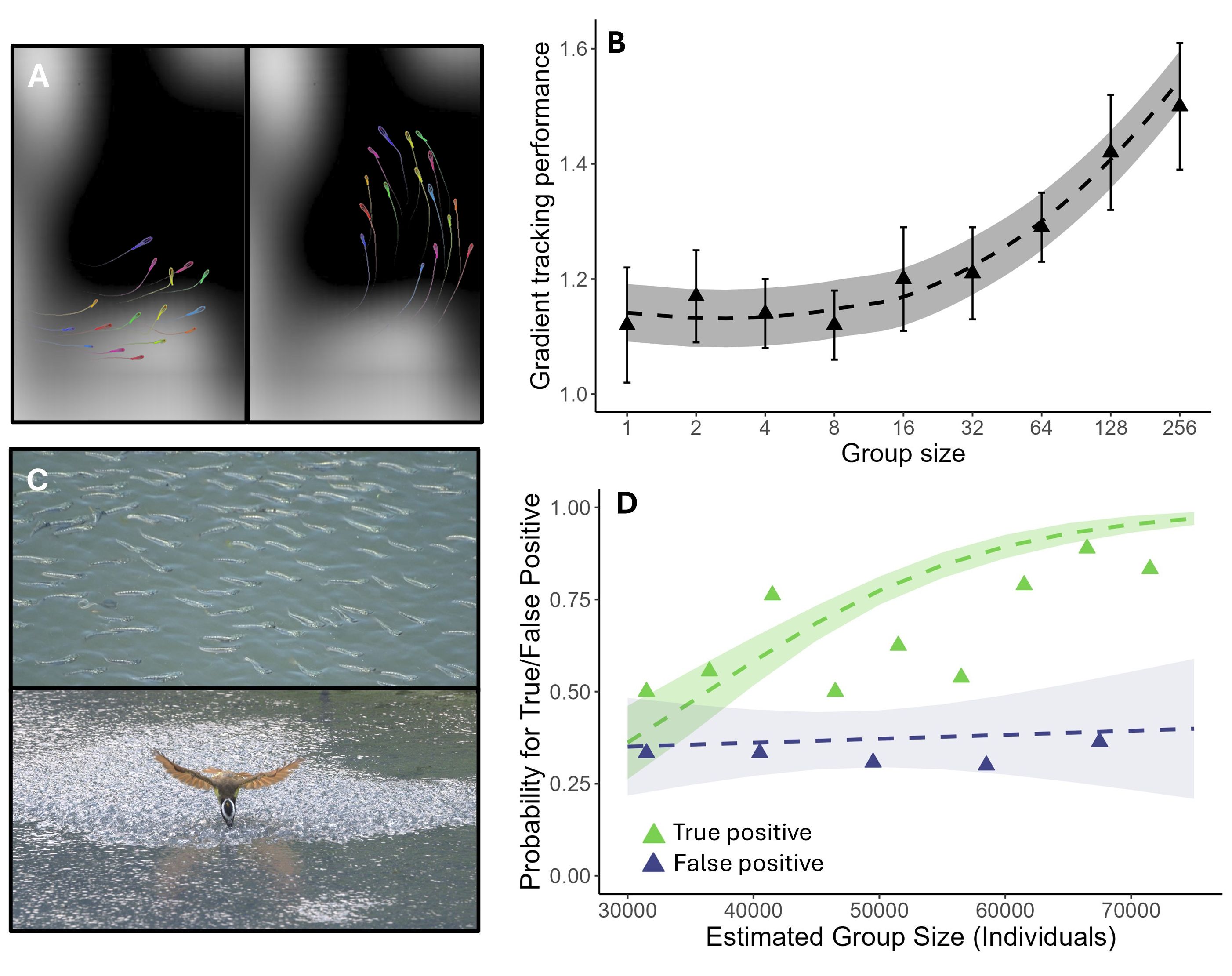
Gradient sensing in fish increases with shoal size. (A) Fish try to find the darker regions of the tank. The snapshots show the fish shoal successfully moving up the gradient into a dark patch. (B) Performance as a function of group size. The data points show the mean performance, and the error bars show twice the standard error. The dashed line is the statistical model’s fit to the data, and the shaded area is its 95% confidence interval. Redrawn from Berdahl et al. (2013). Artist credit: K.P., Humboldt University. Decision accuracy increases with shoal size in fish. Fish at the water surface (C) need to distinguish between a bird attack (D) and a situation in which a harmless bird flew over the fish shoal without attack. Only the real attack requires the fish to dive down. (E) Diving probability for fish shoals when attacked by a bird (true positive probability) increased with shoal size, whereas diving probability in response to a harmless overflight (false positive) did not change as a function of shoal size. Triangles represent binned mean true/false positive rates, and dashed lines represent model-predicted regression fits with standard error on raw data. Redrawn from Pacher et al. (2025). Artist credit: K.P., Humboldt University.
Quorum decisions
Mechanisms by which individuals can arrive at collective intelligence range from simple averaging to majority decisions and flexible quorum decisions (Sumpter, 2006). Quorums imply that a threshold number of individuals has to support a certain decision before it is adopted by the rest of the group. Empirical research has shown that groups are capable of setting the quorum threshold in a self-organized and adaptive way. When high-quality information is available in groups, individuals set higher quorum thresholds, resulting in more accurate decision-making. In addition, diversity in problem-solving among participants and the degree of turn-taking among group members have been shown to improve collective performance in humans (Woolley et al., 2010).
Questions, controversies, and new developments
The role of the environment
Little is known about the environmental conditions under which collective intelligence evolves and when it fails. An exception is the topic of collective gradient sensing, in which the environmental conditions are known to be crucial to outperform solitary behavior. Individuals can only measure the local stimulus intensity whereby independent measurements cancel out errors. No individual needs to compute the gradient explicitly, and the direction for climbing the gradient is an emergent property of the group (Berdahl et al., 2013). However, if gradient directions change quickly, the benefits of collective gradient sensing are likely to decrease because groups are slow in responding to change.
Group size and composition
In humans, there is an ongoing debate regarding the most suitable group sizes and compositions for committees, think tanks, and expert groups in relation to the specific problems that they are meant to address. Decision performance often increases with group size and group diversity but not necessarily always so. Wishful thinking, biases because of self-interest, lack of independent information, social influence, and an inability to sufficiently judge the problem at hand can limit decision performance (Becker et al., 2017; Lorenz et al., 2011). Also, larger groups often take more time for decisions and therefore may reduce decision efficiency. Diversity of views can also result in communication barriers, making it harder for individuals to understand each other and thereby limiting the extent to which independent information can be utilized.
The temporal dimension in decisions
An additional frontier in collective intelligence research in animals and humans explores the temporal dimension, where groups decide when to act. Novel theoretical frameworks that incorporate time’s irreversibility and speed–accuracy tradeoffs regarding the timing of collective decisions could unlock fundamentally different collective mechanisms, expanding the understanding of group decision-making across biological systems (Kao et al., 2024).
Integrating artificial intelligence into human decisions
The recent arrival of large language models has been interpreted by some authors as an opportunity for collective decision-making [see Large Language Models]. Integrating artificial intelligence (AI) into human decision-making may have the potential to improve decisions. In these hybrid collectives, AI may help by aggregating knowledge, accelerating idea generation, mediating language barriers, and synthesizing consensus from massive inputs. Thus, at the current state, AI can serve as a multiplier or facilitator of collective information processing. However, risks include the undermining of collective intelligence by creating illusions of consensus, artificially reducing group member diversity through homogenization, and facilitating the rapid spread of misinformation. Close monitoring and further research are needed to see if the benefits outweigh these risks (Burton et al., 2024).
Generality of collective intelligence
It has been argued that all intelligence could be seen as collective intelligence (Falandays et al., 2023). In collective intelligence, individuals are connected through social interactions, which has strong analogies to nervous systems where nerve cells are connected through synapses. In both cases, intelligent, problem-solving behavior is an emergent property of computational processes on dynamic networks.
Broader connections
An understanding of how collective intelligence works in nonhuman animal groups has frequently been the blueprint for creating intelligent technology and has resulted in many applications. For example, search algorithms inspired by the pheromone trails of ants and their ability to find the shortest paths between nest and food source have attracted much attention, leading to many bio-inspired technological applications. Collective intelligence is widely used as an organizational principle for robot swarms such as drones. Bio-inspired algorithms have also been used to promote collective intelligence in medical decision-making to improve the diagnosis of skin and breast cancers (Kurvers et al., 2016).
Educational environments have traditionally been optimized for the development of individual learning and intelligence. However, it has been argued that an important goal for societies could be to reduce the emphasis on competition and promote collaboration through educational principles that nurture the collective intelligence potential of individuals in groups (Scardamalia & Bereiter, 2006; Woolley et al., 2010).
Further reading
Bonabeau, E., Dorigo, M., & Theraulaz, G. (1999). Swarm intelligence: From natural to artificial systems. Oxford University Press.
Camazine, S., Deneubourg, J.-L., Franks, N. R., Sneyd, J., Theraulaz, G., & Bonabeau, E. (2001). Self-organization in biological systems. Princeton University Press.
Falandays, J. B., Kaaronen, R. O., Moser, C., Rorot, W., Tan, J., Varma, V., Williams, T., & Youngblood, M. (2023). All intelligence is collective intelligence. Journal of Multiscale Neuroscience, 2(1), 169-191. https://doi.org/10.56280/1564736810
Galesic, M., Barkoczi, D., Berdahl, A. M., Biro, D., Carbone, G., Giannoccaro, I., Goldstone, R. L., Gonzalez, C., Kandler, A., Kao, A. B., Kendal, R., Kline, M., Lee, E., Massari, G. F., Mesoudi, A., Olsson, H., Pescetelli, N., Sloman, S. J., Smaldino, P. E., & Stein, D. L. (2023). Beyond collective intelligence: Collective adaptation. Journal of the Royal Society Interface, 20(200), 20220736. https://doi.org/10.1098/rsif.2022.0736
References
Becker, J., Brackbill, D., & Centola, D. (2017). Network dynamics of social influence in the wisdom of crowds. Proceedings of the National Academy of Sciences, 114(26), E5070–E5076. https://doi.org/10.1073/pnas.1615978114
↩Berdahl, A. M., Kao, A. B., Flack, A., Westley, P. A. H., Codling, E. A., Couzin, I. D., Dell, A. I., & Biro, D. (2018). Collective animal navigation and migratory culture: From theoretical models to empirical evidence. Philosophical Transactions of the Royal Society B: Biological Sciences, 373(1746), 20170009. https://doi.org/10.1098/rstb.2017.0009
↩Berdahl, A., Torney, C. J., Ioannou, C. C., Faria, J. J., & Couzin, I. D. (2013). Emergent sensing of complex environments by mobile animal groups. Science, 339(6119), 574-576. https://doi.org/10.1126/science.1225883
↩Burton, J. W., Lopez-Lopez, E., Hechtlinger, S., Rahwan, Z., Aeschbach, S., Bakker, M. A., Becker, J. A., Berditchevskaia, A., Berger, J., Brinkmann, L., Flek, L., Herzog, S. M., Huang, S., Kapoor, S., Narayanan, A., Nussberger, A.-M., Yasseri, T., Nickl, P., Almaatouq, A., … Hertwig, R. (2024). How large language models can reshape collective intelligence. Nature Human Behaviour, 8(9), 1643–1655. https://doi.org/10.1038/s41562-024-01959-9
↩Couzin, I. D. (2009). Collective cognition in animal groups. Trends in Cognitive Sciences, 13(1), 36-43. https://doi.org/10.1016/j.tics.2008.10.002
↩Falandays, J. B., Kaaronen, R. O., Moser, C., Rorot, W., Tan, J., Varma, V., Williams, T., & Youngblood, M. (2023). All intelligence is collective intelligence. Journal of Multiscale Neuroscience, 2(1), 169-191. https://doi.org/10.56280/1564736810
↩Galton, F. (1907). Vox populi. Nature, 75, 450-451. https://doi.org/10.1038/075450a0
↩Kao, A. B., Banerjee, S. C., Francisco, F. A., & Berdahl, A. M. (2024). Timing decisions as the next frontier for collective intelligence. Trends in Ecology & Evolution, 39(10), 904-912. https://doi.org/10.1016/j.tree.2024.06.003
↩Krause, J., Ruxton, G. D., & Krause, S. (2010). Swarm intelligence in animals and humans. Trends in Ecology & Evolution, 25(1), 28-34. https://doi.org/10.1016/j.tree.2009.06.016
↩Kurvers, R. H. J. M., Herzog, S. M., Hertwig, R., Krause, J., Carney, P. A., Bogart, A., Argenziano, G., Zalaudek, I., & Wolf, M. (2016). Boosting medical diagnostics by pooling independent judgments. Proceedings of the National Academy of Sciences, 113(31), 8777-8782. https://doi.org/10.1073/pnas.1601827113
↩Lorenz, J., Rauhut, H., Schweitzer, F., & Helbing, D. (2011). How social influence can undermine the wisdom of crowd effect. Proceedings of the National Academy of Sciences, 108(22), 9020-9025. https://doi.org/10.1073/pnas.1008636108
↩Pacher, K., Bierbach, D., Sevinchan, Y., Vollmoeller, C., Juarez-Lopez, A., Jiménez-Jiménez, J. E., Krause, S., Romanczuk, P., Arias-Rodríguez, L., & Krause, J. (2025). Better and faster collective decisions by larger fish shoals in the wild. Science Advances, 11(31), eadt8600. https://doi.org/10.1126/sciadv.adt8600
↩Rackham, H. (1932). Aristotle: Politics. Harvard University Press.
↩Scardamalia, M., & Bereiter, C. (2006). Knowledge building: Theory, pedagogy, and technology. In K. Sawyer (Ed.), Cambridge handbook of the learning sciences (pp. 97-118). Cambridge University Press.
↩Sumpter, D. J. T. (2006). The principles of collective animal behaviour. Philosophical Transactions of the Royal Society B: Biological Sciences, 361(1465), 5-22. https://doi.org/10.1098/rstb.2005.1733
↩Woolley, A. W., Chabris, C. F., Pentland, A., Hashmi, N., & Malone, T. W. (2010). Evidence for a collective intelligence factor in the performance of human groups. Science, 330(6004), 686-688. https://doi.org/10.1126/science.1193147
↩