Pictures are puzzling. On the one hand, there is the fact of pictorial diversity: pictures are artifacts produced for a diverse range of purposes, using a variety of methods and materials, and exemplifying many different styles. On the other hand, there is general agreement, at least among philosophers, that depiction is a functional kind. Whether an artifact is a picture depends, broadly speaking, on the way it is used, on how intended viewers are supposed to interpret or respond to it. This suggests that there may be theoretically interesting unity beneath the apparent diversity. But what function do different types of pictures characteristically perform? What is essential to picturing? One starting point is the idea that depiction, unlike language, is a distinctively visual form of representation. To interpret a photograph of an object, for example, you need to see it, and what you understand, when you look at the photograph, concerns the way the depicted object visually appears (or appeared) relative to a certain spatial point of view. Neither of these things need be true of a description of an object. The idea that pictures are distinctively visual representations, although intuitive, has been developed in a variety of competing ways. In particular, there is room for debate concerning both the respects in which depiction is distinctively visual as well as the relevant notion of representation.
History
Anatomically modern Homo sapiens evolved in Africa at least 300,000 years ago. The earliest known figurative images—cave paintings of animals (and more rarely people)—only begin to appear much later in the archaeological record, during a period in the Upper Paleolithic sometimes referred to as the transition to “behavioral modernity” (see Figure 1). Although the development of pictorial art is often interpreted as a milestone in the evolution of human communication, marking the emergence of abilities to convey information about perceptibly absent objects and events via “external symbolic storage” (Renfrew & Scarre, 1998; Tversky, 2011), we should not presume that we fully understand the purpose(s) for which the first pictures were made. Interpretations of the archaeological record informed by our own familiar uses of pictures as tools for communicating visual information may provide a distorting lens through which to view images created in temporally and culturally remote contexts (Summers, 2003).
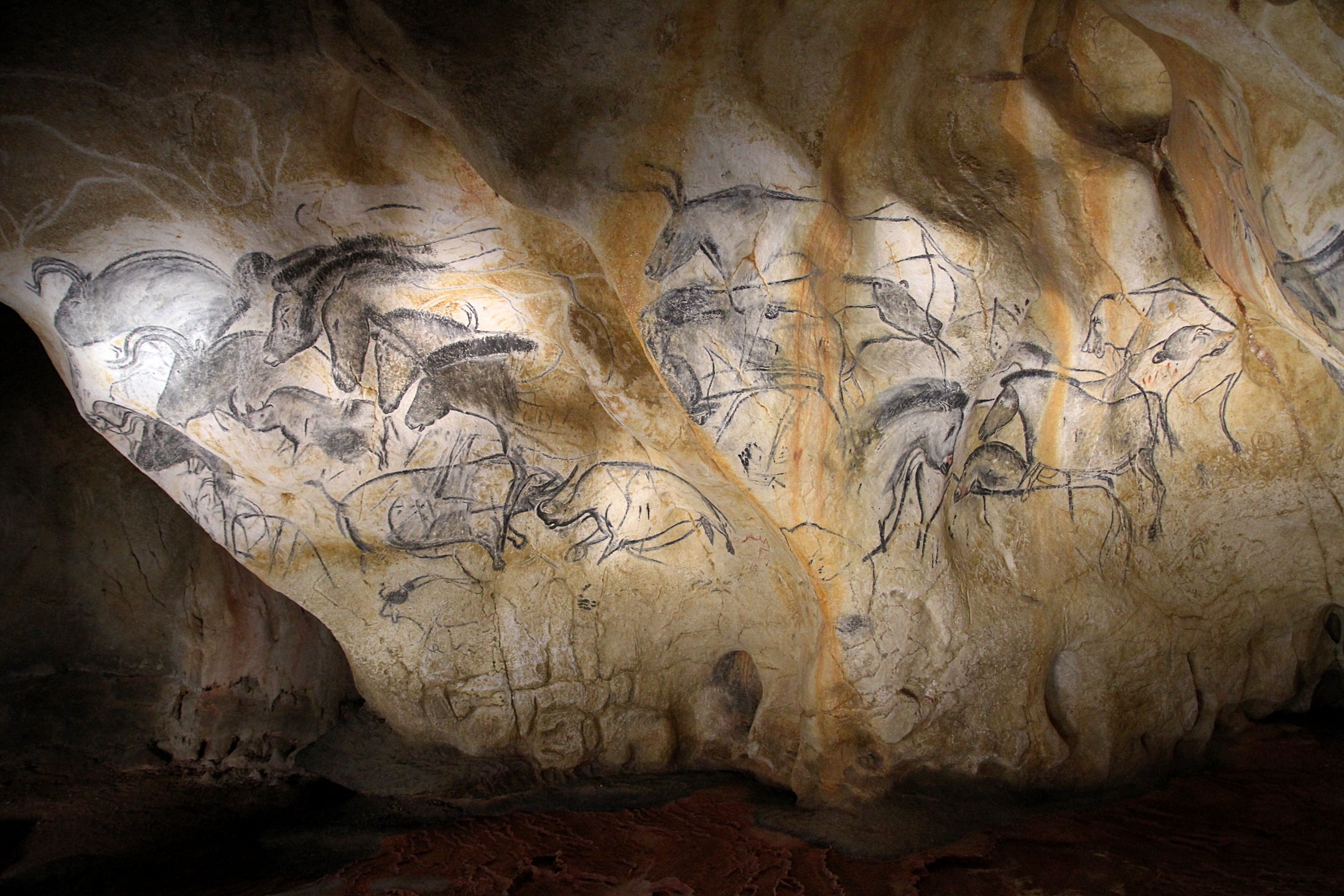
Replica of the Panel of the Horses, Chauvet Cave, France, c. 34,000 BCE. Photo credit: Claude Valette (CC BY-SA).
Depiction has long been understood as a form of mimesis or imitation. In Plato's dialogue Sophist (235d–236c), for example, image-making (eidōlopoiikē technē) divides into the making of faithful likenesses (eikastikē) and the making of semblances (phantastikē), the latter distorting a subject's true proportions so that the work looks correct from the viewer’s perspective. Illusionistic picture-making belongs to this second class. Images, the Eleatic Stranger pronounces, are “human-made dreams for those who are awake” (Plato, 360 BCE/2008). Sculptures were similarly regarded, in classical antiquity, as mimetic artifacts. According to Pliny the Elder, the art of modeling (plastice) portraits from clay was invented when the daughter of Butades, a potter of Sicyon, traced the shadow of her lover's face, and her father pressed clay onto the outline and formed a relief. In the Renaissance, methods of perspectival projection, pioneered by Filippo Brunelleschi and codified by Leon Battista Alberti in his 1435 treatise De Pictura, enhanced image makers’ abilities to emulate the visual appearance of voluminous objects and three-dimensionally organized scenes through 2D media. “The first intention of the painter,” Leonardo da Vinci wrote, “is to make a flat surface display a body as if modeled and separate from this plane” (quoted in Kemp, 1989, p. 15). A similar understanding of the aim of picture making later dominated reflection on depiction in the British Empiricist tradition in philosophy. “Perspective, shading, giving relief, and coloring,” Thomas Reid (1764/1819) tells us, “are nothing else but copying the appearance which things make to the eye” (p. 149). In the 19th century, Charles Sanders Peirce influentially referred to representation mediated by the sharing of properties or structure as iconic representation [see Iconicity]. Current debates in the philosophy of perception and cognitive science focus on the respects in which the iconic representational contents and formats differ from those of linguistic and propositionally articulated cognitive representations (Block, 2023; Burge, 2010, 2022).
There are many complementary ways to study the history of image making and visual culture from the Upper Paleolithic to the present. One approach—of special interest to the cognitive science of perception—focuses on the evolution of what might be called opticality in pictorial art, that is, the development of techniques used by image makers to achieve the appearance of depth, voluminous shape, interposition, surface color, shading, transparency, luminosity, and other visible features via 2D pictorial media. There is a vast literature dedicated to the emergence of linear perspective projection of 3D scenes during the Renaissance (Kemp, 1990; Kubovy, 1986; see Figure 2). However, cognitive scientists and art historians have also studied, to mention just a few examples, the use of occlusion cues in Upper Paleolithic cave images (Biederman & Kim, 2008), the construction of pictorial space in ancient and non-Western art traditions (Bell, 2007; Davis, 2017), methods for depicting transparency (Sayim & Cavanagh, 2011), and the “visual recipes” used to render the look of different materials (metal, glass, cloth, etc.) in Dutch Golden Age painting (Di Cicco, 2022). Opticality is a matter of degree. Stick figures and standardized pictographic symbols, such as the International Symbol of Access, reside at the minimally optical end of the spectrum, whereas photographs, movies, and computer-generated imagery reside at the maximally optical end of the spectrum. Most recent philosophical theories of depiction, including those discussed here, focus on explaining how highly optical, 3D scene–displaying pictures, like photographs and realistic paintings, relate to their subject matter.
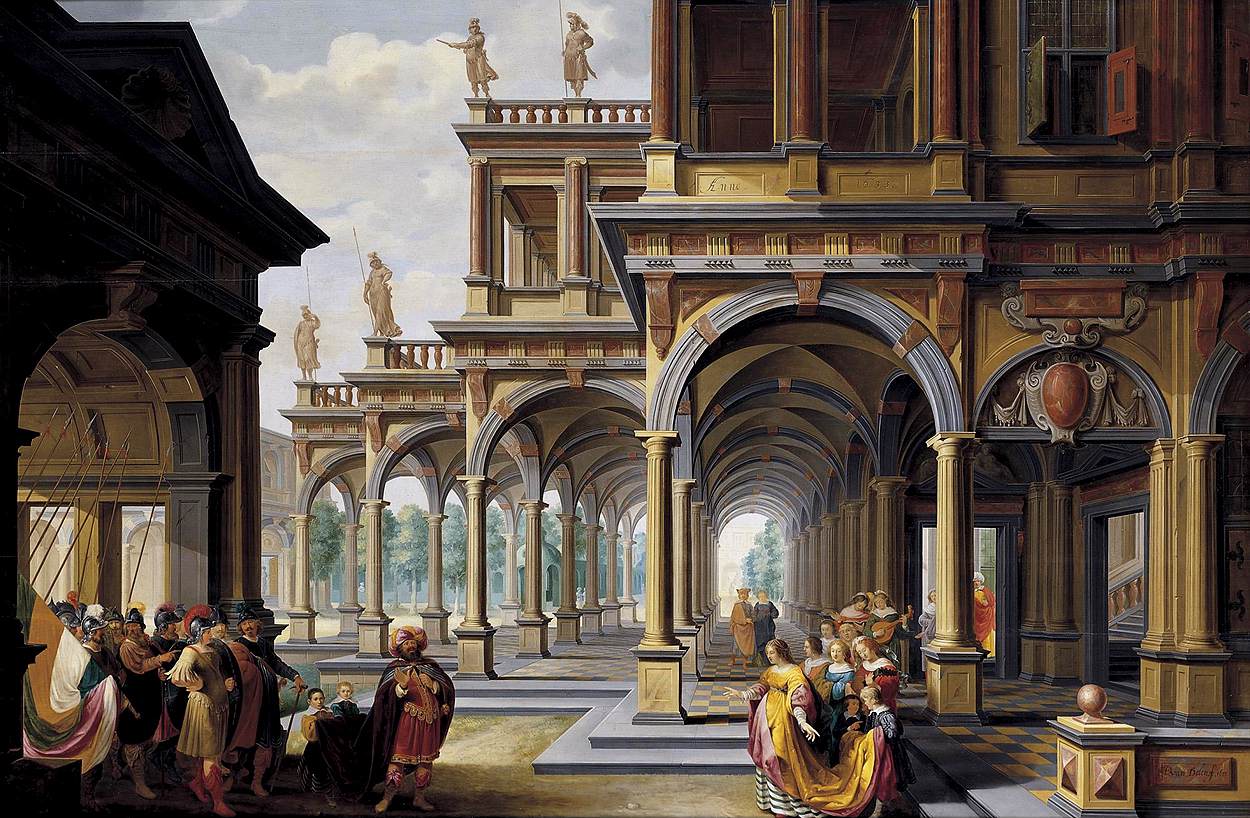
Painting in linear perspective and the appearance of 3D space: Architectural Capriccio With Jephthah and His Daughter, Dirck van Delen (1633).
Core concepts
A long line of philosophers identify intended resemblance as the key to understanding how pictures work. There is little contemporary consensus, however, on which resemblances govern the form of iconic representation that is distinctive of depiction.
Objective and experienced resemblance
Objective resemblance theories look to similarities that actually obtain between a picture and the object or scene that it depicts. The shape of a patch of color on a painting’s surface, for example, might exemplify an object’s silhouette or “occlusion shape” when seen from a certain point of view (Hyman, 2013). More broadly, the 2D array of color and lightness values displayed across a picture’s surface might mirror the 2D array of color and lightness values present to the eye when viewing the scene the picture depicts (Haugeland, 1991 and Kulvicki, 2006 refer to this array as the picture’s “bare bones” content, which, unlike the picture’s “fleshed out” content, abstracts from the dimension of depth).
Experienced resemblance theories, by contrast, utilize the idea of apparent as opposed to actual resemblance to explain depiction. In one version of this view, a painting depicts an object O just in case viewers are supposed to experience a region on the painting’s surface as resembling that of O in respect of its outline shape (Hopkins, 1998). Alternatively, the resemblance governing depiction might obtain between aspects of the subject’s visual experience when looking at a picture, on the one hand, and their visual experience when looking at the pictured scene, on the other (Budd, 1993; Peacocke, 1987).
Perceptualism
Experienced resemblance theories pursue a perceptualist approach to depiction; they appeal to how intended viewers perceptually respond to pictures when explaining how pictures perform their distinctive function. Perceptualism comes in many forms. So-called “illusionistic” approaches to depiction are rooted in vision science. Pictures reflect (or emit) light to the eye structured by many of the same sources of optical information as are present in the light reflected from real-world scenes [see Scene Perception]. Hence, a picture of a scene can have some of the same effects on the viewer’s visual system as would the scene itself when perceived from the picture’s point of view (Briscoe, 2016, in press; Gibson, 1979; Gombrich, 1961/2000). Relevant sources of optical information include, but are not limited to, occlusion, texture gradients, shadows, reflections, relative size, familiar size, linear perspective, atmospheric haze, and height in the visual field (Ames, 1925; Kennedy, 1974; Koenderink & van Doorn, 2003). The informational continuity between ordinary seeing and picture perception explains why many familiar types of pictures elicit an experience of pictorial space beyond the picture plane (Kemp, 1990; Kubovy, 1986). It also explains why it is commonplace in vision science to make use of pictures—typically photographs and computer-generated images—in psychophysical research on scene perception (Koenderink, 1999), studies of natural scene statistics (Geisler, 2008), neuroimaging experiments (Chang et al., 2019), studies of feature representation in deep neural networks (Fleming & Storrs, 2019), and other areas of investigation.
Seeing-in
Other perceptualist accounts of depiction rely less on empirical grounding. One of the most influential approaches defines depiction in terms of a sui generis experience elicited by pictures called “seeing-in” (Wollheim, 1987). This experience is characterized as phenomenologically “twofold”: when a viewer sees and understands a picture, they are concurrently aware of the design on the 2D surface and of the 3D scene it depicts. The theory holds that these two aspects are integrated in a way that makes it difficult, if not impossible, to relate to ordinary, nonpictorial seeing. On this point, the theory challenges views according to which viewers must instead alternate between competing 2D and 3D interpretations of the light reflected from or emitted by a picture’s surface (Gombrich, 1961/2000).
Imagining seeing
Some theorists offer different accounts of our engagement with photographs and handmade pictures. In the imagining seeing theory (Walton, 1990), handmade pictures, like paintings and drawings, function as props in games of visual make-believe. Successfully interpreting a painting of a landscape, for example, depends on the viewer’s ability to imagine of their actual perceiving of the canvas that it is an experience of seeing the depicted landscape itself. By contrast, the mechanical process whereby photographs are produced obviates a role for imagination and makes them “transparent” to the objects they depict; the viewer is able to see through a photograph of Winston Churchill to Churchill himself (Walton, 1984). In this view, both handmade pictures and photographs function as props in visual make-believe; what sets photographs apart is that their transparency makes engagement with them continuous with ordinary, nonpictorial seeing in a way that engagement with a handmade picture is not.
Recognition
Recognition-based theories of depiction offer yet another perspective on the perceptual response most relevant to understanding depiction. According to the recognition approach, pictures crucially engage our visual capacity to recognize whatever is depicted on the basis of its appearance (Lopes, 1996; Schier, 1986). Theories diverge, however, regarding how best to characterize the relevant notion of recognition. In one approach, in order to understand a painting that depicts a horse, the viewer must successfully recognize a horse in the painting (Lopes, 1996). In other approaches, the relevant act of categorization is erroneous (a false positive), like mistaking a cow for a horse on a dark night. The error, further, is one made by the visual system and not by the perceiver, who normally has access to optical information that specifies the presence of the pictorial surface (Currie, 2009; Newall, 2009).
Structural and projectivist theories
Perceptualist accounts of depiction focus on the distinctively visual nature of pictorial representation. Structural and projectivist theories, by contrast, seek to understand depiction independently of how pictures are visually perceived. What makes a representation R pictorial, according to structural accounts, is not how we perceptually respond to R—rather, it is the syntactic and semantic features of the system to which R belongs (Goodman, 1976; Kulvicki, 2006). Recent projectivist accounts similarly avoid appeal to perceptual facts when explaining depiction, focusing instead on the rules that govern different projective mappings from the structure of a 3D scene to the configuration of 2D features on the picture plane (Greenberg, 2013).
Questions, controversies, and new developments
J. J. Gibson (1980) once quipped, “Most people think they know what a picture is. Anything so familiar must be simple. They are wrong.” As should be clear, there is still substantial disagreement when it comes to the nature of depiction. One area of central philosophical debate for perceptualist theories concerns the nature of pictorial experience. Many questions remain open in the literature. Is the experience elicited by a picture in its viewers properly perceptual in nature, as illusionistic theories maintain? Or does it instead centrally involve an act of pretense (make-believe)? Do handmade pictures trigger different responses in their viewers than do photographs and other mechanically produced pictures? Finally, what is the appropriate characterization of what is sometimes described as the “duality” of pictorial experience? When we look at a picture, do we alternate between awareness of the 2D pictorial surface and awareness of the depicted 3D scene (Gombrich, 1961/2000)? Or do we typically experience both the surface and scene at once (Wollheim, 1987)? Research in cognitive science and philosophy concerning the different sources of optical information and visual processing mechanisms that respectively support pictorial space perception and ordinary, nonpictorial seeing may help to throw light on these and other questions (Briscoe, 2018, in press; Linton, 2023; Vishwanath, 2014, 2023).
The connection between depiction and representation
An even more foundational question concerns the assumed connection between depiction and representation. It is uncontroversial that, in one familiar, nontechnical sense of the term “representation,” a picture of a horse represents a horse. This is the sense in which figurative art, including figurative sculpture, intuitively contrasts with abstract art, so we can call it the merely mimetic or “figurative” sense of representation.
Language is clearly not a form of figurative representation; a description of a horse, in contrast with a painting or sculpture of a horse, does not display the visual appearance or likeness of a horse (putting aside imitative gestures of various kinds that might accompany the words used in such a description). Language is a form of representation, however, in the sense that it is a public tool for storing and communicating information between individuals [see Meaning]. Call this the “communicative” sense of representation. Systems of communicative representations are minimally characterized by sets of vehicles (items or structures that do the work of representing) and sets of contents (different states of affairs that can be represented by different vehicles). Representational vehicles always have variable aspects or parts (Millikan, 2004). Transformations that alter how a given vehicle is constructed give rise, in a systematic way, to corresponding differences in the vehicle’s content and, so, to corresponding differences in how its users are guided by the vehicle in their cognitive and practical undertakings [see Compositionality].
Silk flowers, scarecrows, movie set façades, Halloween masks, topiary animals, decoy ducks, and the acanthus leaves on the capitals of Corinthian columns are all plausible examples of representations in the first, figurative sense of the term “representation” but not in the second, communicative sense of the term. The job of a topiary lion, for example, is not to guide the way its viewers engage in practical or theoretical activities directed in relation to lions. A topiary lion could, of course, be repurposed to answer questions concerning the visual appearance of a real lion, but that is typically not its primary function. Figurative representations, it should be noted, belong to a wider class of noncommunicative, mimetic artifacts, many of which exploit nonvisual media. Nonvisual examples include artificial flavors and fragrances, food substitutes like margarine and vegetarian bacon, the felt textures of faux fabrics, and the sounds of synthesized musical instruments. None of these mimetic artifacts plausibly function as representations in the communicative, information-conveying sense of the term.
Most philosophical theories of depiction have been structured by the typically unargued assumption that depiction is not only a form of figurative representation but is also a form of communicative representation. More specifically, philosophical work on depiction typically begins from the assumption that pictures are vehicles for conveying information about the way an object or scene visually appears relative to a particular point of view. “[W]hen we encounter pictures,” Robert Hopkins, for instance, writes, “we encounter objects that are patently communicative episodes. They are messages in a bottle of the visual world” (Hopkins, 2006, p. 156). With this assumption in place, theories of depiction are then tasked with delineating the respects in which pictorial or image-based systems of representation are similar to and different from language-based systems of representation.
It is uncontroversial that we sometimes use pictures as vehicles for communicating information about the way their objects look or visually appear (for example, scientific illustrations and passport photographs). In relevant cases, pictures function as signs—in a broad sense of the term—that mediate between cooperating “senders” and “receivers” (Godfrey-Smith, 2017). They serve to answer questions about an object (or scene) by displaying aspects of its visual appearance. What could be called the “communicative model” of depiction assumes something stronger: that (figurative) pictures, in general, are vehicles of representational content that attribute visual features to their objects. The communicative model has guided philosophical reflection on depiction over the last 50 years. It has also sometimes informed work outside of philosophy on the development of communicative representation on both phylogenetic (Renfrew & Scarre, 1998) and ontogenetic timescales (DeLoache, 2004).
Commitment to the communicative, visual information-conveying model of depiction is prevalent but not universal. Ernst Gombrich (1951/1963) presents an opposing perspective. Many pictures, he argues, perform an essentially substitutive or surrogative function. They do not “stand for” the objects they depict but “stand in” for them. A picture P that depicts and displays the visual appearance of some object O may not be intended to answer questions or communicate information about O’s visible features. Instead, P may display O’s visual appearance (or selected aspects thereof) in order that P perform some role or achieve some effect performed or achieved by O itself (see Wiesing, 2010 and Briscoe, 2016 for different ways of developing this thought). The communicative model, if Gombrich is right, may overintellectualize depiction and overlook the variety of purposes to which our picture-making practices are put.
Symbolic uses of pictures
In addition to distinguishing between figurative representation and communicative representation by means of depiction, it is also important to note the wide variety of symbolic uses to which pictures may be put. A picture of a lion, by definition, depicts a lion, but the likeness of a lion may be conventionally used to symbolize a particular individual, an institution, a nation, or an abstract quality (like courage or sovereignty; see Figure 3). Unlike depiction, symbolization can connect an image to anything whatsoever, including things that have no visual appearance at all. Theories of depiction proper typically do not take on the burden of explaining pictorial symbolization, which is governed by different principles and engages different cognitive capacities.

The Royal Coats of Arms of the United Kingdom depicts a lion, which in turn is a symbol of England. Licensed under CC BY-SA 3.0.
Broader connections
Theoretical work on the nature of depiction has historically been carried out almost entirely within philosophy and art history.
The major exception is the ecological tradition in psychology, which has developed substantive accounts of how pictures function, continuous with its broader theory of visual perception (Gibson, 1979; Hagen, 1986; Kennedy, 1974). Outside this tradition, cognitive scientists have rarely taken up the question of what makes something a picture. This is not to say that pictures play no role in cognitive science—quite the contrary—but the empirical literatures in which pictures figure typically presuppose a conception of depiction rather than defend one, and they pursue questions that are often distinct from the questions addressed by philosophical theories of depiction. Four of these adjacent literatures deserve mention.
Pictorial space perception
A substantial body of empirical research investigates the optical information and visual processing mechanisms that enable viewers to experience depth and 3D structure when looking at flat pictorial surfaces (Ames, 1925; Kennedy, 1974; Koenderink & van Doorn, 2003; Kubovy, 1986; Vishwanath, 2023). Key questions concern whether the visual system systematically compensates for oblique viewing angles to eliminate perspective distortion (Pirenne, 1970), whether binocular information specifying the 2D surface results in a compressed or flattened impression of depth (Koenderink et al., 1994; Schlosberg, 1941; Vishwanath, 2014), and whether the geometry of pictorial space—in particular the scaling of virtual depth—varies across individual observers (van Doorn et al., 2012).
Pictorial space perception is plausibly an important ingredient of depiction on perceptualist accounts, but it should not be conflated with depiction itself. Indeed, the dominant psychological explanation, outlined above, of why we experience depth in 2D images is not specific to pictorial artifacts—it applies equally to natural images, like camera obscura projections, as well as to “accidental images,” like stains on a wall or patterns in landscape agate that give the appearance of an object or scene (Wollheim, 1987; see Figure 4).
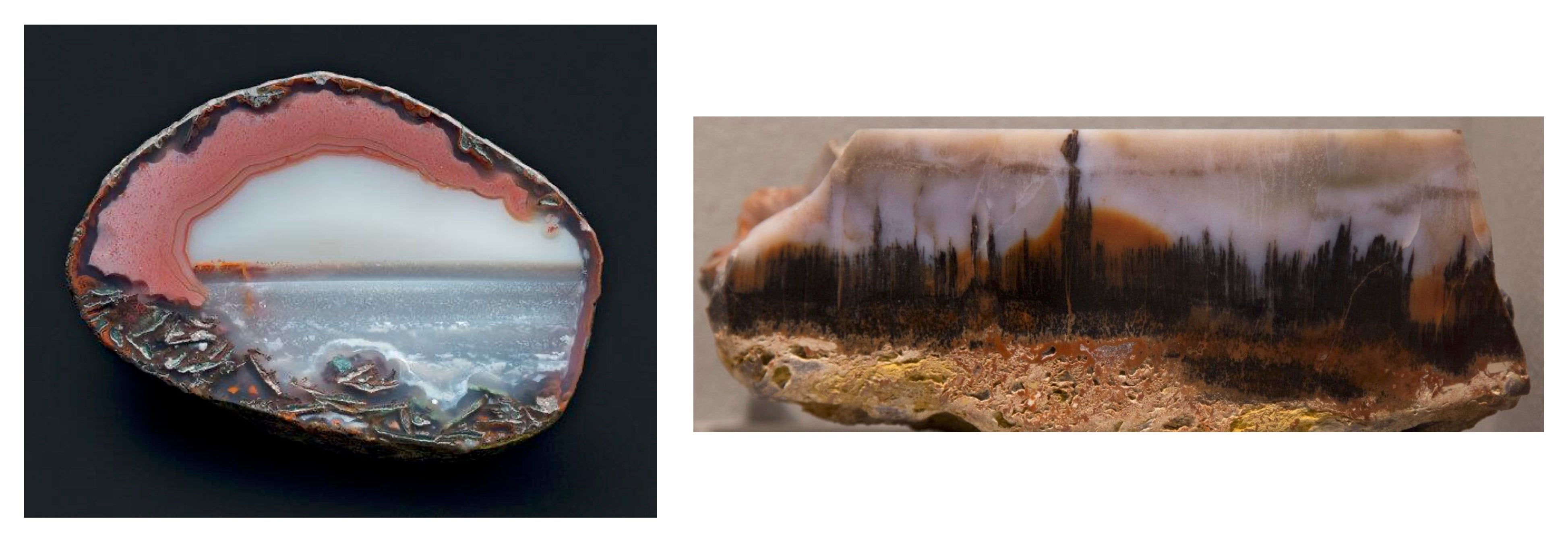
Accidental images in landscape agate. What do you see? Left credit: National Museum of Scotland, Edinburgh, CC BY-NC-ND 4.0. Right credit: Photo by Kevin McGee, CC BY-NC-SA 2.0.
Pictorial competence
Developmental psychologists have investigated how children come to understand pictures as a distinctive kind of artifact—when, for instance, they are able to perceptually distinguish a picture from its object or learn to exploit the informational potential of depiction. This research, however, typically takes for granted, rather than defends, a particular conception of what depiction is. In particular, it typically assumes that pictures are vehicles of communicative representation (see, e.g., DeLoache, 2004).
If, as substitutive models of depiction suggest, many figurative pictures do not have an information-conveying purpose (Gombrich, 1951/1963), then the development of pictorial understanding may require less cognitive sophistication than the communicative model implies.
Diagrams and diagrammatic reasoning
A separate literature investigates the comprehension and use of diagrams, graphs, and other abstract visual displays (Hegarty, 2011; Heiser & Tversky, 2006; Larkin & Simon, 1987; Norman, 1991; for a helpful overview, see Shin et al., 2025). Whereas work on pictorial space perception asks how flat surfaces can yield experiences of 3D objects and scenes, work on diagrammatic reasoning typically focuses on how the different types of visual structure exhibited by 2D diagrams help us solve logical, mathematical, or spatial problems. These visual structures serve as tools for cognitive offloading, shifting the computational burden from internal memory, inference, and mental simulation onto perceptual routines operating over stable patterns in the external world—thereby changing which computations are performed (Kirsh, 2010) [see Cognitive Artifacts].
Mental imagery and representational format
Cognitive science has long debated whether mental images have an iconic or propositional representational format [see Mental Imagery]. On the iconic view, visual imagery represents in a functionally depictive format whose spatial structure mirrors that of the represented scene (Kosslyn et al., 2006); on the propositional view, the apparently pictorial character of imagery reflects aspects of what is represented (a possible visible scene) rather than the underlying format, which is language-like (Pylyshyn, 2003). More recently, the iconic–propositional distinction has been pressed into broader service. On one prominent recent proposal, it marks the border between perception and cognition in mental architecture (Block, 2023). These debates concern the format of internal mental representations, however, not the nature of external, artifactual pictures, which is the topic of this entry [see Mental Representation].
In each of these four areas, philosophical work on the nature of depiction provides a theoretical backdrop against which more specific empirical questions about pictures can be sharpened. Conversely, empirical findings in vision science, developmental psychology, and other relevant areas of cognitive science impose constraints on what an ultimately defensible philosophical theory of depiction should look like.
Further reading
Gombrich, E. H. (2000). Art and illusion: A study in the psychology of pictorial representation. Princeton University Press. (Original work published 1961)
Hecht, H., Schwartz, R., & Atherton, M. (Eds.). (2003). Looking into pictures: An interdisciplinary approach to pictorial space. MIT Press.
Koenderink, J. J. (2012). Pictorial space. De Clootcrans Press.
Kulvicki, J. (2014). Images. Routledge.
References
Ames, A. (1925). The illusion of depth from single pictures. Journal of the Optical Society of America, 10(2), 137-147. https://doi.org/10.1364/JOSA.10.000137
↩Bell, D. (2007). Hokusai’s project: The articulation of pictorial space. Brill.
↩Biederman, I., & Kim, J. G. (2008). 17,000 years of depicting the junction of two smooth shapes. Perception, 37(1), 161-164. https://doi.org/10.1068/p5907
↩Block, N. (2023). The border between seeing and thinking. Oxford University Press.
↩Briscoe, R. (2016). Depiction, pictorial experience, and vision science. Philosophical Topics, 44(2), 43-81. https://doi.org/10.5840/philtopics201644217
↩Briscoe, R. (2018). Gombrich and the duck-rabbit. In M. Beaney, B. Harrington, & D. Shaw (Eds.), Aspect perception after Wittgenstein: Seeing-as and novelty (pp. 49-88). Routledge.
↩Briscoe, R. (in press). Depiction and sensory engineering. Philosophy.
↩Budd, M. (1993). How pictures look. In D. Knowles & J. Skorupski (Eds.), Virtue and taste (pp. 154-175). Blackwell.
↩Burge, T. (2010). Origins of objectivity. Oxford University Press.
↩Burge, T. (2022). Perception: First form of mind. Oxford University Press.
↩Chang, N., Pyles, J. A., Marcus, A., Gupta, A., Tarr, M. J., & Aminoff, E. M. (2019). BOLD5000, a public fMRI dataset while viewing 5000 visual images. Scientific Data, 6(1), 49. https://doi.org/10.1038/s41597-019-0052-3
↩Currie, G. (2009). Art of the paleolithic. In S. Davies, K. Higgins, R. Hopkins, R. Stecker, & D. Cooper (Eds.), A companion to aesthetics (2nd ed., pp. 1-10). Wiley-Blackwell.
↩Davis, W. (2017). Visuality and virtuality: Images and pictures from prehistory to perspective. Princeton University Press.
↩DeLoache, J. S. (2004). Becoming symbol-minded. Trends in Cognitive Sciences, 8(2), 66-70. https://doi.org/10.1016/j.tics.2003.12.004
↩Di Cicco, F. (2022). The legacy of Willem Beurs‒Bridging the gap between art and material perception. Art & Perception, 10(2), 111-136. https://doi.org/10.1163/22134913-bja10037
↩Fleming, R. W., & Storrs, K. R. (2019). Learning to see stuff. Current Opinion in Behavioral Sciences, 30, 100-108. https://doi.org/10.1016/j.cobeha.2019.07.004
↩Geisler, W. S. (2008). Visual perception and the statistical properties of natural scenes. Annual Review of Psychology, 59, 167-192. https://doi.org/10.1146/annurev.psych.58.110405.085632
↩Gibson, J. J. (1979). The ecological approach to visual perception. Houghton Mifflin.
↩Gibson, J. J. (1980). Foreword: A prefatory essay on the perception of surfaces versus the perception of markings on a surface. In M. Hagen (Ed.), The perception of pictures (Vol. 1, pp. xi-xvii). Academic Press.
↩Godfrey-Smith, P. (2017). Senders, receivers, and symbolic artifacts. Biological Theory, 12(4), 275-286. https://doi.org/10.1007/s13752-017-0276-4
↩Gombrich, E. H. (1963). Meditations on a hobby horse. In Meditations on a hobby horse and other essays on the theory of art (pp. 1-11). Phaidon. (Original work published 1951)
↩Gombrich, E. H. (2000). Art and illusion: A study in the psychology of pictorial representation. Princeton University Press. (Original work published 1961)
↩Goodman, N. (1976). Languages of art (2nd ed.). Hackett.
↩Greenberg, G. (2013). Beyond resemblance. Philosophical Review, 122(2), 215-287. https://doi.org/10.1215/00318108-1963716
↩Hagen, M. (1986). Varieties of realism: Geometries of representational art. Cambridge University Press.
↩Haugeland, J. (1991). Representational genera. In W. Ramsey, S. Stich, & D. Rumelhart (Eds.), Philosophy and connectionist theory (pp. 61-89). Lawrence Erlbaum Associates.
↩Hegarty, M. (2011). The cognitive science of visual‐spatial displays: Implications for design. Topics in Cognitive Science, 3(3), 446-474. https://doi.org/10.1111/j.1756-8765.2011.01150.x
↩Heiser, J., & Tversky, B. (2006). Arrows in comprehending and producing mechanical diagrams. Cognitive Science, 30(3), 581-592. https://doi.org/10.1207/s15516709cog0000_70
↩Hopkins, R. (1998). Picture, image, and experience. Cambridge University Press.
↩Hopkins, R. (2006). The speaking image: Visual communication and the nature of depiction. In M. Kieran (Ed.), Contemporary debates in aesthetics and the philosophy of art (pp. 135-159). Blackwell.
↩Hyman, J. (2013). Depiction. Royal Institute of Philosophy Supplement, 71, 129-150. https://doi.org/10.1017/S1358246112000276
↩Kemp, M. (1989). Leonardo on painting. Yale University Press.
↩Kemp, M. (1990). The science of art: Optical themes in western art from Brunelleschi to Seurat. Yale University Press.
↩Kennedy, J. (1974). A psychology of picture perception. Jossey-Bass Publishers.
↩Kirsh, D. (2010). Thinking with external representations. AI & Society, 25(4), 441-454. https://doi.org/10.1007/s00146-010-0272-8
↩Koenderink, J. J. (1999). Virtual psychophysics. Perception, 28(6), 669-674. https://doi.org/10.1111/bjop.12308
↩Koenderink, J. J., & van Doorn, A. (2003). Pictorial space. In H. Hecht, R. Schwartz, & M. Atherton (Eds.), Looking into pictures. MIT Press.
↩Koenderink, J. J., van Doorn, A., & Kappers, A. (1994). On so-called paradoxical monocular stereoscopy. Perception, 23, 583–594. https://doi.org/10.1068/p230583
↩Kosslyn, S., Thompson, W., & Ganis, G. (2006). The case for mental imagery. Oxford University Press.
↩Kubovy, M. (1986). The psychology of perspective and Renaissance art. Cambridge University Press.
↩Kulvicki, J. (2006). On images: Their structure and content. Clarendon Press.
↩Larkin, J. H., & Simon, H. A. (1987). Why a diagram is (sometimes) worth ten thousand words. Cognitive Science, 11(1), 65-100. https://doi.org/10.1016/S0364-0213(87)80026-5
↩Linton, P. (2023). Minimal theory of 3D vision: New approach to visual scale and visual shape. Philosophical Transactions of the Royal Society B: Biological Sciences, 378(1869), 20210455. https://doi.org/10.1098/rstb.2021.0455
↩Lopes, D. (1996). Understanding pictures. Clarendon Press.
↩Millikan, R. (2004). The varieties of meaning. MIT Press.
↩Newall, M. (2009). Pictorial experience and seeing. British Journal of Aesthetics, 49, 129-141. https://doi.org/10.1093/aesthj/ayp002
↩Norman, D. (1991). Cognitive artifacts. In J. M. Carroll (Ed.), Designing interaction: Psychology at the human-computer interface (pp. 17-38). Cambridge University Press.
↩Peacocke, C. (1987). Depiction. The Philosophical Review, 96(3), 383-410. https://doi.org/10.2307/2185226
↩Pirenne, M. H. (1970). Optics, painting, and photography. Cambridge University Press.
↩Plato. (2008). Sophist (B. Jowet,, Trans.). Project Gutenberg. (Original work published 360 BCE)
↩Pylyshyn, Z. (2003). Seeing and visualizing: It’s not what you think. MIT Press.
↩Reid, T. (1819). An inquiry into the human mind on the principles of common sense. Stirling and Slade. (Original work published 1764)
↩Renfrew, C., & Scarre, C. (Eds.). (1998). Cognition and material culture: The archaeology of symbolic storage. McDonald Institute for Archaeological Research.
↩Sayim, B., & Cavanagh, P. (2011). The art of transparency. i-Perception, 2(7), 679-696. https://doi.org/10.1068/i0459aap
↩Schier, F. (1986). Deeper into pictures. Cambridge University Press.
↩Schlosberg, H. (1941). Stereoscopic depth from single pictures. The American Journal of Psychology, 54(4), 601-605. https://doi.org/10.2307/1417214
↩Shin, S. J., Lemon, O., & Mumma, J. (2025). Diagrams and diagrammatical reasoning. In E. N. Zalta & U. Nodelman (Eds.), The Stanford encyclopedia of philosophy (Fall 2026 ed.). Stanford University Press.
↩Summers, D. (2003). Real spaces: World art history and the rise of western modernism. Phaidon.
↩Tversky, B. (2011). Visualizing thought. Topics in Cognitive Science, 3(3), 499–535. https://doi.org/10.1111/j.1756-8765.2010.01113.x
↩van Doorn, A. J., Koenderink, J. J., Leyssen, M. H., & Wagemans, J. (2012). Interaction of depth probes and style of depiction. i-Perception, 3(8), 528-540. https://doi.org/10.1068/i0500
↩Vishwanath, D. (2014). Toward a new theory of stereopsis. Psychological Review, 121(2), 151-178. https://doi.org/10.1037/a0035233
↩Vishwanath, D. (2023). From pictures to reality: Modelling the phenomenology and psychophysics of 3D perception. Philosophical Transactions of the Royal Society B: Biological Sciences, 378(1869), 20210454. https://doi.org/10.1098/rstb.2021.0454
↩Walton, K. (1984). Transparent pictures: On the nature of photographic realism. Critical Inquiry, 11(2), 246-277. https://doi.org/10.1086/448287
↩Walton, K. (1990). Mimesis as make-believe: On the foundations of the representational arts. Harvard University Press.
↩Wiesing, L. (2010). Artificial presence: Philosophical studies in image theory. Stanford University Press.
↩Wollheim, R. (1987). Painting as an art. Thames & Hudson.
↩